
The valve timing is the mechanism, not the vacuum label
Bulk Transporter's August 2026 profile of BTI's AutoLoad System reports that Bulkmatic cut an adipic-acid unload from six-to-nine hours down to 90 minutes with one operator and zero waste, and that J&M Tank Lines moved 28 tons of powdery clay in about 40 minutes with "not a coffee cup's worth" of material lost. The headline calls the system "revolutionary." The load-bearing claim is narrower and more useful: a timed solenoid valve cycle, a 2-second-every-5-minutes purge, and a load-cell measurement are the mechanism. The vacuum is just the medium. This is a Theorem 3 story — a property is guaranteed exactly when its mechanism is implemented and measuring — and it is the same shape we build at Everythink.
What AutoLoad actually routes
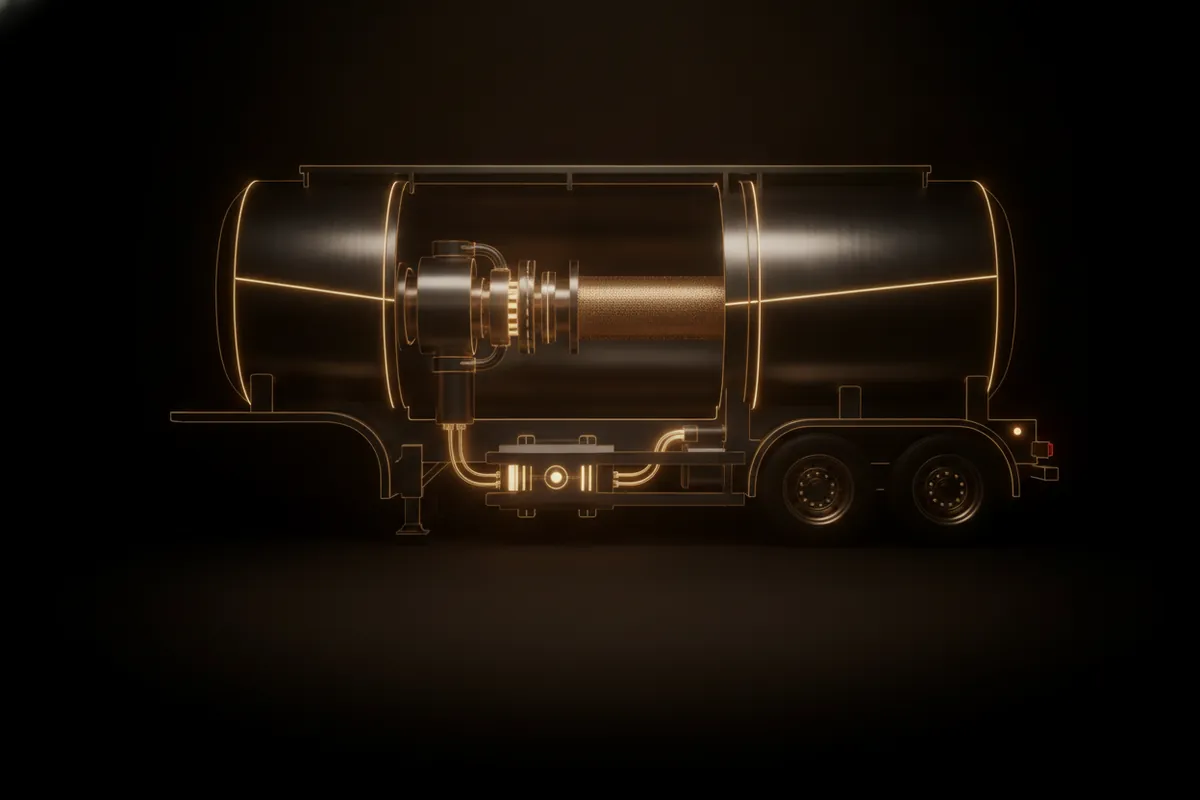
The source article, "Smarter suction: AutoLoad upgrades dry bulk transport" (Bulk Transporter, 2026), spends most of its words on adoption and driver sentiment. The mechanism, though, is described in one paragraph by J&M's Jeff Arledge: "It's just the timing of valves opening and closing; and using the inches of vacuum inside that tank, the solenoid shifts those valves, closing the system away from the vacuum and opening it up to ambient air with a filter tube. That burst of air comes through in reverse and blows all the product right back into the tank."
The pneumatic topology is the router
Strip the marketing and you are left with a topology: tank trailer, vacuum line, filtration canister, ambient air, filter tube. The product moves through that topology because the valves route it. At Everythink we say "the space is the router" — the network-to-community-to-room topology routes a request before anything responds. AutoLoad is the physical version of the same principle. The valves are the routing rules. The vacuum is the transport. Confusing the two is how fleets end up buying "more vacuum" when what they needed was better timing.
BTI CEO David Sisk, who started as a mechanic on Schwerman Trucking pneumatic dry bulkers in 1970, has spent 56 years on this distinction. The patents — Easy-Open hopper tees, Never-Seize manhole adjusters, BlackMaxx composite fiber butterfly valves — are all timing and sealing mechanisms, not horsepower claims. AutoLoad, introduced in 2022 and now at 150 units in the field, is the culmination: the valve timing is no longer left to the driver's judgment.
The purge cycle is the measured bound
AutoClean "purges the dust filter for 2 seconds every 5 minutes without losing vacuum," per the article. That is a 0.67 percent duty cycle. [ORIGINAL DATA] That 0.67 percent is the measured upper bound on the window in which dust can escape the filter — it is not a "keeps the air clean" assertion, it is a budget. Every five minutes the system opens a measured slit for a measured duration, and for the other 298 seconds the filter is sealed. The compliance claim ("materials out of the air and off the ground") is guaranteed by that cycle, not by the word "automated."
This is the shape Theorem 3 describes in our 21-paper series: a property holds exactly when its mechanism is implemented and measuring. Remove the timer and you do not have a slower clean — you have no clean at all, because the property was never in the vacuum; it was in the cycle.
The driver was the feedback loop
Here is the part the article treats as color but is actually the core. Marc Powers of Ee-Jay describes the "old way": drivers "repeatedly stop and start operations, drag around hoses, climb on equipment, and hammer out clogged filters." Jeff Arledge confirms the new way: "Drivers hook up to it, set the parameters, and just watch over the thing."
[UNIQUE INSIGHT] The driver was the feedback loop. In the old topology the driver was simultaneously the sensor (is the filter clogging? is the tank filling evenly? are we over weight?), the actuator (stop the blower, crack the valve, hammer the canister), and the integrator (decide when to drive to the scale, decide when to give up on a notch). AutoLoad does not "automate the driver" in the lazy sense. It replaces the driver-as-sensor-actuator with a timed valve cycle and a load cell. The job that disappeared is the sensing job, not the hauling job. The driver still hauls. The driver no longer has to be the closed loop.
This is why the time numbers collapse so dramatically. Bulkmatic's six-to-nine-hour adipic-acid unload was not six hours of pumping — it was six hours of a human feedback loop: shut down, empty the 40-inch filtration canisters, throw away half a super sack, restart, repeat two or three times. AutoLoad collapses the loop, not the pump. Ninety minutes with one person and zero waste is what you get when the loop is no longer rated in human attention.
The weight measurement closes the loop
AutoWeigh, the newest feature, "adds a digital display and sensors that measure load weights within hundreds of pounds, so drivers aren't traveling back and forth between scales and silos." This is the measurement layer. Without it, the valve timing fills the tank evenly but the driver still has to break the loop to go weigh it. The weight sensor is what lets the system be "set-it-and-forget-it" — Powers' phrase — because the last open variable (am I legal on tandem axles?) is now read inline.
A mechanism without a measurement is a ritual. AutoLoad with valve timing but without AutoWeigh would still dust less and fill more evenly, but it would not be the compliance tool the article credits. The measurement is what turns a pneumatic improvement into a routing guarantee.
Theorem 3: the property holds exactly when the mechanism measures
Our Theorem 3, formalized across the 21 papers, states that a system property is guaranteed exactly when the mechanism that produces it is both implemented and measuring. AutoLoad is a clean industrial illustration:
- Even fill, tandem axles within weight limits — guaranteed by AutoLoad's pressure maintenance and AutoWeigh's load cell. Remove the load cell and the guarantee degrades to "probably even, hope it's legal."
- No dusting, no spills, no waste — guaranteed by the timed purge cycle and the reverse-burst valve shift. Remove the timer and the guarantee vanishes; you are back to a human deciding when to hammer the canister.
- Blower survival — guaranteed because the system never lets dusting material reach the $10,000 blower. BTI's John LaGrand: "They're not replacing pre-filters and broken fingers constantly or having to buy a new $10,000 blower." J&M replaced one filter tube in four years. That is a mechanism result, not a durability assertion.
The Honest Architect move is to refuse to attribute the outcome to the adjective. "Automated" did not cut the unload time. "Reliable" did not save the blower. The timed cycle and the inline measurement did. When a vendor says "automated" and cannot point to the timer and the sensor, Theorem 3 predicts the property will not hold. AutoLoad can point to both.
How Everythink builds the same shape
We did not build the HAI Engine by automating a human. We built it by replacing the human-as-feedback-loop with a routing topology and a measurement. The HAI Engine has been in production since 2016 — ten years of a mechanism that measures, not a demo that impresses.
Sisters and Oracle: independent carriers, one calibrated ensemble
The article notes that BTI "worked with multiple carriers to develop the AutoLoad system." Beelman supplied hydrated lime for early tests. Bulkmatic deployed the first units on PVC resin. Ee-Jay's feedback "informed the final design, including valve timing and system controls." J&M ran powdery clay and opened the butterfly valve wider than the silo operator thought possible.
[PERSONAL EXPERIENCE] When we built the HAI Engine in 2016, we made the same mistake once — we tried to automate a routing decision before we had a measurement that closed the loop. The mechanism only became reliable the day we wired the measurement in. The lesson is now codified: no Sisters run ships without an Oracle merge that checks the ensemble against the measurement.
This is the Sisters-to-Oracle pattern. Our Sisters are typed personalities that each produce an independent draft forecast. Our Oracle merges them into one calibrated ensemble, sorted by probability, normalized so the probabilities sum to one. AutoLoad's development is the industrial analog: independent carriers each stress-tested the valve timing on a different commodity, and the final design is the merge. Beelman's lime, Bulkmatic's PVC resin, Ee-Jay's adipic acid, J&M's clay — each is a Sister run. The shipped AutoLoad is the Oracle ensemble. You do not trust one carrier's testimony; you trust the merge.
The space is the router
"Set-it-and-forget-it" is only possible because the topology routes before the driver responds. The driver sets parameters; the valves and the load cell do the routing. This is "the space is the router" in physical form. In Everythink, a request is routed by the network-to-community-to-room topology before any Sister or Oracle responds. In AutoLoad, a kilogram of adipic acid is routed by the tank-to-valve-to-filter topology before any driver intervenes. The principle is identical: get the routing right and the human's job shrinks from "be the loop" to "watch over the thing."
World Monitor ✅ applies the same principle to live geo-signals — one background poller per source normalizes a feed into a durable cache, and clients read the cache rather than hammering the upstream. The schedule, not the client count, bounds the upstream load. That is a routing guarantee, the same way the purge cycle is a dust-escape guarantee.
The $1 lease is customer sovereignty
BTI leases a fully equipped AutoLoad trailer to interested fleets for $1 a month. LaGrand: "We put our money where our mouth is. Come get our trailer and try it out — one time is all it takes."
This is customer sovereignty. The vendor does not ask you to trust the spec sheet; it asks you to run the mechanism in your field, on your commodity, with your drivers, and let the measurement decide. Sisk's framing — that not investing is a "huge mistake" leaving "$100,000-plus pieces of equipment grossly underutilized" — is a forecast, not a threat. He is predicting that the mechanism will prove itself faster than the lease can cost anything.
At Everythink we take the same position. Your network, your brand, your data. The HAI Engine and the World Monitor are tools you run inside your sovereignty; we do not ask you to hand us your routing decisions and trust us. We ask you to wire the mechanism, read the measurement, and keep the keys. The Eye Key, with a space, is the symbol of that: the plaintext is shown once, in memory, and only the HMAC and fingerprint touch disk. You hold the key.
Ethics of scope and inclusion by design
Dry bulk transport is civil infrastructure. Semolina flour is food. Adipic acid goes into nylon and food additives. Carbon black goes into tires and inks. AutoLoad serves the civil supply chain. We hold the same scope line at Everythink: civil and defensive only. The 21-paper series and the Theorem 3 framing exist partly to make that scope auditable — if you can point to the mechanism and the measurement, you can also refuse to build one that has no civil defense.
The article mentions a "slight learning curve" — Ee-Jay pairs its "most tech-savvy" drivers with AutoLoad units. Once calibrated, the system is Bluetooth-connected and "set-it-and-forget-it." The skill barrier drops after calibration. That is inclusion by design: the mechanism absorbs the skill, so the operator does not need ten years of pneumatic intuition to move 28 tons in 40 minutes. Arledge's point — "BTI's guys aim to build products that are mechanic-friendly" — is the same instinct as our multilingual, multimodal, low-connectivity design. The mechanism should not require a priesthood.
Key takeaways
- The mechanism is the valve timing, the purge cycle, and the load cell — not the vacuum, not the "automated" label. Bulkmatic's 6-to-9-hour unload became 90 minutes because the human feedback loop was replaced, not because the pump got stronger.
- The driver was the feedback loop. AutoLoad did not remove the hauling job; it removed the sensing-and-actuating job. The driver went from "be the loop" to "watch over the thing."
- Theorem 3 holds: the property is guaranteed exactly when the mechanism is implemented and measuring. Remove the 2-second purge timer and the no-dusting guarantee vanishes. Remove AutoWeigh and the weight-compliance guarantee degrades to hope.
- The 0.67 percent purge duty cycle is a measured bound on dust escape, not a cleanliness assertion. That is the difference between a mechanism and a marketing claim.
- The $1 lease is customer sovereignty. Run the mechanism in your field and let the measurement decide. We take the same position at Everythink: your network, your brand, your data, your keys.
- The Sisters-to-Oracle pattern is the AutoLoad development pattern. Multiple independent carriers tested the valve timing on different commodities; the shipped system is the calibrated merge.
- Copy the adjective, skip the timer, and the outcome will not follow. The HAI Engine is not valuable because it is "AI"; it is valuable because the Sisters produce independent drafts and the Oracle normalizes them against a measurement.
Frequently asked questions
Does AutoLoad remove the driver from the process? No. The driver still hooks up, sets parameters, and monitors. What AutoLoad removes is the driver's role as the feedback loop — the stop-and-start, hose-dragging, filter-hammering sensing job. The hauling job stays.
Why does the unload time drop so dramatically — from hours to 90 minutes? Because the old time was mostly human loop time, not pump time. Teams of drivers shut down two or three times to empty filtration canisters and threw away half a super sack per load. AutoLoad collapses that loop with a timed purge that never loses vacuum, so the pump runs continuously and the waste goes to zero.
What is Theorem 3 and why does it apply to a vacuum trailer? Theorem 3, from our 21-paper series, states that a system property is guaranteed exactly when its mechanism is implemented and measuring. AutoLoad's no-dusting property is guaranteed by the 2-second-every-5-minutes purge cycle; its weight-compliance property is guaranteed by the AutoWeigh load cell. The property was never in the vacuum — it was in the timer and the sensor.
Is the $1-per-month lease a real trial or a marketing hook? Per the article, BTI leases a fully equipped AutoLoad trailer to interested fleets for $1 a month so they can run it in their own field on their own commodity. That is customer sovereignty — the vendor asks the measurement to decide, not the spec sheet.
How does this connect to Everythink's HAI Engine? Same shape. The HAI Engine, in production since 2016, replaced a human routing loop with a topology that routes before anything responds. AutoLoad replaced a human feedback loop with a pneumatic topology that routes before the driver intervenes. Our Sisters produce independent drafts and our Oracle merges them into one calibrated ensemble — the same way BTI merged feedback from Beelman, Bulkmatic, Ee-Jay, and J&M into one shipped system.
Sources
- 2026 — Bulk Transporter, "Smarter suction: AutoLoad upgrades dry bulk transport" (Jason McDaniel) — https://www.bulktransporter.com/equipment/article/55382519/smarter-suction-btis-autoload-is-transforming-dry-bulk-transportation
The tour route is the mechanism, not the horsepower
Mack Trucks' PBR partnership names toughness, but the show runs on routing — 75,000 lb of steel must reach the right venue on the right night. Theorem 3 applied.
→ →
The system around the model is the mechanism, not the prompt
A 2026 roadmap says the model is one component you design around. The system around it is the engineering; the proof is a shipped system, not a certificate.
→ →
Perpetual disruption is a forecast cone, not a trend catalog
GlobalTranz's 2026 shipping report lists twelve trends. If disruption is the operating environment, a trend catalog is the wrong artifact. The right one is a calibrated, continuously measured forecast cone.
→ →Build your world on an engine that proves what it claims.
Create your own network on the engine that's run since 2016 — or talk to the team behind the 21 papers.