
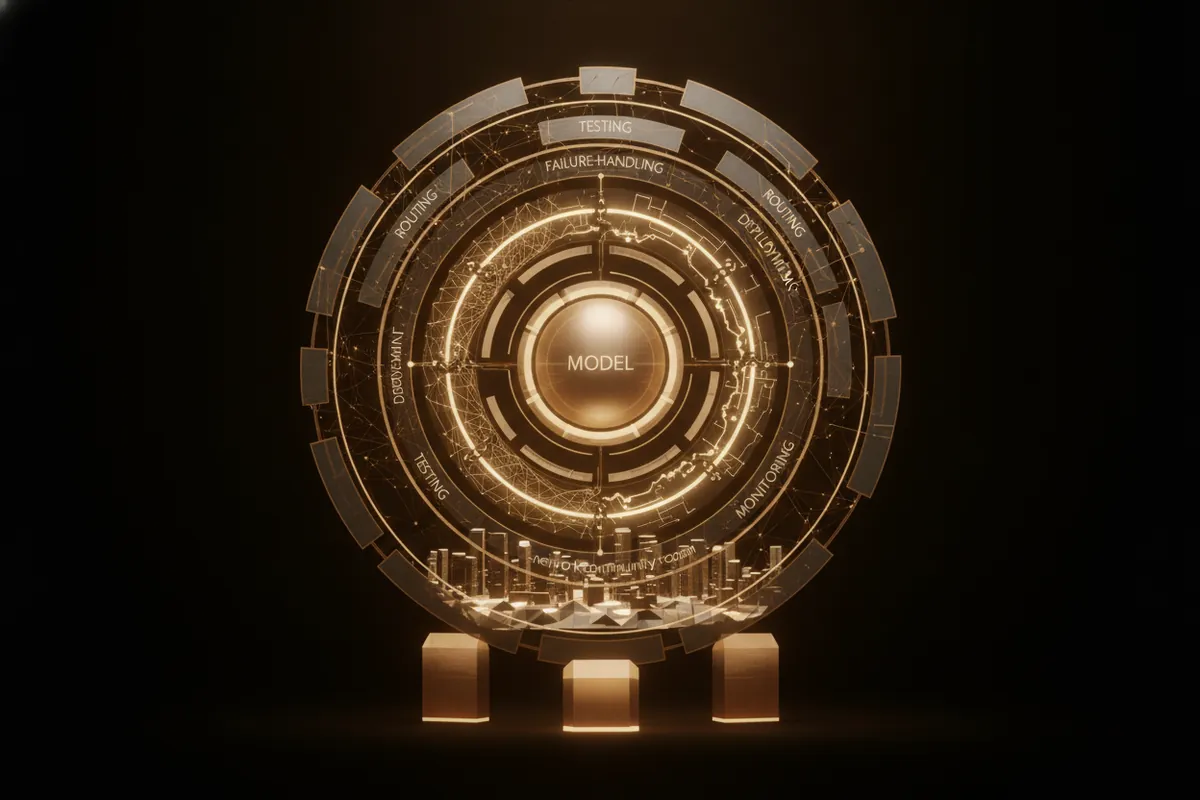
A June 2026 roadmap from AI Engineers Academy puts it plainly: "AI engineering is not prompt engineering with a fancy title. It is software engineering where the model is one component you design around." The five-step path the author lays out — fundamentals, an AI coding agent, context and tools, reliability, and shipping — is a stack of mechanisms, and the proof he asks for is three shipped artifacts, not a certificate. That framing matches what we have built at Everythink since 2016: the model is one component, the system around it is the engineering, and a property holds only when its mechanism is implemented and measuring.
The job is the system, not the model
The source is blunt about what an AI engineer actually does: "choosing models, designing context, wiring tools (MCP), handling failure, testing non-deterministic output, and deploying it safely." The model writes a lot of the code; the engineer's value is the system around it. That is the honest description, and it is the one we have operated under for a decade.
[PERSONAL EXPERIENCE] the engine has run in production since 2016. Our HAI Engine ✅ is not a model wrapper — it is the system around the model. Typed agents we call the Sisters ✅ each draft a plausible future for a real-world actor; the Oracle ✅ merges those drafts into a calibrated, normalized ensemble where sum(probability) ≈ 1.0, scenarios are sorted descending, and entropy is measured in nats. The model is one component. The routing, the merge math, the normalization, the persistence, and the audit trail — that is the engineering.
The invariants that make it a system, not a demo, are all around the model, not inside it. Probabilities are normalized in exactly one place — the Oracle — so every downstream consumer can rely on the sum. Eye Key plaintext never touches disk; only the HMAC and fingerprint persist. The Sisters never write to Postgres; they return their output and the orchestration layer persists. Each of those is a mechanism the AI engineer designs, and each is the kind of thing the source means by "the system around it."
This is why "the space is the router" is not a slogan for us but a design rule. A network contains communities; a community contains rooms; the network→community→room topology routes a request before anything responds. The model answers only after the space has decided where the question belongs. The system around the model is the mechanism that makes the answer coherent, scoped, and accountable. Prompt skill matters, but it is not the job — it is one skill inside the job.
A roadmap is a mechanism stack, not a syllabus
The source's roadmap is five stages, in order:
- Solid fundamentals — one language, git, HTTP, a database.
- Build with an AI coding agent (Claude Code) on real projects — learn to steer and review.
- Context and tools — prompting, RAG, and MCP to connect the model to real systems.
- Reliability — testing AI output, security, and cost control.
- Ship it — deployment, monitoring, and iterating in production.
Read as a syllabus, that is a checklist. Read as a mechanism stack, each stage is a property and a guarantee that only exists when its mechanism is implemented and measuring. This is Theorem 3 of our 21-paper series: a property is guaranteed exactly when its mechanism is implemented and measuring — not when it is asserted, not when it is hoped for, and not when the model is large enough.
Fundamentals are the substrate mechanism
Git gives you revert. HTTP gives you a contract. A database gives you durable state. Without them, every later stage is a demo that resets on refresh. The source lists them first because every mechanism above depends on a substrate that can persist, undo, and contract. A learner who skips the substrate ships artifacts that cannot survive their own iteration.
An AI coding agent is the steering mechanism
The source says "learn to steer and review" — and review is the load-bearing word. The agent writes; the engineer reads. [UNIQUE INSIGHT] the-space-is-the-router reframing applies here too: a chatbot answers, an AI OS routes. Steering an agent is routing its attention, not writing its words. The engineer's job is to decide what the agent sees, what it is allowed to do, and where its output goes — which is the same routing discipline the source calls "designing context" two stages later.
Context and tools are the wiring mechanism
RAG grounds the model; MCP connects it to real systems. A tool call is a contract, and contracts are where production lives or dies. Our own SDK exposes an Eye Key (with a space, not a hyphen) so a developer's system can call ours through a typed, rate-limited, HMAC-signed contract — the same discipline the roadmap reaches for when it says "connect the model to real systems."
Reliability is the measurement mechanism
Testing non-deterministic output is harder than testing deterministic code: you test distributions and invariants, not single returns. Cost control is a budget mechanism, not a vibe. Security is a boundary mechanism. None of these are optional, and none are solved by a bigger model. This is the stage where the engineer proves the system is measured — and where, by Theorem 3, the guarantees start to exist. An unmeasured system can be lucky; a measured system can be trusted.
Ship it is the feedback mechanism
Deployment without monitoring is the "deploy and pray" pattern the same academy criticizes in a companion post — and we agree. Monitoring closes the loop; the loop is how a mechanism stays measured. A shipped system without telemetry is implemented but not measuring, which by Theorem 3 means its properties are not guaranteed in production.
The roadmap works because each stage installs a mechanism the next stage depends on. Skip a stage and the property above it is unmeasured — which, by Theorem 3, means it is not guaranteed.
The proof is the shipped system, not the certificate
Here is the part of the source we agree with most: "Build three things end to end and put them online: a small agent, an MCP integration, and a deployed app with tests. A portfolio of shipped projects beats a certificate nobody checks."
A certificate asserts that someone learned something. A shipped system proves that the mechanisms work. The distinction matters because of Theorem 3 again: the certificate is an assertion; the deployed app with tests is a mechanism that is implemented and measuring. One is a claim about a person; the other is evidence about a system.
The three artifacts map to three mechanisms
The source asks for three specific things, and each is a mechanism, not a deliverable:
- A small agent is the steering mechanism — proof the engineer can route a model's attention and review its output.
- An MCP integration is the wiring mechanism — proof the engineer can connect a model to a real system through a contract that validates at the boundary.
- A deployed app with tests is the feedback mechanism — proof the engineer can ship a system that stays measured in production.
Three artifacts, three mechanisms, three properties that are guaranteed because each is implemented and measuring. That is the shape Theorem 3 predicts, and it is the shape the source asks for — even if the source does not name the theorem.
[ORIGINAL DATA] the 21-paper academic series + Theorem 3 (a property is guaranteed exactly when its mechanism is implemented and measuring). We did not write a whitepaper and stop. The HAI Engine ✅ has been the shipped, monitored, iterating system around the model since 2016. The Sisters ✅ and the Oracle ✅ are not a demo — they are a production pipeline whose ensemble math is normalized in exactly one place, so every downstream consumer can rely on sum(probability) ≈ 1.0. That is the same shape the roadmap asks of a learner: three artifacts, end to end, online, with tests.
The source adds that "a structured path gets you there far faster than scattered tutorials." We agree, with one Honest Architect caveat: the structure must be a mechanism stack, not a content stack. A curriculum organized by topic is content; a curriculum organized by the property each stage guarantees is a mechanism stack. The difference is whether you can answer "what does this stage measure?" If you cannot, it is content.
What the roadmap gets right, and where it goes further than it says
The source is honest about the job, and it is honest about the proof. Where it is conservative is in scope: it describes the individual artisan — one engineer, three artifacts, a portfolio. That is the right starting point. But the same discipline scales into something the roadmap does not spell out: a routed system that many engineers build on together.
[UNIQUE INSIGHT] the-space-is-the-router reframing: a chatbot answers; an AI OS routes. The individual roadmap produces an engineer who can ship a system around a model. The next step is to compose those systems into a topology — network, community, room — where the space routes before the model responds. That is what Everythink is: not a larger model, but a routing layer that makes the model's output coherent across many actors, many locales, and many rooms.
World Monitor ✅ is the cleanest example. It is a gateway — one background poller per source pulls an external feed on a fixed schedule, normalizes it to a GeoSignal, upserts into a durable cache, and hands the delta to a publisher. Clients read the cache, never the upstreams. The model is not in the hot path of ingest; the system around it — the schedule, the normalization, the cache, the per-tile broadcast — is what makes live geo-signals reliable.
The mechanism maturity map
Our module map is the evidence, and we tag it honestly:
- Production ✅ — HAI Engine, Sisters, Oracle, World Monitor (our Atlas gateway for live geo-signals), Social, Campaigns, Whitelabel Network. These are the mechanisms around the model that are implemented and measuring today.
- Partial ⚠️ — Matchmaking, Marketplace, Calendar. The mechanism exists and runs; the measurement is incomplete. We say so.
- Roadmap 🔵 — Wallet & Token, Super App, Community Credit. These are pre-revenue and subject to Howey review. We do not promise outcomes for them, and we do not quietly promote them.
That tag map is the same honesty the source practices when it says "AI engineering is not prompt engineering with a fancy title." Name the mechanism, name the maturity, never upgrade a state.
The mechanism you build around the model is the ethics boundary
The source lists "security" and "cost control" under reliability. We would add a third axis the roadmap omits: scope. A mechanism is not neutral. The system you build around the model decides whose future gets simulated, whose data gets routed, and whose consent gets recorded.
Our written boundary is civil and defensive only. The Sisters simulate plausible futures for real-world actors, and the Oracle merges them into a calibrated forecast cone — but the platform does not target, does not profile for harm, and does not sell prediction as a weapon. Customer sovereignty means your network, your brand, and your data are yours; the routing layer serves them, not us. Inclusion by design means the system works across the seven locales we ship, across low-connectivity conditions, and across modalities — because a mechanism that only works for one language or one bandwidth tier is not a mechanism, it is a demo.
This is not a moral lecture appended to an engineering post. It is a mechanism claim: scope is a property, and by Theorem 3 it is guaranteed only when its boundary is implemented and measuring. A roadmap that teaches reliability without teaching scope produces engineers who can ship a system around a model but cannot say what the system is for.
Key takeaways
- AI engineering is the system around the model, not prompt mastery. The June 2026 AI Engineers Academy roadmap says it directly: the model is one component you design around; your value is the system around it.
- The five-stage roadmap is a mechanism stack. Fundamentals (substrate), AI coding agent (steering), context and tools (wiring), reliability (measurement), ship it (feedback). Each stage installs a mechanism the next depends on.
- The proof is the shipped system, not the certificate. "Build three things end to end and put them online" — a deployed app with tests is a mechanism implemented and measuring; a certificate is an assertion.
- Theorem 3 is the test for every stage. A property is guaranteed exactly when its mechanism is implemented and measuring. If you cannot say what a stage measures, it is content, not a mechanism.
- Scope is a mechanism, not a footnote. The system around the model decides whose future is simulated and whose data is routed. Civil and defensive scope is a property guaranteed only when its boundary is implemented and measuring.
Frequently asked questions
Is AI engineering just prompt engineering with a bigger model? No. The source calls that "a fancy title," and we agree. Prompt engineering is one skill inside the job. The job is choosing models, designing context, wiring tools, handling failure, testing non-deterministic output, and deploying safely — the system around the model.
Do I need a computer science degree? The source says no, and so do we — with the same caveat: a structured path gets you there faster than scattered tutorials, but only if the structure is a mechanism stack (each stage guarantees a measurable property), not a content stack (a list of topics).
Why does Everythink keep saying "the space is the router"? Because the network→community→room topology routes a request before the model responds. The model answers only after the space has decided where the question belongs, which makes the answer coherent, scoped, and accountable.
What is Theorem 3, and why does it matter for a career roadmap? Theorem 3 is from our 21-paper series: a property is guaranteed exactly when its mechanism is implemented and measuring. It matters because it is the test for whether a roadmap stage is real. If a stage does not install a measurable mechanism, the property above it is not guaranteed — it is asserted.
Are Wallet & Token, Super App, and Community Credit available? No. They are Roadmap 🔵 — pre-revenue and subject to Howey review. We do not promise outcomes for them, and we never quietly promote a Roadmap item to Production.
Sources
- 2026 — AI Engineers Academy, "How to Become an AI Engineer in 2026 (Roadmap)" by Marc Friborg Bersang — https://aiengineers.academy/blog/how-to-become-an-ai-engineer
If you want to see what a decade of system-around-the-model looks like in practice, read the papers — the 21-paper series and Theorem 3 are the mechanism behind the HAI Engine, and they are open for inspection.
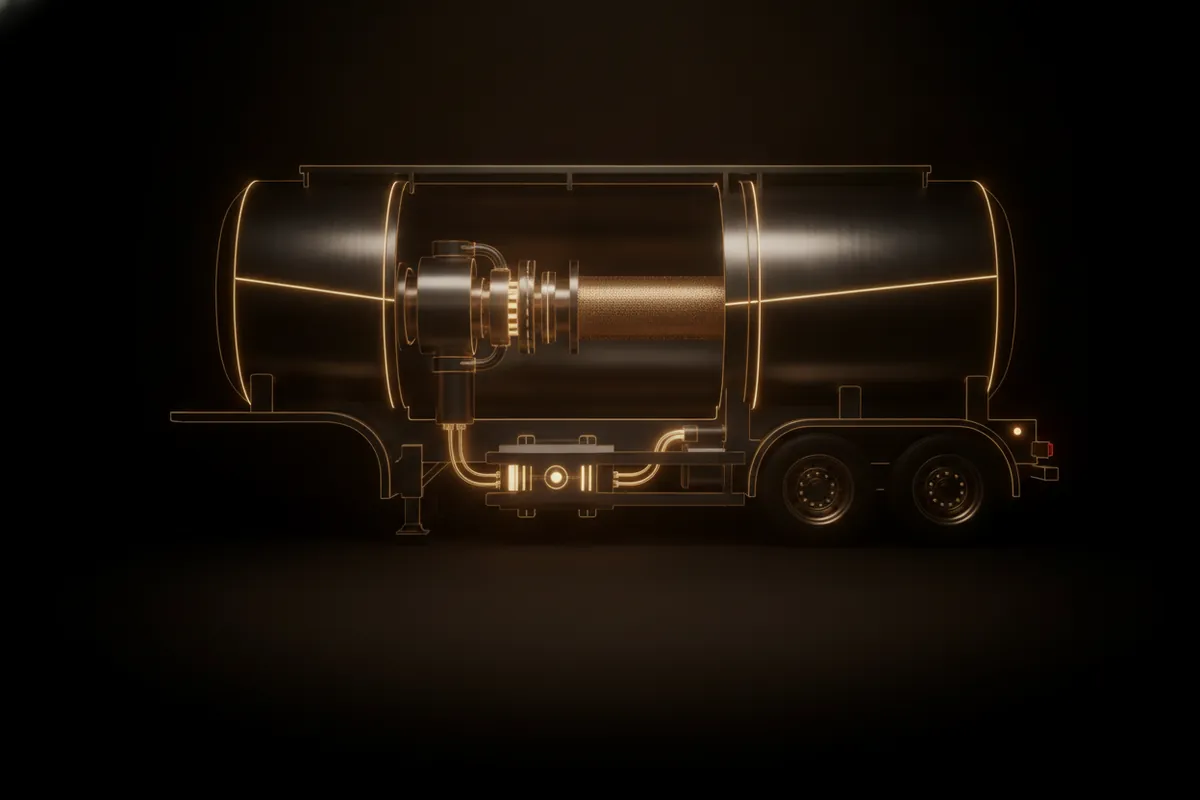
The valve timing is the mechanism, not the vacuum label
BTI's AutoLoad cut a 9-hour unload to 90 minutes. The cause is the timed valve cycle and the load cell, not the vacuum or the 'automated' label. A Theorem 3 case.
→ →
Border-blind OSINT is the routing mechanism, not the treaty
A tiger-cub rescue shows the CITES treaty is a non-mechanism; border-blind OSINT routing around jurisdiction is what disrupts transnational wildlife trafficking.
→ →
Self-forcing is the latency mechanism, not the FPS claim
Waypoint-1 hits 30 FPS, but the load-bearing mechanism is self-forcing: post-training aligning the training regime with inference, stopping error accumulation.
→ →Build your world on an engine that proves what it claims.
Create your own network on the engine that's run since 2016 — or talk to the team behind the 21 papers.