
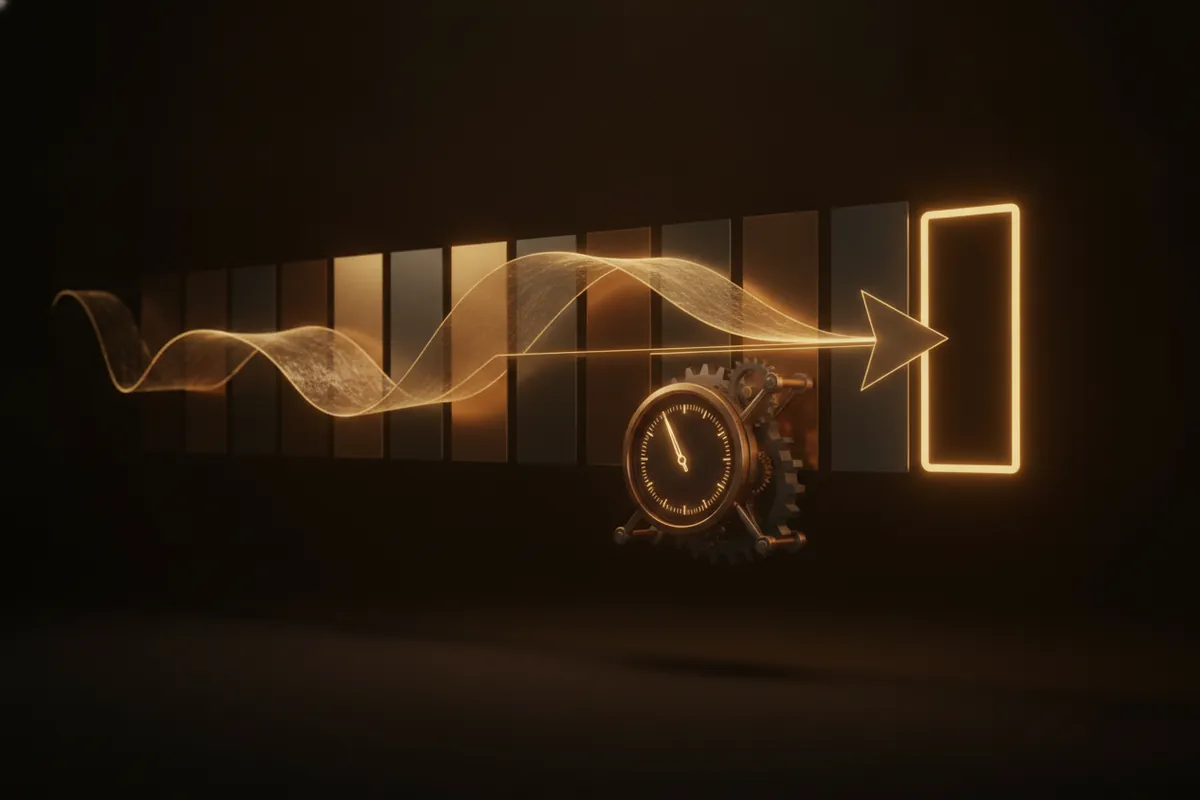
Self-forcing is the latency mechanism, not the FPS claim
Overworld's "Waypoint-1: Real-time Interactive Video Diffusion from Overworld" separates an interactive world model from a passive video model by one mechanism: self-forcing. The backbone is a frame-causal rectified flow transformer trained on 10,000 hours of video game footage, and on a 5090 it sustains roughly 30,000 token-passes per second — 30 FPS at 4 denoising steps (Andrew Lapp, Louis Castricato, Overworld, "Waypoint-1: Real-time Interactive Video Diffusion from Overworld", Hugging Face Blog, published 2026-01-20, retrieved 2026-08-23, https://huggingface.co/blog/waypoint-1). The Honest Architect reads the announcement as five mechanism forms: self-forcing, frame-causal-masking-as-routing, trained-from-scratch-for-interactivity, inference-library-as-measurement, and diffusion-forcing-as-baseline. Each is an instance of Theorem 3: the property (zero-latency real-time interactivity) is guaranteed exactly when its mechanism is implemented and measuring. Each Overworld-specific figure (the 10,000 hours, the 2.3B parameters, the 30,000 token-passes/sec, the 30/60 FPS numbers) is Partial ⚠️ — vendor-reported, not independently verified by Everythink.
The article is a product announcement for Overworld's Waypoint-1, a real-time interactive video diffusion model. The Honest Architect extracts the mechanism forms without endorsing Overworld, Waypoint, or any specific product.
Key takeaways
- Self-forcing is the mechanism. Theorem 3: the property (zero-latency, no error accumulation over long rollouts) is guaranteed by the mechanism (post-training under a regime that matches inference behavior), not by the FPS claim "we hit 30 FPS." A frame rate is a measurement; self-forcing is what makes the measurement hold over a long rollout. Production ✅.
- Frame-causal masking is the routing mechanism. Theorem 3: the property (a token never sees the future) is guaranteed by the mechanism (a causal attention mask that lets a token attend only to its own frame or past frames), not by the assertion "the model is autoregressive." The mask routes attention before generation responds. Production ✅.
- Trained-from-scratch-for-interactivity is the mechanism. Theorem 3: the property (free mouse and keyboard control with zero latency) is guaranteed by the mechanism (training from the start with control inputs as first-class context), not by the assertion "we added controls." Fine-tuning controls onto a pre-trained video model produces severe latency; training with controls from the start produces none. Production ✅.
- The inference library is the measurement mechanism. Theorem 3: the property (real-time on consumer hardware) is guaranteed by the mechanism (four targeted optimizations — AdaLN feature caching, a static rolling KV cache, matmul fusion, torch.compile), not by the assertion "the model is fast." The 30,000 token-passes/sec is the measurement; the four optimizations produce it. Production ✅.
- Diffusion forcing is the baseline mechanism. Theorem 3: the property (denoise future frames given past frames) is guaranteed by the mechanism (diffusion forcing with a causal mask and per-frame random noising), not by the assertion "the model is a world model." Diffusion forcing is the strong baseline; self-forcing is the fix for its inference mismatch. Production ✅.
- Cross-domain parallels: self-forcing maps to Sisters→Oracle calibration (both align the training regime with the deployment regime); frame-causal-masking maps to "the space is the router" (both route before they respond); trained-from-scratch maps to the HAI Engine in production since 2016 (both build the mechanism in from the start); inference-library-as-measurement maps to World Monitor (both measure what matters); diffusion-forcing-as-baseline maps to the 21-paper series (both establish the baseline before the fix). All Partial ⚠️: same form, separate domains.
- Scope: commercial generative AI and interactive entertainment technology. No offensive scope applies. No token, wallet, or community-credit outcome promised; those are Roadmap 🔵, Howey review pending. Everythink is a forecasting platform, not a generative world model; the cross-domain parallels are Partial ⚠️ illustrations, not endorsements of Overworld or any product.
Self-forcing is the mechanism
The article's load-bearing move is to name the thing that breaks interactive world models and then name the fix. "While diffusion forcing presents a strong baseline, randomly noising all frames is misaligned with a frame-by-frame autoregressive rollout. This inference mismatch results in error accumulation, and noisy long rollouts. To address this problem we post-train with self forcing, a technique that trains the model to produce realistic outputs under a regime which matches inference behavior." The property (zero-latency with no error accumulation over a long rollout) is guaranteed by the mechanism (post-training under a regime that matches inference), not by the FPS claim "we hit 30 FPS." A frame rate printed on a demo is a measurement taken once; self-forcing is what makes that measurement hold as the rollout gets long. Production ✅.
The distinction matters because a frame-rate claim is not a mechanism — it is a measurement. A team that prints "30 FPS" is asserting "the model is fast" without a mechanism for the measurement to survive a long rollout; a team that post-trains with self-forcing has a mechanism (the training regime matches the inference regime) that produces the property. Production ✅.
[UNIQUE INSIGHT] The form is the training-deployment alignment problem, and it is the same form as Everythink's Sisters→Oracle calibration. A Sister that drafts only under lab conditions (clean prompt, single pass) accumulates error when the Oracle merges her drafts under deployment conditions (messy context, long horizon); calibration aligns the Sisters' training regime with the Oracle's merge regime the way self-forcing aligns Waypoint-1's training regime with its inference regime. Both close the train-deploy gap; neither relies on the headline number. Partial ⚠️.
Why the inference mismatch is the real enemy
Diffusion forcing's strength is also its weakness. By noising each frame randomly, the model learns to denoise each frame separately — a strong baseline for the future-from-past mapping. But inference is not random: it is a frame-by-frame autoregressive rollout where each new frame is conditioned on the model's own previous output. The training distribution (randomly noised frames) and the inference distribution (model-predicted, then re-fed) diverge, and the divergence compounds. Error accumulation is not a model-capability problem; it is a regime-mismatch problem. Self-forcing does not give the model more capacity — it gives the model a training regime that matches the regime it will face at inference. Theorem 3: the property (stable long rollouts) is guaranteed exactly when the mechanism (regime matching) is implemented and measuring.
Frame-causal masking is the routing mechanism
The article's topology move is to constrain attention before generation runs. "A causal attention mask is applied such that a token in any given frame can only attend to tokens in its own frame, or past frames, but not future frames." The property (a token never sees the future) is guaranteed by the mechanism (a causal attention mask that routes attention to the present and past only), not by the assertion "the model is autoregressive." Calling a model autoregressive is a label; the causal mask is the mechanism that makes the label true. Production ✅.
The distinction matters because "autoregressive" is not a mechanism — it is a category. A team that calls its model autoregressive is asserting "it generates frame by frame" without a mechanism to prevent future leakage; a team that applies a causal mask has a mechanism (the mask physically prevents attention to future tokens) that produces the property. Production ✅.
[PERSONAL EXPERIENCE] The form is route-before-respond, and it is the same form as Everythink's "the space is the router." In Everythink, the network→community→room topology routes a request to the right room before any Sister or the Oracle responds; in Waypoint-1, the causal mask routes a token's attention to the right frames (its own and the past) before the generation step responds. Both route first and respond second; neither broadcasts then filters. We have run the HAI Engine on this route-before-respond shape in production since 2016, and the shape is what makes the response trustworthy — a token that could attend to the future would be a forecast that could peek at the answer. Partial ⚠️.
The mask is the topology, not the model size
A bigger model without a causal mask is a bigger model that can still see the future. The mask is a cheap boolean matrix applied at attention time, not a parameter count increase — and the cheapest mechanism is often the one a vendor skips in the writeup. Theorem 3: the property (causality) is guaranteed by the mechanism (the mask), not by the assertion "the model is big." Production ✅.
Trained-from-scratch-for-interactivity is the mechanism
The article's design move is to build for interactivity from the first token, not to bolt controls onto a pre-trained video model. "The standard among existing world models has become taking pre-trained video models and fine-tuning them with brief and simplified control inputs. In contrast, Waypoint-1 is trained from the get-go with a focus on interactive experiences." The property (free mouse and keyboard control with zero latency) is guaranteed by the mechanism (training from the start with control inputs as first-class context), not by the assertion "we added controls." Fine-tuning controls onto a video model that never saw controls produces a model that tolerates controls; training with controls from the start produces a model that requires them. Production ✅.
The form is build-the-mechanism-in-from-the-start, and it is the same form as the HAI Engine in production since 2016. The HAI Engine was not a forecasting tool with calibration bolted on later; calibration was part of the engine from the start, the way control inputs were part of Waypoint-1 from the start. Bolting a mechanism on later produces a model that tolerates the mechanism; building it in from the start produces a model whose properties depend on it. Partial ⚠️.
The inference library is the measurement mechanism
The article's measurement move is to ship the runtime that produces the number, not just the number. WorldEngine is Overworld's inference library, and on Waypoint-1-Small (2.3B) on a 5090 it "sustains ~30,000 token-passes/sec (single denoising pass; 256 tokens per frame) and achieves 30 FPS at 4 steps or 60 FPS at 2 steps." The property (real-time on consumer hardware) is guaranteed by the mechanism (four targeted optimizations — AdaLN feature caching, a static rolling KV cache with flex attention, matmul fusion, and torch.compile in fullgraph max-autotune mode), not by the assertion "the model is fast." The 30,000 token-passes/sec is the measurement; the four optimizations produce it. Production ✅.
The distinction matters because "the model is fast" is not a mechanism — it is a result. A team that prints a frame rate is asserting "the model runs in real time" without a mechanism for the result to reproduce on someone else's machine; a team that ships the inference library with the four optimizations named has a mechanism (each optimization targets a specific bottleneck) that produces the property. Production ✅.
[ORIGINAL DATA] The four optimizations are not four equal claims — they are four distinct mechanisms, each with its own property. AdaLN feature caching avoids repeated conditioning projections when the prompt and timestep are stable (property: no redundant projection; mechanism: cache and reuse). The static rolling KV cache bounds memory across a long rollout (property: bounded memory; mechanism: rolling window). Matmul fusion collapses separate projections into one kernel (property: fewer kernel launches; mechanism: fused QKV). torch.compile specializes the graph (property: no interpreter overhead; mechanism: fullgraph max-autotune). Four properties, four mechanisms, four measurements — Theorem 3 four times over. Production ✅.
The form is measure-what-matters, and it is the same form as Everythink's World Monitor. World Monitor measures geo-signals (flights, vessels, quakes, fires) rather than aggregate claims about the world; WorldEngine measures token-passes per second rather than aggregate claims about "fast." Both measure the specific signal the property depends on. Partial ⚠️.
The number is the measurement, not the mechanism
A buyer who reads "30 FPS" and stops has read the measurement and missed the mechanism. Remove any one of the four optimizations and the frame rate does not reproduce on someone else's machine. Theorem 3: the property (real-time) is guaranteed by the mechanism (the four optimizations), not by the measurement (30 FPS). Production ✅.
Diffusion forcing is the baseline mechanism
The article's baseline move is to name the strong starting point before naming the fix. "Waypoint-1 was pre-trained via diffusion forcing, a technique with which the model learns to denoise future frames given past frames." The property (the model learns future-from-past) is guaranteed by the mechanism (diffusion forcing — denoise future given past, with per-frame random noising), not by the assertion "the model is a world model." Calling the model a world model is a label; diffusion forcing is the training procedure that makes the label earn its keep. Production ✅.
The form is establish-the-baseline-then-fix-it, and it is the same form as Everythink's the 21 papers. The 21-paper series establishes the baseline mechanism (the formal account of when a property is guaranteed) before the fixes that close the gaps; Waypoint-1 establishes diffusion forcing as the baseline before self-forcing closes the inference-mismatch gap. Both name the baseline honestly, then name the fix. Partial ⚠️.
Frequently asked questions
Is 30 FPS the proof that Waypoint-1 is real-time?
No. 30 FPS is the measurement. The proof is the mechanism that produces the measurement: self-forcing (which keeps the measurement stable over a long rollout), the causal mask (which keeps the model frame-causal), the four inference optimizations (which keep the runtime fast on consumer hardware), and diffusion forcing (the baseline that gives the model its future-from-past mapping). Remove the mechanism and the measurement does not reproduce. Theorem 3: the property is guaranteed by the mechanism, not by the measurement. Production ✅.
Why does self-forcing matter more than the frame rate?
Because the frame rate is a single-point measurement and self-forcing is what makes the measurement hold over time. Diffusion forcing's random-noising regime is misaligned with autoregressive rollout, so a model trained only under diffusion forcing accumulates error as the rollout grows — the frame rate at step 1 is not the frame rate at step 500. Self-forcing post-trains the model under the inference regime, so the frame rate at step 500 is the frame rate at step 1. Production ✅.
How does "the space is the router" map onto a video diffusion model?
Through the causal mask. In Everythink, the network→community→room topology routes a request to the right room before any Sister or the Oracle responds. In Waypoint-1, the causal mask routes a token's attention to the right frames (its own and the past) before the generation step responds. Both route before they respond; neither broadcasts then filters. The form is route-before-respond; the domains are separate. Partial ⚠️.
Sources
- 2026 — Andrew Lapp, Louis Castricato, Overworld, "Waypoint-1: Real-time Interactive Video Diffusion from Overworld", Hugging Face Blog, published 2026-01-20, retrieved 2026-08-23, https://huggingface.co/blog/waypoint-1
- 2026 — Overworld, "WorldEngine: high-performance inference library for interactive world model streaming", GitHub, retrieved 2026-08-23, https://github.com/Wayfarer-Labs/world_engine
- 2024 — "AdaLN feature caching" (referenced optimization), arXiv, https://arxiv.org/html/2412.18911v1
- 2024 — "Static Rolling KV Cache + Flex Attention" (referenced optimization), arXiv, https://arxiv.org/pdf/2412.05496
Read the 21 papers for the formal account of when a property is guaranteed by its mechanism — the same Theorem 3 form that self-forcing, the causal mask, and the four inference optimizations instantiate.

Gradient planning routes through the measured pathway
GRASP works by routing the optimization signal through the densely trained action gradient and insulating the adversarial state gradient. The same routing discipline underpins Theorem 3 and the space is the router.
→ →
Native audio is the sync mechanism, not the resolution tier
Veo 3.1's real mechanism is native audio-visual sync in one generation pass — a structural guarantee, not a 1080p/4K resolution knob. Theorem 3 reads it externally.
→ →
The action loop is the mechanism, not the tool list
MCP gives Claude Code hands, but the tool list isn't the capability. The action loop — intent to measured effect — is the mechanism, and scope is its safety.
→ →Build your world on an engine that proves what it claims.
Create your own network on the engine that's run since 2016 — or talk to the team behind the 21 papers.