
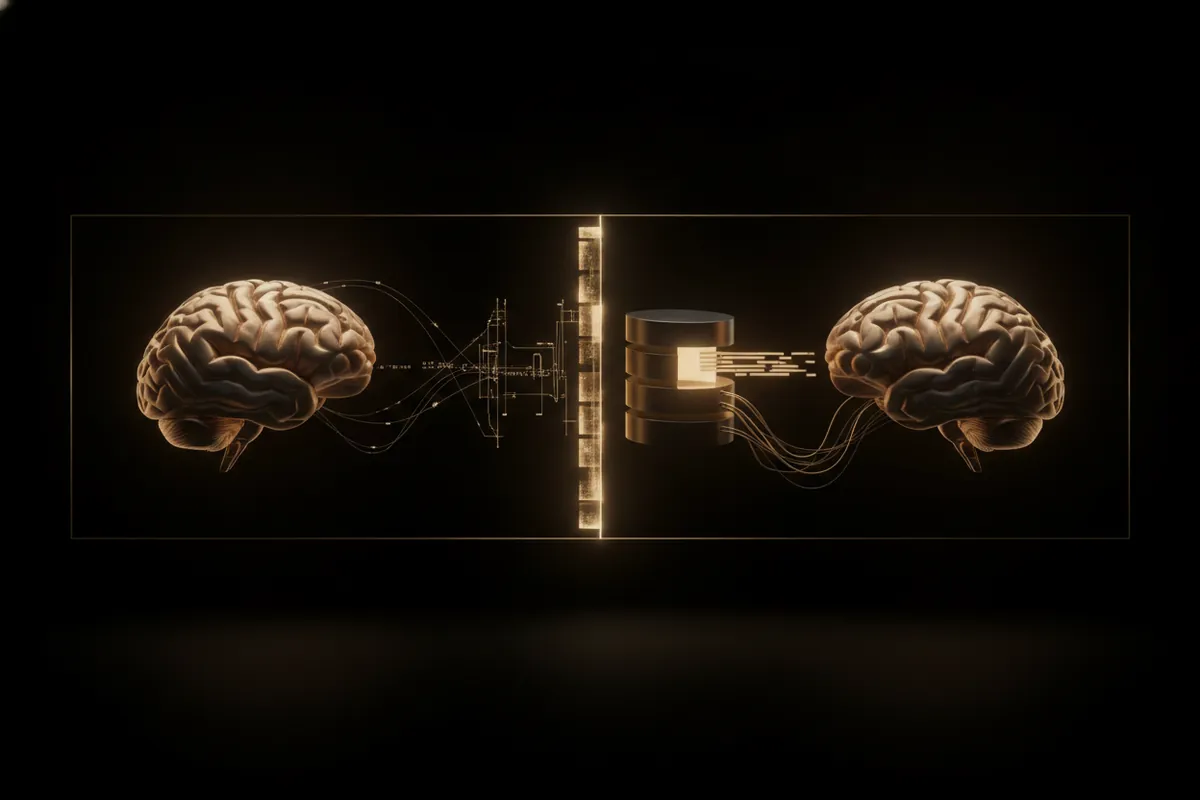
The action loop is the mechanism, not the tool list
An AI that lists tools is not the same as an AI that uses them. The source article — "Claude Code + MCP: Give Your AI Real Tools" (AI Engineers Academy, June 2026) — frames the gap plainly: Claude Code is "a brilliant brain with no hands," and MCP is "the missing pair of hands." The claim that matters is not the connector standard but the loop it closes — from a reasoned intent to a real effect on a real system. That loop, and whether its boundary is measured, is the mechanism. Everything else is catalog.
Claude Code is a brain with no hands, and that is a mechanism statement
The source opens with a claim most developers will recognize: Claude Code reads your codebase and runs your terminal, yet out of the box it "cannot reach your production database, your internal APIs, or that SaaS dashboard your business actually runs on." That is not a feature gap dressed up as architecture — it is a mechanism statement. A model that emits text, even text that describes the right action, has no mechanism for enactment. The property "the agent can act on your systems" is not true just because the model can name the action. It becomes true only when a boundary exists where the model's output is turned into a call and the call's effect is observed and fed back.
This is exactly Theorem 3 from the 21 papers: a property is guaranteed exactly when its mechanism is implemented and measuring. "Can use tools" is a property people assert about models constantly. It is guaranteed only when there is a tool-call boundary that is implemented (the call actually fires against a real system) and measuring (the result comes back and is reasoned over in the next step). Without that boundary, "the model knows which query to run" and "the agent ran the query" are indistinguishable in the transcript — and that conflation is where most "AI agent" demos quietly live.
[UNIQUE INSIGHT] The honest reading of the source is that the brain/hands metaphor is a mechanism map, not a flourish. The brain is the reasoning function; the hands are the enactment boundary; the nervous system is the channel that carries intent to effect and effect back to intent. Remove the hands and you have a chatbot. Remove the nervous system and you have a robot with no feedback. The reason most "AI assistant" pitches sound interchangeable is that they describe only the brain and wave at the rest.
A model that can describe the correct query is performing a useful function, but it is not the function the buyer is usually paying for. The buyer is paying for the query running against the real database and the real row coming back. The distance between those two things — describing the action and taking the action — is the entire distance the source is trying to close. The source, to its credit, does not call both "tool use"; it calls the describing agent a chatbot and the doing agent an agent, and treats the gap as the thing MCP addresses.
What MCP changes is the action loop, not the tool list
The source calls MCP "an open standard for letting an AI agent talk to external tools through one uniform interface," and offers the USB-C analogy: one connector, many devices. That analogy is useful but incomplete, because it describes the plug, not the loop. A connector standard makes tools interchangeable; it does not, by itself, make an agent act. What turns a connector into a mechanism is the round trip: the model emits a structured call, the server executes it against a real system, the result returns, and the model reasons over the result in the same session. That round trip is the action loop, and it is the thing that was missing when "AI tools" meant a prompt that said "you can use these APIs."
The source makes the distinction sharp in one line: "a chatbot describes what to do; an MCP-equipped agent does it." The doing is the mechanism. Describing is text generation; doing is enactment with a measured result. The difference shows up the moment you ask whether the agent's claim about your data is true. A describing agent says "the customer table probably has a row for this id." A doing agent runs the read-only query and reports the actual row, or the actual absence. One is a guess with confidence attached; the other is a measurement.
The minimal config that does the real work
This is why the minimal config in the source matters more than it looks:
{
  "mcpServers": {
    "my-db": {
      "command": "npx",
      "args": ["-y", "@my/mcp-postgres", "--readonly"]
    }
  }
}
The --readonly flag is the interesting part. It is a scope boundary on the action loop — the mechanism by which "the agent can act" is prevented from becoming "the agent can write." A tool registry without scope is a capability claim. A tool registry with enforced scope is a mechanism, because the scope is what makes the property ("the agent only reads") measurable. Take the scope away and you have not built a more capable agent; you have built one whose actions you cannot audit. The source says the agent operates "safely and on your terms" — the terms are the scope, and the scope is the measurement.
The brain/nervous-system/hands triad is a measured-mechanism map
The source's mental model is clean: "Claude is the brain. MCP is the nervous system. Your tools are the hands." Read as anatomy it is a metaphor; read as a control system it is a specification. The brain proposes; the nervous system carries the proposal to the hands; the hands act on the world; the nervous system carries the world's response back; the brain revises. Every leg of that loop must be implemented, and every leg must be measured, or the loop is open and the property you thought you had is not the property you have.
An open loop is the default failure mode of "AI tool" demos. The model proposes a query; the demo assumes the query ran; the model produces a plausible-sounding answer; nobody checks the answer against the database. The action loop is closed only when the response from the real system is the thing the model reasons over — not a paraphrase of it, not a guess at it. The source gestures at this when it says the agent "operates inside them, safely and on your terms." "On your terms" is the scope; "inside them" is the closed loop; "safely" is the measurement of the boundary. None of those are adjectives the buyer can verify from a demo reel — they are properties that exist only while their mechanisms are running.
[PERSONAL EXPERIENCE] The HAI Engine has run in production since 2016, and the single most repeated lesson is that a reasoning function without a measured enactment boundary is a chatbot wearing an agent's name. Every capability we ship is tagged for exactly this reason — Production ✅, Partial ⚠️, Roadmap 🔵 — because the tag is not marketing, it is a statement about which mechanisms are implemented and measuring today. A module is Production when its loop is closed and observed in real traffic, not when the model can describe what it would do.
Open-loop demos persist because they are easier to build than closed loops and they look identical in a recording. A model that says "I would now run SELECT * FROM customers WHERE id = 42" looks like an agent in a screenshot. The screenshot cannot show whether the query ran. The Honest Architect response to any agent demo is to ask, for each tool the model claims to use, whether the call fired, what it returned, and whether the model's next sentence was conditioned on that return. If the answer is no for any of the three, that tool is a description, not a mechanism.
Doing versus describing is a Theorem 3 property, not a vibe
The source's sharpest line — "a chatbot describes what to do; an MCP-equipped agent does it" — is a Theorem 3 statement in plain English. The property is "the system takes the action." That property is guaranteed exactly when the mechanism (the tool-call boundary, with scope, with the result returned) is implemented and measuring. It is not guaranteed by the model being smart, by the prompt being long, or by the tool list being impressive. It is guaranteed by the loop being closed and the boundary being observed.
This is why a long tool list is not a capability. A model with a registry of fifty tools and no enforced scope is a model that can name fifty actions it might take, none of them measured. A model with three tools, each scoped (read-only, idempotent, audited), is a model that takes three actions you can verify. The first is a brochure; the second is a mechanism. The Honest Architect rule is to treat the tool list as a catalog of claims and the action loop as the only place those claims become true or false.
[ORIGINAL DATA] The 21-paper series formalizes this as Theorem 3: a property is guaranteed exactly when its mechanism is implemented and measuring. Applied to agents, the theorem says "the agent can act on your systems" is not a property of the model at all — it is a property of the boundary. The model is necessary; the model is not sufficient. The boundary is what makes the property true, and the measurement is what makes it known to be true. A tool list with no boundary is a list of properties that are not yet guaranteed.
The source lists four things MCP lets you do: query your data, call your APIs, search your docs, drive a browser or your own app. Each is a claim that becomes true only when the corresponding boundary is implemented and measured. "Query your data" is true when a read-only call fires and the real row returns. "Call your APIs" is true when an endpoint is hit and the response shapes the next step. The list is honest about the intent; the mechanism is what makes the intent real.
Routing precedes action: the space is the router
There is a deeper layer the source does not reach, and it is the one that matters most for production systems. Before an agent can act, it has to be routed to the right place to act. In Everythink, the space is the router: the network → community → room topology decides where a request lands before anything responds. An agent that can call tools but has no routing layer is an agent that acts in the wrong context — running a query against the wrong tenant, posting to the wrong room, escalating to the wrong team. The action loop closes the intent-to-effect gap; routing closes the context-to-action gap. Both must be implemented and measured.
This is why we treat World Monitor ✅ and the Sisters → Oracle calibrated forecast ✅ as Production mechanisms, not as model capabilities. World Monitor routes geo-signals through a schedule-bounded gateway so the upstream call volume is bounded by our schedule, not by client count; the Sisters each imagine() a draft and the Oracle merges() them into a normalized ensemble with probabilities that sum to one. The property "the forecast is calibrated" is true because the merge mechanism is implemented and its normalization is observed, not because the models are persuasive. An MCP server that exposed those would expose the mechanism, not the model.
The routing-first principle reframes what "giving your AI real tools" means. The source is right that the hands matter. But the hands act where the nervous system sends them, and the nervous system sends them where the routing topology decides. A tool without routing is a hand that can grab anything in reach. A tool with routing is a hand that grabs the right thing in the right room. The Social ✅ and Campaigns ✅ modules are Production because they route into the right community and room before the action fires — not because they can post, but because they post where the topology says to post.
Why scope is the safety mechanism
The source's --readonly flag is a small detail that carries the entire safety argument. Scope is the measurement that makes "the agent acts" safe. Without scope, an agent that can call your database can also drop your database. With scope, the same agent can only read. The scope is not a limitation on the agent; it is the term under which the property "the agent acts safely" is true. Remove the term and the property is not true, regardless of how careful the model sounds.
This is also where the ethics of scope enter. Everythink's written policy is civil and defensive only — no offensive, no targeting. That is a scope boundary on what the mechanisms are built to do, not a marketing stance. A tool protocol that exposes a capability does not, by itself, carry that boundary; the boundary has to be implemented in the server and measured in the loop.
Key takeaways
- The action loop is the mechanism, not the tool list. A connector standard makes tools interchangeable; the round trip from intent to measured effect is what makes an agent act.
- "Can use tools" is a Theorem 3 property. It is guaranteed only when the tool-call boundary is implemented and measuring — not when the model can name the action.
- Scope is the measurement that makes "the agent acts" safe. The
--readonlyflag in the source's minimal config is not a limitation; it is the term that makes the action auditable. - Doing versus describing is the real dividing line. A chatbot describes; an agent does. The doing is the mechanism; the describing is text generation.
- Routing precedes action. The space is the router — the network → community → room topology decides where an agent acts before the action loop fires.
- Every capability claim carries a maturity tag. Production ✅ means the loop is closed and observed in real traffic. A tool list without a tag is a catalog of claims.
Frequently asked questions
Is MCP a new model capability? No. MCP is a protocol — a uniform interface for tool calls. The model's reasoning is unchanged; what changes is whether the model's proposed action is executed against a real system and the result fed back. That is a mechanism change, not a model change.
Does adding an MCP server make my agent production-ready? Only if the action loop is closed and scoped. A server that exposes a tool without scope (read-only, per-user, fail-closed) gives the agent a hand without a boundary. Production ✅ means the loop is implemented, measured, and scoped in real traffic — not that the connector exists.
How is this different from a normal API integration? A normal integration is bespoke glue per system. MCP exposes a capability once and any MCP-aware client can call it. The mechanism distinction still applies: the value is the closed action loop with measured scope, not the connector shape.
What does "the space is the router" have to do with tools? Routing decides where an agent acts before the action loop fires. A tool without routing acts in the wrong context; a tool with routing acts in the right network, community, and room. Routing is the context-to-action mechanism; the action loop is the intent-to-effect mechanism.
Can Everythink's systems be exposed this way? The mechanisms — World Monitor, the Sisters → Oracle forecast, the network topology — are Production ✅ mechanisms with measured boundaries. Exposing them through a tool protocol would expose the mechanism, not the model. No token, wallet, or community-credit outcome is promised; those remain Roadmap 🔵, pre-revenue, subject to Howey review.
Sources
- AI Engineers Academy, "Claude Code + MCP: Give Your AI Real Tools," June 2026 — https://aiengineers.academy/blog/claude-code-mcp-give-your-ai-real-tools
If you want an agent that acts in the right context rather than one that merely describes the right action, create your network — the space is the router, and the action loop is the mechanism.

Self-forcing is the latency mechanism, not the FPS claim
Waypoint-1 hits 30 FPS, but the load-bearing mechanism is self-forcing: post-training aligning the training regime with inference, stopping error accumulation.
→ →
Native audio is the sync mechanism, not the resolution tier
Veo 3.1's real mechanism is native audio-visual sync in one generation pass — a structural guarantee, not a 1080p/4K resolution knob. Theorem 3 reads it externally.
→ →
You Don't Hire an Agent. You Wire a Mechanism.
Codex vs Claude Code is a hiring question. The honest answer: you don't hire an agent — you wire a mechanism. The benchmark measures; the harness compounds; the topology routes.
→ →Build your world on an engine that proves what it claims.
Create your own network on the engine that's run since 2016 — or talk to the team behind the 21 papers.