

The Women In Trucking Association named Aurélie Doucette its 2026 Distinguished Woman in Logistics not for personality but for a structure: she runs a 1,500-person operation across 72 locations and, as Executive Champion of Penske Logistics' Women's Business Resource Group, a six-chapter community of more than 800 women. The award, announced in August 2026 at the TIA Capital Ideas Conference, recognizes a routing mechanism, not a leadership style.
Why the award is about topology, not temperament
Doucette was selected from finalists Eileen Dabrowski (CEO, Apex Tide Consulting) and Erin Mitchell (COO, YMX Logistics) for a career that began 25 years ago as a traffic coordinator at Transfreight and now spans 72 locations serving 29 customers across medical, healthcare, food, and beverage sectors. The differentiator the WIT citation returns to is not temperament — it is the structure she built around people.
The Honest Architect reads this the same way we read any system: the mechanism is the topology. A leader who personally removes obstacles scales linearly with their own hours. A leader who builds a community that routes obstacles to the people who can remove them scales with the community's size. Doucette's BRG is the second kind of object. It has 800 members, six chapters, and programming across leadership development, career coaching, mentorship, and work-life integration. That is a network with rooms, not a help desk.
[UNIQUE INSIGHT] the-space-is-the-router reframing: a mentor who answers is a chatbot; a community that routes is an AI OS. Doucette did not build a mentoring hotline — she built a topology.
The BRG is a community, and a community is a routing surface
The Penske Women's Business Resource Group is not a committee. It is a community split into six geographically dispersed chapters, each running its own in-person meetings (the 2024 chapter meetings are the cited example). In our vocabulary, that is a network containing communities containing rooms — the same three-level topology our platform routes through before any agent responds.
Why topology matters here: a field-based associate in a Southeast dedicated-carriage yard is not in the same room as a headquarters analyst. A single "women's network" mailing list flattens that difference and routes nothing — it broadcasts. Six chapters route. A member in one chapter can reach a mentor in another through a path, not a shout. That is the difference between a distribution list and a routing surface, and it is the difference the WIT award is quietly crediting.
In Everythink, the Social module ✅ is exactly this kind of community fabric: a network owner creates communities, communities create rooms, and routing happens by topology before any content is generated. The BRG's six chapters are communities; its leadership-development panels and mentorship initiatives are rooms. The structure is the product. A "women's initiative" with no chapter structure has no routing surface and, predictably, no ripple.
Servant leadership is a routing function, not a virtue
The article describes Doucette's philosophy as servant leadership — enabling others, removing obstacles, and creating opportunities for success. Colleagues describe her as measuring success "by the growth and achievements of the people around her" rather than by business metrics alone. That sounds soft. It is not.
Removing obstacles is a routing function: an obstacle is a blocked path, and removing it re-opens the route. "Creating opportunities for success" is adding edges to a graph. A leader who does this personally is a high-capacity switch with one node. A leader who teaches 800 members to do it for each other is a mesh. The ripple effect the article describes — "mentees advance into increasingly influential positions, creating a ripple effect that expands opportunities for others" — is a routing topology propagating, not a personality inspiring.
This is why the operational results and the people results are the same result. Doucette's first year as VP delivered "consistent revenue and pretax growth" through "challenging market conditions." Her team earned Wayne Sanderson Farms' 2024 Dedicated Partner of the Year Award. She has twice received Penske Logistics' President's Award (2021, 2023). A leader whose mentees run their own yards and customer accounts produces more consistent operations than one who holds every decision. The business metrics are a downstream measurement of the routing health.
[PERSONAL EXPERIENCE] the engine has run in production since 2016 — we have seen the same pattern in software: a platform that routes requests to the right agent outperforms a single omniscient agent, every time.
Theorem 3: a pathway is guaranteed only when it is implemented and measuring
The WIT citation credits Doucette with "creating pathways" for women. The Honest Architect has a formal name for that claim. Theorem 3, from our 21-paper series, states that a property is guaranteed exactly when its mechanism is implemented and measuring. "Women advance" is a property. It is guaranteed only when the pathway that produces advancement exists and is instrumented.
Doucette's BRG is the implementation. The measurement is the part the article gestures at but does not name: she tracks mentee advancement into "increasingly influential positions." That is the measurement. Without it, "creating pathways" is an aspiration. With it, it is a guaranteed property — not guaranteed to produce every outcome, but guaranteed to be detectable when it fails, which is what "guaranteed" means in engineering.
[ORIGINAL DATA] the 21-paper academic series + Theorem 3 (a property is guaranteed exactly when its mechanism is implemented and measuring). This is why we distrust any inclusion program that has a mission statement and no advancement metric. The mission statement is the claim; the metric is the mechanism. Doucette has both, and the WIT award is, intentionally or not, rewarding the second.
What "measuring" looks like in a real BRG
The article lists the BRG's programming: leadership development, career coaching, mentorship initiatives, discussions on career progression, work-life integration, and personal well-being. Each of those is a room with a purpose. The measurable version of each is: how many members entered a leadership-development cohort, how many completed it, how many were promoted within 18 months. The article does not give those numbers, and we will not invent them. The point is that the structure is the kind of structure that can be measured, which is the precondition for the guarantee. A program that cannot be measured cannot be guaranteed, and a program that is not measured will, by Theorem 3, drift to whatever the loudest participant wants — which is how good intentions become optics.
Inclusion by design is a routing decision, not a poster
Doucette's father, she says, taught her "the value of hard work, caring for people, and finding creative solutions." She frames obstacles as challenges: "I don't see obstacles the same way others might see it. I tend to take the obstacles as challenges and find a way to make it work." That is a routing mindset — the obstacle is a blocked edge, the creative solution is an alternate path.
Inclusion by design is the same decision at the level of a platform. We build Everythink multilingual, multimodal, and low-connectivity-capable not because it is virtuous but because a platform that only routes one kind of person is a smaller graph. The BRG that only meets at headquarters routes only headquarters-adjacent women. The 2024 in-person chapter meetings across "geographically dispersed regions" were a routing expansion — they added edges for field-based employees who were previously unreachable. That is inclusion as topology engineering, which is the only kind of inclusion that survives a reorganization.
The World Monitor ✅, our Atlas gateway, does the same thing for geo-signals: it routes by geohash tile so a client only receives the deltas relevant to its viewport. Inclusion by design and efficient routing are the same mechanism at different scales — you include by building the path, not by declaring the value. A poster declares; a chapter meeting builds the edge.
What Doucette's career arc tells a platform builder
Her 25-year arc — traffic coordinator at Transfreight, through acquisition by Penske, to VP overseeing Southeast Dedicated Contract Carriage — is a path through a graph. She did not skip levels; she traversed edges that existed because someone built them. The acquisition is an edge rewrite: the same person, new topology. The fact that she continued advancing after the rewrite is a statement about the person, but also about the topology that absorbed her without dropping the path.
For a platform builder, the lesson is that the most durable value is in the routing surface, not in any single node. If Penske's org chart had been a star with one leader at the center, the acquisition would have severed it. Because it was (at least in her slice) a mesh with mentorship edges, the path survived. Everythink's Whitelabel Network ✅ is built on the same premise: a customer's network is their graph, and it is portable because the topology is theirs, not ours. Customer sovereignty means the routing surface survives vendor changes the way Doucette's career survived an acquisition.
Leading 1,500 associates across 72 locations for 29 customers is not a job one person does by hand; it is a job a topology does, with a person at its center setting the routing policy. Replace the person and the topology keeps routing. Replace the topology and the person drowns, no matter how talented. The award, read structurally, is for the topology.
The mentorship ripple is a calibrated ensemble, not a single forecast
The "ripple effect" — mentees advancing and creating opportunities for others — is compounding, and compounding is what makes ensembles beat single predictions. In our architecture, the Sisters each draft a plausible future and the Oracle merges them into a calibrated forecast cone. A single mentor's prediction of a mentee's career is one Sister's draft. A community of 800 women, each routing opportunities to the next cohort, is an ensemble. The cone is wider and more honest than any individual forecast, and it is calibrated by the same logic: the more independent paths you merge, the less any single bias dominates.
This is why a BRG outperforms a lone heroic mentor. The lone mentor is one Sister; the BRG is the swarm. The calibration is not a feature of any one member's generosity — it is a property of the topology. Matchmaking ⚠️, in our roadmap, is the partial mechanism that turns ad-hoc mentorship into routed mentorship; until it is fully measured, the BRG's chapter structure is doing the routing by hand, which is exactly how good mechanisms begin. The Calendar ⚠️ module plays the same role for the rooms: it turns "we should meet" into a scheduled edge, partial because recurring events are only one shape a room can take.
Why we care about this as builders of an AI OS
We build a platform whose central claim is that the space is the router: a network contains communities, communities contain rooms, and routing happens by topology before any agent responds. Doucette's BRG is a non-software instance of the same architecture, and it works for the same reason — topology routes, and routing compounds. The HAI Engine ✅ has run in production since 2016 doing exactly this for information: routing a request to the right agent, the right room, the right community. The principle does not change when the nodes are people instead of agents.
We also care because of the ethics of scope. The article is about a logistics leader who builds pathways for women in a hard, physical industry. That is civil and constructive work. Our scope is the same: civil and defensive use only, no offensive targeting, no surveillance framing. A platform that routes people to opportunities is within scope; a platform that routes people toward harm is not. The boundary is not a marketing claim — it is a written policy, and Theorem 3 applies to it too: the boundary is guaranteed only when its enforcement mechanism is implemented and measuring.
Key takeaways
- The WIT 2026 Distinguished Woman in Logistics Award credits a topology, not a temperament: 800 women, six chapters, 72 locations, 29 customers.
- A BRG is a community, and a community is a routing surface. A mailing list broadcasts; a chapter structure routes.
- Servant leadership is a routing function — removing obstacles re-opens paths; the ripple effect is a mesh propagating.
- Theorem 3: "women advance" is guaranteed only when the pathway is implemented and measuring. Doucette's mentee-advancement tracking is the measurement.
- Inclusion by design is topology engineering — adding edges for field-based employees is the same mechanism as routing by geohash tile.
- The most durable value is in the routing surface, not in any single node — which is why customer sovereignty (your network, your graph) survives reorganizations and acquisitions.
Frequently asked questions
Is the BRG really a "routing mechanism," or is that a metaphor? It is a routing mechanism in the engineering sense: it has nodes (members), edges (mentorship and chapter relationships), and it directs requests (a member seeking a mentor, a sponsor, or a path) to the node that can handle it. A mailing list has no edges — it only broadcasts. The difference is structural, not metaphorical.
Does Everythink claim its platform does what a human BRG does? No. We claim the same architectural principle — topology routes before any agent responds — applies to both. The Social module ✅ provides the community-and-room fabric; the human BRG provides the judgment and relationships. The principle is shared; the implementations are different.
What is Theorem 3 in plain language? A property (like "women advance" or "the forecast is calibrated") is guaranteed only when the mechanism that produces it is both built and instrumented. A goal without a measuring mechanism is a wish. Doucette's mentee-advancement tracking is the measuring half.
Is Community Credit available to fund BRG-style programs? No. Community Credit is a Roadmap 🔵 module, pre-revenue, and subject to Howey review. We do not promise token, wallet, or community-credit outcomes. The BRG's value, as the article describes it, is operational and human, not financial.
Why does a logistics award matter to an AI platform company? Because the mechanism is the same. Routing people to opportunities and routing requests to agents are the same pattern at different scales. We learn from a working instance of the pattern in a hard, physical industry, and we recognize it when we see it.
Sources
- 2026 — Women In Trucking Association, "Aurélie Doucette: Creating Pathways and Results" — https://www.womenintrucking.org/blog/aur%C3%A9lie-doucette-creating-pathways-and-results
Create your network — or read the 21 papers that prove why topology routes before any agent responds.

BFCM's Last-Minute Win Is Routing, Not a Tactic List
GRIN's 12 last-minute BFCM tactics share one mechanism: routing. The network, community, room topology decides who sees what before anything responds — tactics just fill a pre-built route.
→ →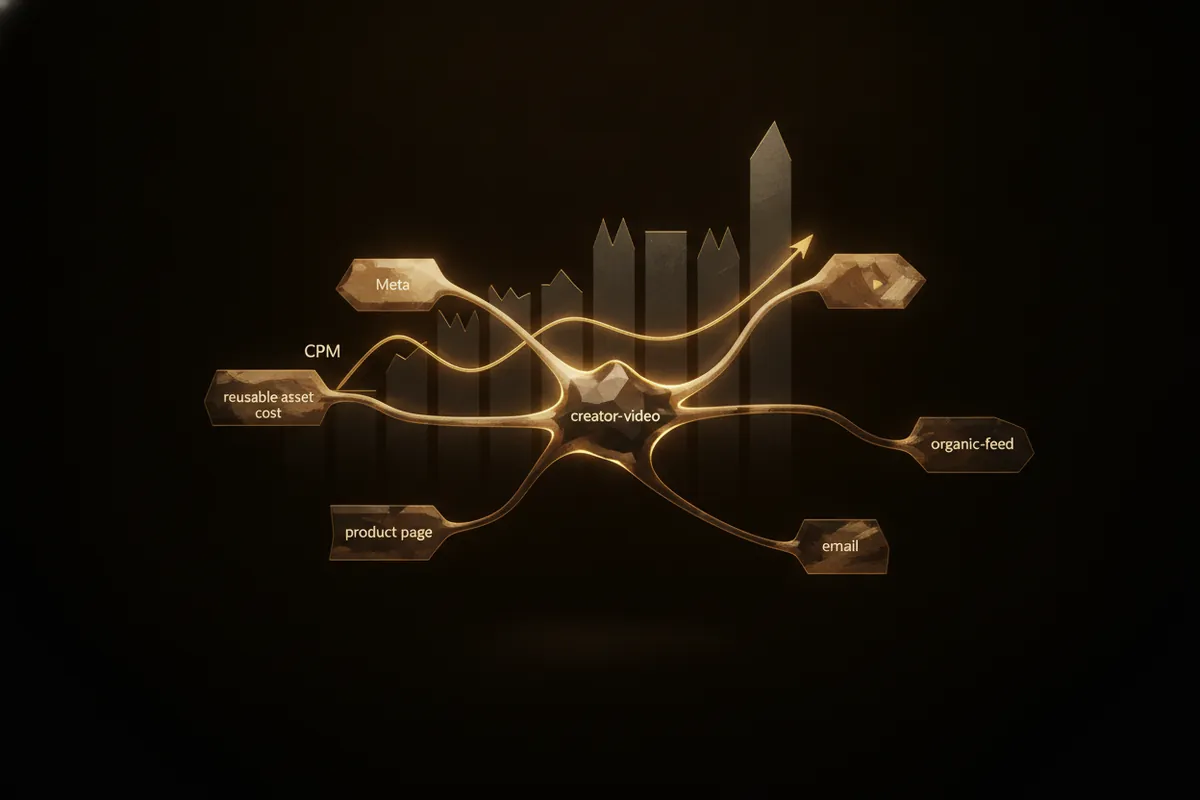
Creator asset reuse is the routing mechanism
Rising CPMs make a paid-only plan buy less each year. The mechanism that lets creator content outperform a budget increase is reuse routing one asset to five surfaces, not content volume.
→ →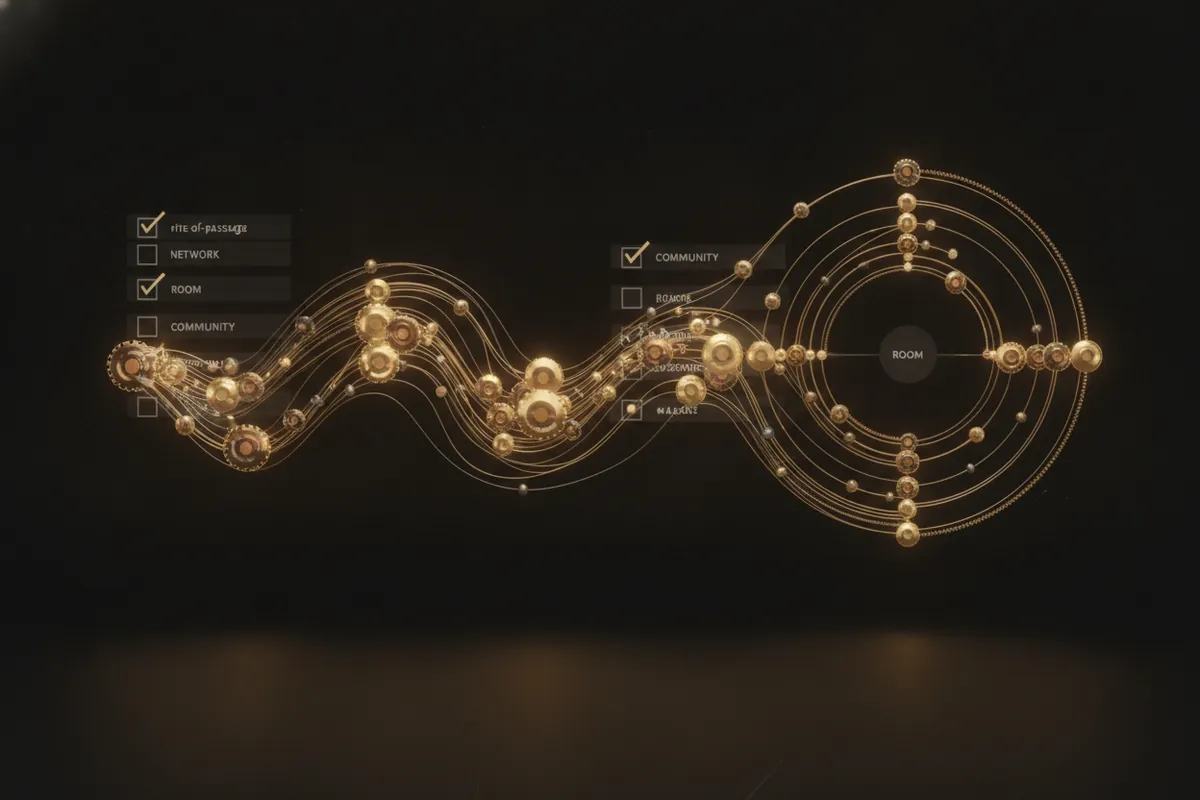
Rites of passage are mechanisms that got measured
A front-end rites-of-passage list is a catalog of mechanisms learned in production. Theorem 3 says a property is guaranteed only when its mechanism is implemented and measuring.
→ →Build your world on an engine that proves what it claims.
Create your own network on the engine that's run since 2016 — or talk to the team behind the 21 papers.