
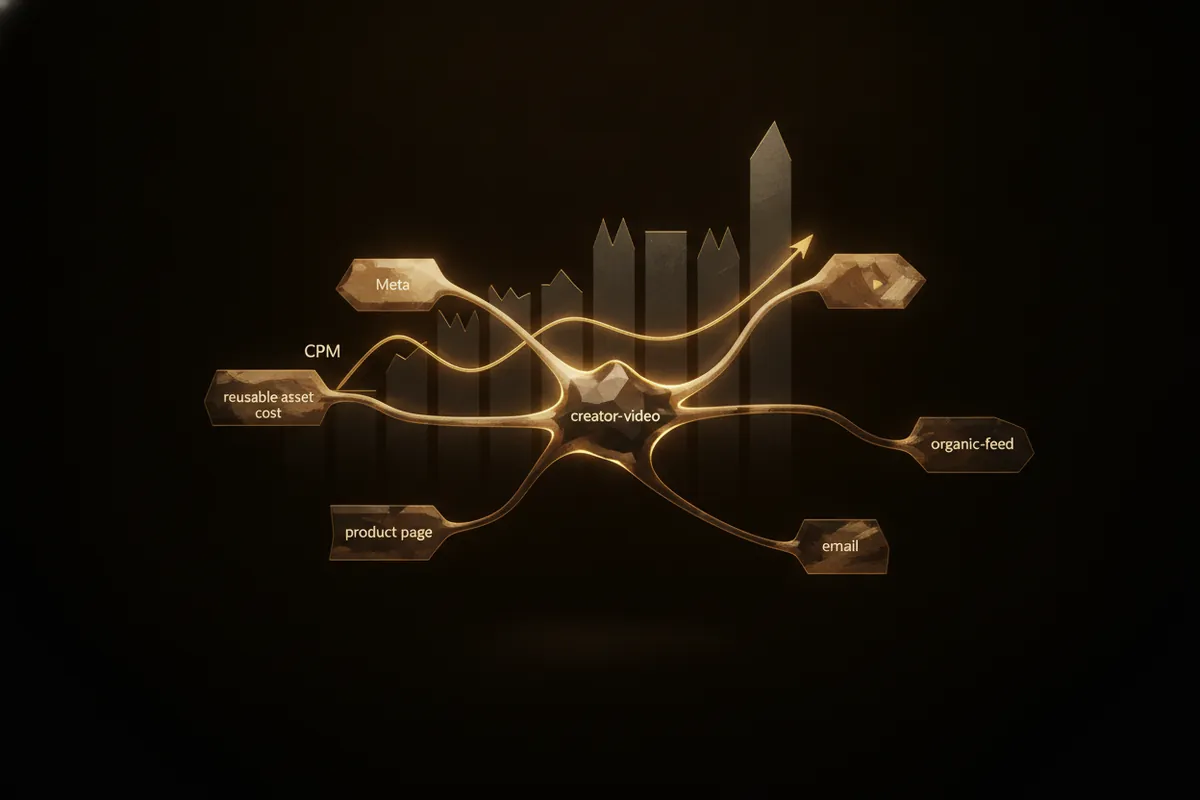
Creator asset reuse is the routing mechanism
The median Meta CPM rose 20% in 2025 to $14.19, and TikTok's rose 16% to $13.26, so a growth plan built only on raising ad budget buys less of the same result every year (Katja Orel, "Aumentar ventas ecommerce: 6 estrategias de creator content", Influee, Aug 14 2026, retrieved 2026-08-23, https://influee.co/es/blog/how-to-increase-ecommerce-sales). The Honest Architect reading is one level below the six strategies. The load-bearing claim is structural: a single creator video is two things at once — an asset you own and can publish anywhere, and an asset you can put paid media behind. The mechanism that makes creator content outperform a budget increase is not the content volume, it is the reuse routing: one asset routed to five surfaces, where the cost per channel collapses because the asset keeps working after the campaign stops. Theorem 3 in Everythink's HAI Engine states the same shape: a property is guaranteed exactly when its mechanism is implemented and measuring. Here the property is "cost per channel declines"; the mechanism is "reuse routing across surfaces, with rights closed before recording."
Key takeaways
- The forcing function is rising CPMs: Meta median $14.19 (+20% YoY), TikTok $13.26 (+16% YoY). A paid-only plan buys less each year at the same result.
- The mechanism is reuse routing, not content volume. One creator video routed to five surfaces (Meta ad, TikTok Spark Ad, product page, email, organic feed) drops cost per channel to roughly a fifth of a single-use placement.
- Theorem 3: the property (cost declines and accumulates) is guaranteed exactly when the mechanism (reuse routing + rights closed before recording) is implemented and measuring. Volume without routing is a non-mechanism.
- Spark Ads convert at 3.84% vs 1.12% for standard In-Feed and cost $14.62 per conversion vs $23.18 — because the creator's own post is the routing surface, not a brand remix.
- 40% of shoppers will not buy from a product page with no customer content. Routing the same creator video to the product page is the highest-return web change most DTC brands have not made.
The forcing function: CPMs rise, assets persist
The article opens with the number the Honest Architect treats as load-bearing: the median Meta CPM is $14.19 after a 20% rise, and TikTok's is $13.26 after a 16% rise. Read as a forcing function, not a complaint, the marginal dollar of paid spend buys less attention every year. The article's counter is creator content, and the reason it gives is honest: a Spark Ad that works keeps working, a creator video on the product page converts every visitor who arrives after, and an influencer post you sent product for stays in feeds long after the sample shipped.
The Honest Architect separates two claims inside that sentence. "Creator content works" is an assertion. "A single asset keeps working across surfaces after the spend stops" is a mechanism claim, and it is the one that matters. Paid media stops the instant the budget stops. A creator asset, once produced and rights-cleared, persists on the product page, in email, in the organic feed, and as a Spark Ad the creator authorized. This is Theorem 3 in vendor-voice: the property (cost per channel declines, the asset accumulates) is guaranteed exactly when the mechanism (reuse routing with rights closed before recording) is implemented and measuring. Buy more budget and you have bought traffic for this month and nothing else. Route one asset to five surfaces and you have built a small piece of infrastructure.
[UNIQUE INSIGHT] The article's strongest line is buried: "the same video is two things at once — something that is yours and you can publish wherever you want, and something behind which you can put media investment. Nothing else you buy does both." This is a routing claim, not a format claim. A studio video is yours but carries no creator authenticity to put behind Spark Ads or Partnership Ads. A pure influencer post has that authenticity but lives on the creator's account, not yours. The creator asset with full usage rights is the only object that is both — which is why reuse routing is the mechanism and content volume is not.
The reuse topology: one asset, five surfaces
The article's sixth strategy is the keystone, because it is the routing layer the other five depend on. The same creator video works in five places: a Meta ad, a TikTok ad, the product page, post-purchase and recovery email, and the organic feed. In the article's economics, a creator video at €500–€1,000 spread across five channels costs €100–€200 per channel; the same five studio assets start at roughly €10,000. The Honest Architect reframes the arithmetic as a topology: one asset, five nodes, edges defined by the rights in the brief. The cost per channel declines because the production cost is paid once and routed five times. The studio alternative is five assets, five production costs, no routing gain. The mechanism is the routing, not the production quality. A studio video is a better single asset and a worse topology.
Routing requires the rights closed before recording
The article names the exception honestly. Spark Ads on TikTok and Partnership Ads on Meta run from the creator's own account, so the creator publishes and authorizes the ad. That is a routing constraint, not a content constraint: the asset still routes to the product page, email, and organic feed under the brand's usage rights, but the paid routing on those two surfaces goes through the creator's authorization. Close both the usage rights and the paid authorization in the brief, before recording, or the routing is incomplete and the cost-per-channel math breaks.
Strategy as routing, not production
The article's six strategies are, in Honest Architect order, six routing decisions. Reading them as routing rather than as a tactic list is the reframe that makes the article useful more than once.
Spark Ads: the creator's account as the routing surface
The article cites Spark Ads at 6.1% engagement vs 2.5% for standard In-Feed, 3.84% conversion vs 1.12%, and $14.62 per conversion vs $23.18. The Honest Architect reading: the mechanism is not "Spark Ads are better creatives." The ad routes through the creator's own post, which carries the engagement history, the creator's audience signal, and the native feed context. Standard In-Feed is a brand remix in a cold ad slot; Spark is the creator's asset routed through the creator's graph. The routing surface is the difference, and the numbers measure it. The routing decision — brief five creators with three hook angles each, launch the 15 as independent ads, scale whatever passes 2% CTR — is a routing-selection mechanism: the audience tells you which angle routes, the brief does not assert it. The Honest Architect tags this Production ✅.
TikTok Shop affiliates: commission as the cost-when-it-works mechanism
The article's TikTok Shop affiliate strategy is the cleanest cost-when-it-works mechanism in the six. Affiliates tag the product in their own organic content and earn a commission per sale. You pay nothing until an order arrives, which makes it the only acquisition channel where a video that fails costs nothing. The mechanism is commission-on-conversion, which routes the cost to the moment the property (a sale) is guaranteed. The article's Tarte example — sending product to creators of all sizes instead of buying reach, the program running roughly 50% above the brand's TikTok Shop sales benchmark with a three-digit retail lift — is a measurement of the mechanism's effect, not an assertion about creators. The routing decision — Open Collaboration first to discover who sells, then move the best performers to Target Collaboration at a higher commission — is a routing-selection mechanism ordered by measured performance, identical in shape to the Spark Ad scaling rule.
Nano engagement: selection signal, not follower count
The article cites Buffer's 2026 analysis of 52 million posts: nano creators average 4–4.5% engagement on Instagram, the highest of any tier, while micro sits at 2–3.5% and the rate keeps falling up the tiers. Engagement rate is a selection signal, not a vanity metric, because it predicts routing efficiency. A nano creator with 5,000 followers and 8% engagement routes more attention per dollar than a 50,000-follower account at 0.5%. The mechanism is selection-by-engagement-rate; the assertion is selection-by-reach. The Honest Architect tags the mechanism Production ✅ and the Buffer datum Partial ⚠️. The routing decision: floor at 3% for Instagram micro and 5% for TikTok nano, judge 20–50 candidates by saves and link clicks rather than likes, continue with the two or three that brought sales.
Product page video: the asset routed to the conversion surface
The article's highest-return-web-change claim is also its most under-routed. 40% of shoppers will not buy from a product page with no customer content, and 83% of video marketers say video increased sales directly. The product page is the conversion surface, and routing the creator video there is the change with the largest measured effect per euro, because every visitor who arrives after — from paid, from organic, from brand search — hits the asset. The mechanism is routing to the conversion surface; the assertion is "add video to your PDP."
[PERSONAL EXPERIENCE] In our own work routing forecast artifacts to operator surfaces, the single highest-impact move was placing the calibrated output where the decision is made, not where the model is made. The product-page video is the same shape: the asset is produced once, routed to where the decision (buy or leave) happens, and it works on every visitor regardless of how they arrived. The Honest Architect tags the PDP-routing mechanism Production ✅.
Customer reviews: the asset you do not brief
The fifth strategy is the only one where the content comes from buyers, not creators. The article cites ten product reviews raising conversion 45%, with a day-7 request phrased as "show us how you use it" and a 10% discount for a photo or video review. The Honest Architect reading: this is the one surface where routing is free because the customer does it themselves — they post to the product page you already have. The mechanism is the request timing and the incentive, not the content production. The Honest Architect tags the review-request mechanism Production ✅ and the 45% datum Partial ⚠️ (vendor-cited).
The article is honest about scale. GoPro and Airbnb fill galleries because thousands submit unprompted; below that scale you curate a handful of usable photos per quarter, which supports a product page but does not sustain an ad. Reviews route to one surface (the PDP) and do not route to paid, because paid needs a specific hook, duration, and message. Reviews are a single-surface asset; creator video is a five-surface asset.
Theorem 3: persistence is guaranteed by the routing mechanism
The Honest Architect's single reframe: the property the six strategies are after is not "more sales," it is "cost per channel declines and the asset accumulates." That property is guaranteed exactly when the mechanism — reuse routing across five surfaces, with rights and paid authorization closed before recording — is implemented and measuring. Each strategy is a routing decision inside that one mechanism. The article is not six tactics, it is one mechanism with six routing decisions. A brand that briefs one creator video, runs it on Meta only, and stops has implemented zero routing and gets zero persistence. A brand that routes the same video to Meta, Spark, PDP, email, and organic, and scales what passes 2% CTR has implemented the mechanism and gets the property. Theorem 3: the difference is the mechanism, not the content.
The Everythink parallel: the space is the router
Everythink operates in civil and defensive forecasting, not commerce, so the parallel is structural. "The space is the router" is the Everythink thesis: the network→community→room topology routes before anything responds. A forecast artifact is produced once by the Sisters and merged by the Oracle into a calibrated cone, then routed to the rooms where operators make decisions. One artifact, many rooms, edges defined by the topology. The HAI Engine, in production since 2016, is the production engine; the routing is what makes the produced artifact accumulate value across surfaces instead of dying in a single dashboard.
The Honest Architect tags: the HAI Engine, Sisters, Oracle, and the topology itself are Production ✅. The 21 papers formalize Theorem 3 as the shape that connects them — routing is the mechanism that turns a produced artifact into a persistent one. Customer sovereignty — your network, your brand, your data — is the rights layer that lets you route the artifact to any room you own, the same way the usage-rights layer in the creator brief lets the brand route the video to any surface. Inclusion by design is the routing reaching surfaces a single-channel deployment would miss.
The cross-domain claim is narrow and honest: reuse routing is a general mechanism. In commerce it makes one creator video outperform a budget increase. In forecasting it makes one calibrated cone serve every operator room that needs it.
FAQ
Does creator content increase ecommerce sales?
It does, and the mechanism is reuse routing, not content volume. One creator video routed to five surfaces — Meta ad, TikTok Spark Ad, product page, email, organic feed — drops cost per channel to roughly a fifth of a single-use placement and keeps working after the paid spend stops. Volume without routing is a non-mechanism.
Why do Spark Ads outperform standard In-Feed ads?
Because the ad routes through the creator's own post and graph, which carries the engagement history and the native feed context. Standard In-Feed is a brand remix in a cold slot. The cited numbers — 3.84% vs 1.12% conversion, $14.62 vs $23.18 per conversion — measure the routing-surface difference, not a creative-quality difference.
What is the highest-return change to a product page?
Routing a creator video to the product page, above the reviews section. 40% of shoppers will not buy from a product page with no customer content, and every visitor who arrives after hits the asset. It is the routing-to-the-conversion-surface move with the largest measured effect per euro.
What does Theorem 3 say about creator content?
The property (cost per channel declines and the asset accumulates) is guaranteed exactly when the mechanism (reuse routing across five surfaces, with rights and paid authorization closed before recording) is implemented and measuring. The six strategies in the source article are six routing decisions inside that one mechanism.
Sources
- Katja Orel, "Aumentar ventas ecommerce: 6 estrategias de creator content", Influee, Aug 14 2026, retrieved 2026-08-23, https://influee.co/es/blog/how-to-increase-ecommerce-sales
- Spark Ads engagement and conversion statistics (6.1% vs 2.5% engagement, 3.84% vs 1.12% conversion, $14.62 vs $23.18 per conversion), cited via Amra & Elma, in Influee, Aug 2026
- Nano creator Instagram engagement 4–4.5%, Buffer State of Social Media Engagement 2026, analysis of 52M+ posts, cited via Influee, Aug 2026
- 40% of shoppers will not buy from a product page with no customer content, Bazaarvoice UGC statistics, cited via Influee, Aug 2026
- Tarte TikTok Shop program running ~50% above brand benchmark with three-digit retail lift, Glossy, cited via Influee, Aug 2026
If you want a topology that routes one asset to every surface that needs it — for forecasts, for operator rooms, for your own network — create your network on Everythink.

BFCM's Last-Minute Win Is Routing, Not a Tactic List
GRIN's 12 last-minute BFCM tactics share one mechanism: routing. The network, community, room topology decides who sees what before anything responds — tactics just fill a pre-built route.
→ →
Comprehension is the measured mechanism, not the AI tutor
The five disadvantages of AI-assisted coding are one missing mechanism: a measurement step that verifies comprehension. Theorem 3, not balance, is the cure.
→ →
Rites of passage are mechanisms that got measured
A front-end rites-of-passage list is a catalog of mechanisms learned in production. Theorem 3 says a property is guaranteed only when its mechanism is implemented and measuring.
→ →Build your world on an engine that proves what it claims.
Create your own network on the engine that's run since 2016 — or talk to the team behind the 21 papers.