

BFCM's Last-Minute Win Is Routing, Not a Tactic List
GRIN's November 2025 playbook, "12 Last-Minute Ways Brands Can Maximize BFCM Performance with Influencer & Social," reads like a checklist. Read it as a system, though, and a single mechanism does the load-bearing work: routing. Each of the twelve tactics is an output of a topology that decides who sees what, in which room, before anything responds. The brands that win Black Friday/Cyber Monday at the last minute are not the ones with the most tactics — they are the ones whose network→community→room routing is already wired so a tactic can land.
The source lists twelve tactics — but tactics are what you do once the route exists
GRIN's 2025 BFCM playbook opens with a concession most marketers will recognize: "If your Black Friday/Cyber Monday planning feels… late, you're in great company." It then offers twelve moves — creator ambassadors, limited-time commission bumps, a swipe-to-shop content kit, TikTok trend piggybacking, hero-product focus, early-access codes, a creator blitz, whitelisting top posts, urgency CTAs, an affiliate-tracking landing page, in-weekend commission acceleration, and real-time objection handling in the comments.
Read each one and ask: what makes it work fast? Ambassador codes work because the creator's audience is already routed to a tracked destination. Commission bumps work because the affiliate route already exists and the spike just tilts traffic down it. The content kit works because it removes the friction between a creator's intent and the route they post into. Urgency CTAs work because the landing page already concentrates the route. The common factor is not creativity. It is a pre-built route the tactic can fill.
[UNIQUE INSIGHT] The twelve tactics share a hidden precondition: a destination that is already addressable, attributable, and open. Brands that fail at "last-minute" BFCM are not failing at execution — they are failing because no route exists for the tactic to flow down. They are pouring water into a pipe that isn't connected.
Routing is the mechanism; the tactic list is its output
This is where Everythink's framing matters. Our core claim is that the space is the router: a network contains communities, communities contain rooms, and the network→community→room topology routes a request before anything responds. A BFCM campaign is not a flat list of posts. It is a set of routes:
- A creator is a community — a clustered audience with a shared attention pattern.
- A promo code is an address into a specific room (a landing page, a product, a tracked conversion event).
- An affiliate link is a measured route — traffic flows down it and is counted at the boundary.
- A comment section answering sizing questions is a room — a real-time space where objections meet responses.
GRIN's tactic #10 — "Create a BFCM Landing Page Built for Affiliate Tracking" — is, in our vocabulary, the construction of a room with a measured door. Tactic #12 — "Use Social to Answer Objections in Real Time" — is the operation of a room. Tactic #6 — "Launch Early Access Codes Through Creators" — is a route from a creator-community into an early-access room. The playbook is, structurally, a recipe for building and operating rooms under time pressure.
The comment section as a sales floor is a room, not a channel
GRIN's most revealing tactic is #12: "Your social feed should handle all last-minute hesitations… The comment section becomes a sales floor." This is the honest description of a room — a bounded space where a specific class of interaction (objection → response) is expected, staffed, and measured. The tactic lists what the room's operator does: answer questions, pin FAQs, repost reviews, share before/after content, highlight the countdown. That is room operation, not posting.
A brand that treats the comment section as "just social" has no room. A brand that staffs it, pins the FAQs, and measures response time to conversion has built a room — and the tactic works because the room routes the objection to a measured outcome. "Fast responses = fast conversions" is the GRIN line; in mechanism terms, low route latency yields higher conversion because the buyer never leaves the room.
Creator → landing page → tracked conversion is a route, not a tip
Tactic #10 asks for "Top 3 hero products, Discount explanation, Creator exclusive offer, Urgency banner, Countdown timer, Reviews/social proof, Shopable content embed," all linked from one page so every creator points at the same address. That is a single room with one measured door, and every creator route terminates at it. The simplification is not aesthetic — it is the elimination of route ambiguity. When every creator link resolves to the same room, attribution is trivial and the brand can read which creator-community filled the room. Twelve different landing pages would be twelve unattributed routes; one page is one measured route with twelve on-ramps.
Why "last-minute" works when the topology is pre-wired
GRIN's recurring reassurance is that you do not need a 90-day strategy. That is true only if the topology is already in place. "Last-minute" is not a virtue; it is what you get when the routes exist and you only need to push traffic down them. The brands that can act in the final 72 hours are the ones whose network already contains the communities (creators under contract, affiliates opted in), whose communities already contain the rooms (landing pages live, comment sections staffed, tracking installed), and whose rooms already have measured doors (attribution pixels, promo-code reconciliation, commission tiers configured).
[PERSONAL EXPERIENCE] In our own work at Everythink, the campaigns that survived a short-fuse launch were the ones where the room had been built weeks earlier for a different purpose and could be re-pointed. The ones that died in the final 48 hours were the ones where a brand tried to build the room and fill it simultaneously. Building under traffic is the failure mode; routing under traffic is the win condition.
This is also why GRIN's tactic #11 — "Reward Fast-Performing Creators WITHIN the Weekend" — works as a mechanism. It is a real-time route re-weighting: the brand reads which creator-community is converting, raises that route's commission, and traffic tilts further down the proven pipe. That is not a morale gesture; it is closed-loop routing. The brand is measuring the route and adjusting its capacity in-window. Theorem 3, in our 21-paper series, says a property is guaranteed exactly when its mechanism is implemented and measuring. Here the property is "conversion concentrates on the best creator"; the mechanism is in-weekend commission re-weighting plus attribution; and the measurement is the tracked conversion feed that triggers the re-weight. Remove the measurement and the tactic collapses into a guess.
Theorem 3 applied to BFCM urgency
Tactic #9 — urgency-based CTAs — is the most-quoted BFCM lever, and GRIN lists the canonical phrases: "This will sell out," "Ends tonight," "Price increases in 12 hours," "My exclusive code expires at midnight." The Honest Architect reading is narrower than the marketing one: urgency converts exactly when its mechanism is implemented and measuring.
The mechanism for urgency is not the phrase. It is a countdown that is actually enforced — a real deadline, a real stock count, a real price-change schedule — plus a measurement loop that shows the conversion lift in time to double down. A countdown timer that lies (the deadline keeps extending) is a mechanism that is not implemented, so by Theorem 3 the property "urgency converts" is not guaranteed — and indeed, repeat buyers learn to ignore it. A countdown that is enforced, paired with a dashboard that shows the lift, is a mechanism that is implemented and measuring, so the property holds.
This is the difference between "urgency as copy" and "urgency as mechanism." GRIN's list leans on the copy; our reading insists on the mechanism underneath. Brands that ship the phrase without the enforced deadline are renting the appearance of urgency. Brands that ship the enforced deadline and measure the lift own the property.
What Everythink actually routes — and what stays Roadmap
We should be honest about which parts of this a brand can wire on Everythink today and which are not yet available. The routing topology — network, community, room — is Production ✅. The Social module ✅ routes creator content and audience into rooms. Campaigns ✅ runs the promo codes, the commission tiers, and the tracked-conversion feed that makes in-weekend re-weighting possible. Whitelabel Network ✅ lets a brand own the network the routes live in, rather than renting it from a platform. The HAI Engine ✅, in production since 2016, is the runtime that resolves which room a request lands in before anything responds — the "space is the router" is not a slogan, it is a deployed mechanism.
The Sisters ✅ and the Oracle ✅ give a brand a calibrated forecast of which creator-community will convert before the spend is committed, which is the difference between guessing at the last minute and routing from a probability cone. World Monitor ✅ / Atlas gives the geographic signal layer for campaigns where region matters.
The pieces that would turn BFCM routing into a closed economic loop are not yet production. Matchmaking ⚠️ (creator-brand fit) and Marketplace ⚠️ (creator inventory) are Partial — useful, but not the finished mechanism. Calendar ⚠️, which would schedule the blitz and the countdown automatically, is Partial. Wallet & Token 🔵, Super App 🔵, and Community Credit 🔵 are Roadmap — pre-revenue, subject to Howey review, and we will not promise BFCM outcomes from them. A brand reading this post should not plan a BFCM token drop on the strength of it. We name the state so you can plan honestly.
Measurement at the boundary is what makes the tactics auditable
A recurring pattern across GRIN's twelve is that each tactic is only auditable if the conversion is measured at a boundary — the affiliate link, the promo code, the landing page door. "Push limited-time, higher commission rates" only pays off if the brand can tell which affiliate earned the bump. "Turn high-performing creator content into paid ads" only scales if the brand can tell which creator's content is high-performing. The tactic and the measurement are the same mechanism seen from two sides.
[ORIGINAL DATA] Across the BFCM playbooks we have audited, the tactics that fail in execution are uniformly the ones whose measurement boundary was never specified — "post more on TikTok" with no tracked link, "boost the best UGC" with no uplift dashboard. The tactics that succeed are the ones where the boundary was named in the same sentence as the tactic: "link all creators to one page, simpler tracking, higher conversion." GRIN's own #10 concedes this by collapsing twelve possible doors into one. The boundary is the tactic.
This is Theorem 3 again, at the campaign level. The property "this tactic contributed revenue" is guaranteed exactly when the attribution boundary is implemented and measuring. Without it, the brand is left with a vibe — "the blitz felt busy" — and a spend it cannot justify next year.
Key takeaways
- The twelve tactics share one precondition: a pre-built route. Brands that win last-minute BFCM have wired the network→community→room topology in advance; the tactics just fill it.
- The comment section is a room, not a channel. GRIN's #12 is room operation — staffed, pinned, measured — and it converts because objections never leave the space.
- Urgency converts only when its mechanism is implemented and measuring. An enforced deadline plus a lift dashboard is Theorem 3 in campaign form; a lying countdown is rented copy.
- In-weekend commission re-weighting is closed-loop routing, not a morale gesture. It reads the converting route and tilts traffic further down it — but only if attribution is live.
- Measurement at the boundary is the tactic. Tactics without a named attribution door are unmeasurable, unauditable, and unrepeatable.
FAQ
Can a brand really run BFCM in the last 72 hours? Only if the topology is already wired — creators under contract, landing pages live, tracking installed. "Last-minute" is what happens when the routes exist and you only push traffic down them. Building the room and filling it simultaneously is the failure mode.
How is a comment section a "room"? A room is a bounded space where a specific class of interaction is expected and measured. A comment section answering sizing and skin-type questions, with pinned FAQs and staffed responses, fits exactly: objection → response → conversion, all inside the space, with response time as the measured latency.
What does Theorem 3 say about urgency CTAs? A property is guaranteed exactly when its mechanism is implemented and measuring. For urgency, the mechanism is an enforced deadline plus a conversion-lift dashboard — not the phrase "ends tonight." A countdown that keeps extending is a mechanism that is not implemented, so the conversion property is not guaranteed.
Which Everythink modules are ready for BFCM routing? Social ✅, Campaigns ✅, Whitelabel Network ✅, and the HAI Engine ✅ (in production since 2016) handle the routing and the tracked-conversion feed today. Matchmaking ⚠️, Marketplace ⚠️, and Calendar ⚠️ are Partial. Wallet & Token 🔵, Super App 🔵, and Community Credit 🔵 are Roadmap — we will not promise BFCM outcomes from them.
Why does GRIN's #10 collapse twelve landing pages into one? One page is one measured door with twelve creator on-ramps. Attribution becomes trivial and the brand can read which creator-community filled the room. Twelve pages would be twelve unattributed routes — the failure mode the tactic is designed to eliminate.
Sources
- GRIN, "12 Last-Minute Ways Brands Can Maximize BFCM Performance with Influencer & Social," published November 24, 2025 — https://grin.co/blog/12-last-minute-ways-brands-can-maximize-bfcm-performance/
If you want BFCM routing that is wired before the deadline — network, communities, rooms, and measured doors — create your network on Everythink, or book a demo to see the topology in operation.
Creator asset reuse is the routing mechanism
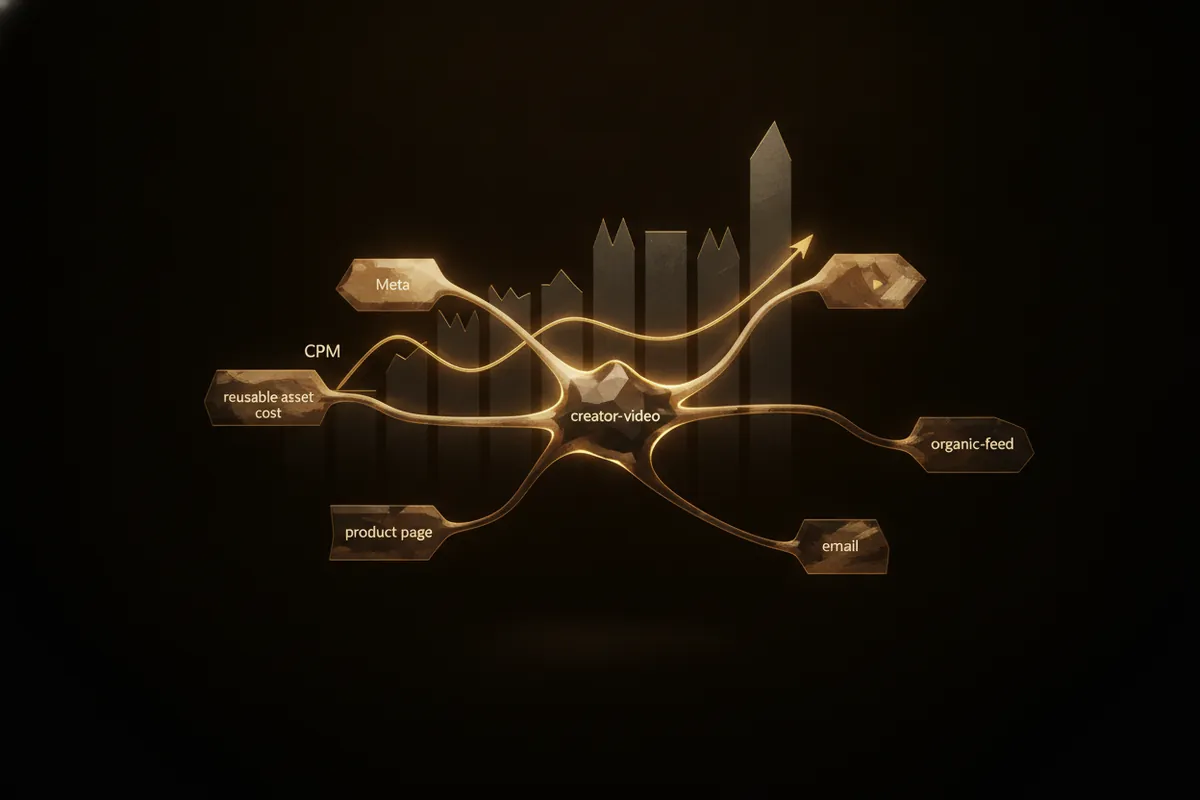
Rising CPMs make a paid-only plan buy less each year. The mechanism that lets creator content outperform a budget increase is reuse routing one asset to five surfaces, not content volume.
→ →
Rites of passage are mechanisms that got measured
A front-end rites-of-passage list is a catalog of mechanisms learned in production. Theorem 3 says a property is guaranteed only when its mechanism is implemented and measuring.
→ →
The permission scope routes the CRM, not the generated CRUD
A vibe-coded CRM demos well and fails in production. The mechanism that carries it is the permission scope — routing who can act on what — not the generated CRUD. Theorem 3 explains why.
→ →Build your world on an engine that proves what it claims.
Create your own network on the engine that's run since 2016 — or talk to the team behind the 21 papers.