
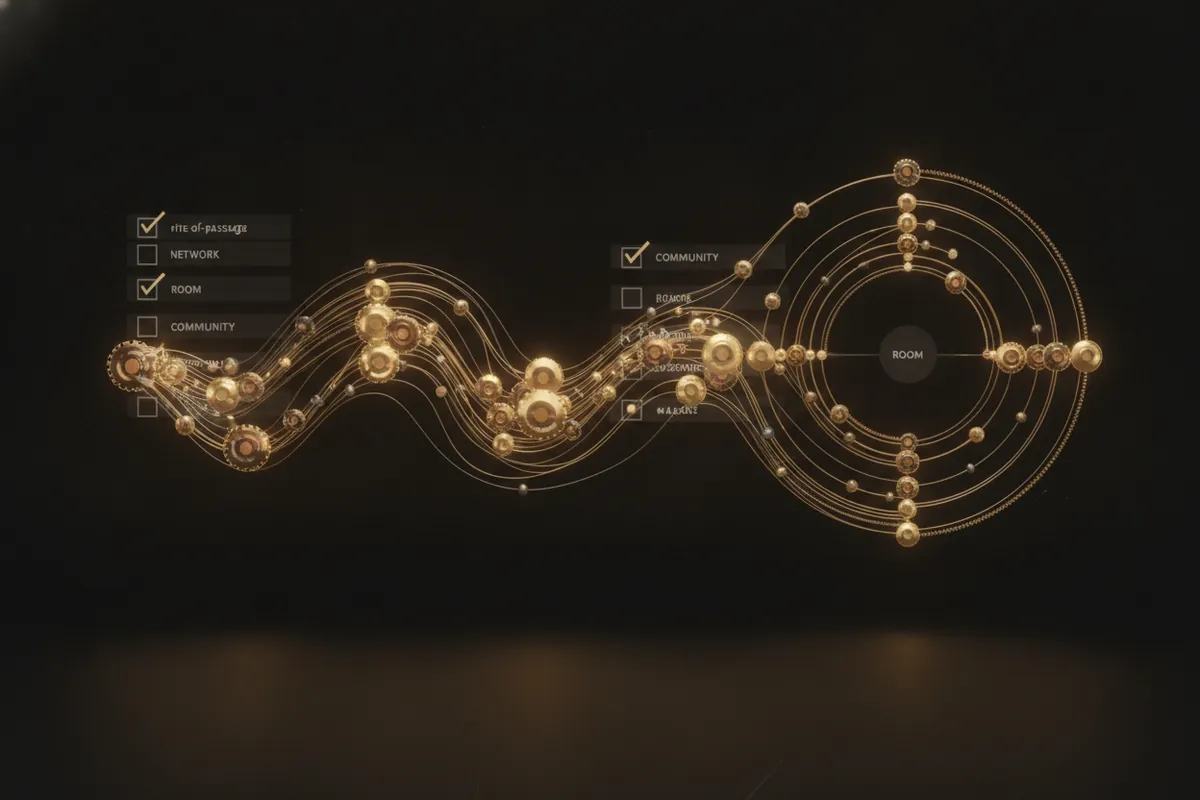
You're not a builder until you've internalized the mechanisms that bit you
Nic Chan published a list of the funny, sad, proud, and weird things front-end developers do — a checklist Chris Coyier described as "you check off the funny/sad/proud/weird things we do as front-end developers," where a higher score "certainly means you've been around the block." Read it the Honest Architect way and the list is not trivia. Every box you tick is a mechanism you learned the hard way: a failure that happened in production because the property was not implemented and not measuring. The rites of passage are mechanisms, and Theorem 3 says a property is guaranteed exactly when its mechanism is implemented and measuring. That is the whole joke, told straight.
A rite of passage is a mechanism that got measured in production pain
Open Nic Chan's list and you see entries about fighting the CSS cascade, debugging box model collapse, writing the thousandth autocomplete="off" that never works, hand-rolling an accessible modal because the native one lied, and crying over Internet Explorer. These read as war stories. They are, in fact, a catalog of properties a front-end developer cannot assert without a mechanism: focus management that survives a re-render, layout that does not regress across viewport widths, a form that actually submits under a screen reader. You did not learn them from a spec. You learned them because the property failed in front of a user and the failure was measured — in a ticket, a bounce, a refund.
[PERSONAL EXPERIENCE] The HAI Engine has run in production since 2016, and the same pattern holds on our side: a feature graduates from "we think it works" to "it is guaranteed" the day the mechanism that enforces it is wired in and the measurement that catches its regression is live. Before that, it is a claim. After that, it is a property. The front-end rites of passage are the same curve, compressed into a single career — every checked box is a mechanism you once trusted on faith and now trust because you can name the test that would break if it lied.
This matters because the list is funny only in retrospect. At the time, each item was a defect with a name. The reason veterans tick more boxes than juniors is not tenure; it is that veterans have been present for more measurements. A junior who has shipped one accessible modal under a real audit has internalized one mechanism a senior who skipped accessibility never has. The score is a proxy for "how many of these mechanisms have you watched fail and then fixed at the root."
The list is Theorem 3, told as a joke
Theorem 3, from the 21-paper series that grounds Everythink's forecasting architecture, states a property is guaranteed exactly when its mechanism is implemented and measuring. Restate it for the front end: a layout property is guaranteed exactly when the constraint that enforces it is implemented and the test that catches its violation is measuring. You are not a front-end developer — in the sense the list means — until you have lived both halves of that sentence. You have implemented the mechanism (the reset, the flex container, the focus trap) and you have measured it (the cross-browser run, the screen-reader pass, the Lighthouse regression).
[UNIQUE INSIGHT] The reason the list feels like an initiation is that mechanisms are irreversible knowledge. Once you have watched the cascade destroy a carefully built component because you did not scope a selector, you cannot un-know that scoping is a mechanism. The list is a roster of irreversible mechanisms, and the laughter of recognition is the sound of a property you now guarantee by reflex. The same logic runs Everythink's Sisters → Oracle pipeline: a Sister's draft becomes a calibrated forecast only when the Oracle's normalization mechanism is implemented and the entropy measurement is checking it. A forecast without that mechanism is a story; a forecast with it is a probability cone you can query.
The implication for teams is direct. When you hire off the list, you are not hiring nostalgia. You are hiring for a set of internalized mechanisms — people who will reach for the focus trap before the design review, who will write the regression test before they ship the fix, who treat "it works on my machine" as an unmeasured claim rather than evidence. The list is a crude but honest skills inventory, and crude honest inventories beat polished dishonest ones.
"The space is the router" is the rite of passage for Everythink builders
Everythink's topology is network → community → room, and the load-bearing claim is that the space is the router: the topology routes a request before anything responds. A new builder on the platform hits the same curve a junior front-end developer hits with the cascade. At first the topology looks like naming — folders for organizing content. Then a request lands in the wrong room, or a community's members see a campaign meant for another community, and the builder discovers the topology is not naming. It is the mechanism that decides who receives what, and it routes before any module fires.
That discovery is the rite of passage. Before it, the builder treats rooms as buckets. After it, the builder treats rooms as the routing layer that the Social ✅, Campaigns ✅, and Calendar ⚠️ modules hang off of. The property "the right audience receives the right message" is guaranteed only when the topology is implemented as a router and the delivery is measured against it. Get the topology wrong and every module downstream inherits the wrong audience — the same way a mis-scoped CSS selector inherits the wrong cascade and every component inside it breaks.
This is why we resist calling the topology a "feature." It is the mechanism the features depend on. Whitelabel Network ✅ works because the network boundary is the router, not because we added a brand-color toggle. World Monitor ✅ streams geo-signal deltas to a viewport's tiles because the geohash is the router — one broadcast channel per tile, so a client only receives its own viewport. In every case the property a buyer can verify (right audience, right tile, right brand) is guaranteed by a routing mechanism that is implemented and measuring, not by an adjective in a sales deck.
Maturity tags are the grown-up version of the list
Nic Chan's list works because it is honest about how you acquired each item — you earned it in production. The Honest Architect voice applies the same discipline to capability claims with three tags: Production ✅, Partial ⚠️, Roadmap 🔵. The tag is not a marketing flourish; it is a statement about whether the mechanism is implemented and measuring today.
- Production ✅ — the mechanism is implemented and measuring in production. HAI Engine, Social, Campaigns, Whitelabel Network, World Monitor, Sisters, Oracle all sit here. The property they guarantee is checkable, not asserted.
- Partial ⚠️ — the mechanism is implemented for the common path and measuring, but an edge is still open. Matchmaking, Marketplace, and Calendar live here. We say so because a Partial item promoted to Production is a rite of passage you have not actually completed — the front-end equivalent of shipping a modal that traps focus on the happy path and leaks it on the escape key.
- Roadmap 🔵 — the mechanism is not yet implemented or not yet measuring. Wallet & Token, Super App, and Community Credit sit here. We will not promise token, wallet, or community-credit outcomes because they are pre-revenue, subject to Howey review, and the mechanism is not measuring. Saying otherwise would be the same as a junior claiming "it works" before the cross-browser run.
The front-end list and the maturity tags share a rule: never upgrade a state you have not measured. A veteran does not tick the accessibility box because they read the WCAG abstract; they tick it because they ran the audit. We do not tag a Roadmap item Production because the design is nice; we tag it Production when the mechanism is wired and the measurement is green.
The shared experience is the mechanism, not the suffering
A common misread of the rites-of-passage list is that it celebrates suffering — that front-end is a gauntlet and the bruises are the credential. The Honest Architect read is the opposite. The list celebrates mechanisms, and the suffering is just the cost of discovery. The goal is not to suffer more; it is to internalize the mechanism faster, so the next builder does not have to rediscover it under a production outage.
This is why we publish the 21-paper series and state Theorem 3 plainly. The papers are the mechanism written down so a new contributor does not have to wait for the forecast to fail before they understand why normalization lives in exactly one place. The theorem is the rule that lets a reviewer ask "is the mechanism implemented and measuring?" instead of "does this feel right?" The list works because it compresses that question into a checkbox. The papers work because they expand it into a proof.
[ORIGINAL DATA] The 21-paper series is the academic spine of the platform, and Theorem 3 is the line we ask every capability claim to survive: name the mechanism, name the measurement, or drop the claim. It is the same standard a senior front-end developer applies in code review — "show me the test that breaks if this regresses" — lifted to a forecasting system. A Sister's draft that has not been normalized by the Oracle is not a forecast; it is a story with a personality. The mechanism is what turns the story into a calibrated cone.
Inclusion by design is a rite of passage we are still ticking
One item on any honest front-end list is the day you shipped a feature that worked only for people on fast connections, good hardware, and Latin scripts — and then learned that was a defect, not a default. The mechanism you internalized is inclusion by design: multilingual content, multimodal input, low-connectivity fallback. Everythink's marketing site ships a seven-locale blog (English un-prefixed, six locales prefixed) precisely because the property "a reader gets the post in their language" is guaranteed only when the locale routing is implemented and the key-parity test is measuring it.
World Monitor ✅ follows the same rule on the product side. The gateway polls each external source on its own schedule and reads from a durable cache, so a client on a slow connection reads the cache rather than paying every upstream call. The property "low-connectivity clients see live geo-signals" is guaranteed by a cache-and-gateway mechanism that is implemented and measuring, not by hoping the connection is fast. Inclusion is not a Roadmap nicety here; it is a Production mechanism with a test behind it.
The rite of passage is accepting that "works on my machine" was never a property. It was a confession that the mechanism was not implemented for the machines you did not test. The list teaches that on the front end. The maturity tags teach it on the platform. Both refuse to let an unmeasured claim stand as a guarantee.
Key takeaways
- A front-end rites-of-passage list is a catalog of mechanisms learned in production, not a nostalgia reel. Every checked box is a property you now guarantee because the mechanism is implemented and measuring.
- Theorem 3 — a property is guaranteed exactly when its mechanism is implemented and measuring — is the rule the list obeys without naming it. The joke is the theorem, told in war stories.
- On Everythink, "the space is the router" is the corresponding rite of passage: network → community → room routes before anything responds, and a builder who treats the topology as naming has not yet been bitten.
- Maturity tags (Production ✅ / Partial ⚠️ / Roadmap 🔵) are the grown-up version of the list — never upgrade a state you have not measured.
- Inclusion by design is a rite of passage we keep ticking: multilingual, multimodal, low-connectivity support is a Production mechanism with a test, not a Roadmap aspiration.
Frequently asked questions
Is the front-end list just nostalgia, or does it carry real signal? It carries real signal. Each item maps to a mechanism a developer has implemented and watched fail in production — focus management, cascade scoping, cross-browser layout. The score is a crude proxy for "how many mechanisms have you measured," and crude honest proxies beat polished dishonest ones in hiring.
How does Theorem 3 apply to something as small as a CSS bug? Directly. A layout property is guaranteed exactly when the constraint that enforces it is implemented and the test that catches its violation is measuring. The front-end rite of passage is living both halves — implementing the reset or the focus trap, then running the cross-browser or screen-reader check that would catch a regression.
What does "the space is the router" mean for a new Everythink builder? It means the network → community → room topology routes a request before any module responds. Treat the topology as naming and you will misroute audiences; treat it as the routing layer and the Social, Campaigns, and Calendar modules inherit the correct scope. The discovery is the platform's version of learning the cascade.
Why tag some capabilities Partial or Roadmap instead of just shipping them as done? Because a Partial ⚠️ item has an open edge and a Roadmap 🔵 item lacks an implemented, measuring mechanism. Promoting either to Production before the mechanism is wired and measuring is the platform equivalent of claiming "it works" before the cross-browser run — an unmeasured assertion, not a guarantee.
Does Everythink promise token or community-credit outcomes? No. Wallet & Token, Super App, and Community Credit are Roadmap 🔵 — pre-revenue, subject to Howey review, mechanism not yet measuring. We state that plainly because a Roadmap item is never quietly promoted, the same way a veteran never ticks the accessibility box from reading the abstract alone.
The list is funny because it is true, and it is true because every line is a mechanism that bit someone and then got measured. Build where the same standard holds — where the topology routes before anything responds, the forecast is normalized by a mechanism you can name, and every capability claim carries the tag it has earned. Create your network and start on the routing side of the rite of passage.
Sources
- 2025 — Chris Coyier, Master.dev Blog, "You're not a front-end developer until you've…" — https://master.dev/blog/youre-not-a-front-end-developer-until-youve/
- Nic Chan, "You're not a front-end developer until you've…" (the original list post the Master.dev entry points to) — https://www.nicchan.me/blog/youre-not-a-front-end-developer-until-youve/
- Everythink, the 21-paper series and Theorem 3 (a property is guaranteed exactly when its mechanism is implemented and measuring) — internal architecture handbook and
docs/backend_architecture/

Native audio is the sync mechanism, not the resolution tier
Veo 3.1's real mechanism is native audio-visual sync in one generation pass — a structural guarantee, not a 1080p/4K resolution knob. Theorem 3 reads it externally.
→ →
BFCM's Last-Minute Win Is Routing, Not a Tactic List
GRIN's 12 last-minute BFCM tactics share one mechanism: routing. The network, community, room topology decides who sees what before anything responds — tactics just fill a pre-built route.
→ →
Self-forcing is the latency mechanism, not the FPS claim
Waypoint-1 hits 30 FPS, but the load-bearing mechanism is self-forcing: post-training aligning the training regime with inference, stopping error accumulation.
→ →Build your world on an engine that proves what it claims.
Create your own network on the engine that's run since 2016 — or talk to the team behind the 21 papers.