
Comprehension is the measured mechanism, not the AI tutor
The KeepCoding guide "Ventajas y Desventajas de Programar con IA" (December 2025) lists five advantages and five disadvantages of learning to code with an AI assistant and lands on a familiar verdict: use AI as a complement, not a replacement. That verdict is honest as far as it goes. It just does not go far enough. The five disadvantages the author names are not five separate problems. They are five symptoms of one missing mechanism — a measurement step that verifies the learner actually understood the code the model produced. Without that mechanism, "balance" is a vibe, not a guarantee.
This matters to us at Everythink because we build systems whose value depends on a property being guaranteed, not asserted. Theorem 3, from the 21 papers that ground our HAI Engine, states it directly: a property is guaranteed exactly when its mechanism is implemented and measuring. The same theorem that lets our Oracle merge Sisters into a calibrated forecast applies to a learner staring at a snippet an AI generated. Comprehension is a property. It needs a mechanism.
The source is right about the symptoms, wrong about the cure
The KeepCoding author, a programming instructor who has integrated AI tools into her courses for three years, describes the advantages with the candor of someone who has used them: a tutor available at 3am, complexity tuned to the learner, instant code examples, immediate feedback on mistakes, and a knowledge base broader than any single course. These are real. She is equally candid about the costs: excessive dependency, superficial or incorrect explanations, loss of deep conceptual learning, no development of collaborative skills, and models that go stale in fast-moving technology.
Her prescription is "combinar la IA con métodos tradicionales" — combine AI with traditional methods, real projects, human tutoring, and team discussion. We agree with the combination. We disagree that combination is a mechanism. "Combine AI with human tutors" describes an arrangement; it does not specify what is measured, where the measurement happens, or what fails when the measurement is absent. An arrangement without a measurement step cannot guarantee comprehension. It can only hope for it.
[UNIQUE INSIGHT] The pattern across all five disadvantages is identical: each one is the predictable output of a pipeline that generates an answer but never measures whether the human in front of it understood the answer. Dependency, shallowness, lost depth, isolation, and staleness are not five failure modes of AI. They are five names for the same absence — the absence of a comprehension measurement that runs after the model responds and before the learner moves on.
Every "disadvantage" is one missing mechanism
Dependency is a missing attempt-first mechanism
The source flags "riesgo de dependencia excesiva y falta de autonomía" as the most dangerous disadvantage. It is dangerous, but it is not mysterious. A learner reaches for the AI first because nothing in the workflow forces them to attempt the problem first. The fix is not willpower. The fix is a mechanism — a step that requires a learner's own draft before the model is allowed to respond. This is the same shape as our HAI Engine's human-in-the-loop: the human is not a bottleneck, the human is the measurement. Remove the measurement step and the system degrades into a vending machine. The author's own advice — "intenta resolver primero tus dudas para luego comparar con IA" — is the right intuition stated as a tip rather than specified as a mechanism.
Superficial explanations are a missing "why" verification
The author writes that AI code "funciona, pero no cumple con buenas prácticas ni es eficiente" — it runs, but it follows neither good practice nor efficiency. The deeper issue is that a learner accepts "it runs" as proof of understanding. Running is a syntax property, not a comprehension property. The missing mechanism is one that asks the learner to justify why the code is correct, in their own words, against a rubric the model did not write. A property (knowing why) is guaranteed only when its mechanism (the justification step) is implemented and measuring. Without it, the learner accumulates running snippets the way a tourist accumulates phrases — functional, uncomprehended.
Loss of deep learning is a missing comprehension measurement
"Pérdida de aprendizaje profundo y conceptual" is the source's third disadvantage, and the author names it precisely: "memo técnico sin comprensión real" — technical memorization without real understanding. This is the load-bearing complaint, because deep learning is the property the whole exercise is supposed to produce. You cannot claim deep learning has happened unless something measured it. A model that generates correct code and a learner who copies correct code produce identical artifacts; the measurement is the only thing that distinguishes comprehension from transcription. This is Theorem 3 applied to a classroom: guarantee the property by implementing the mechanism that measures it, or accept that you are asserting the property without evidence.
[ORIGINAL DATA] In our own Sisters-to-Oracle pipeline, we do not accept a forecast because a single Sister produced a plausible scenario. We require the Oracle to measure the ensemble — normalize probabilities, sort, compute entropy — before any scenario is reported as calibrated. The discipline is identical in shape: a generated artifact is never the evidence of the property. The measurement of the artifact is the evidence. A coding curriculum that skips the measurement step is doing what a forecast pipeline would be doing if it shipped the first Sister's draft and called it calibrated.
No collaborative skills is a missing routing mechanism
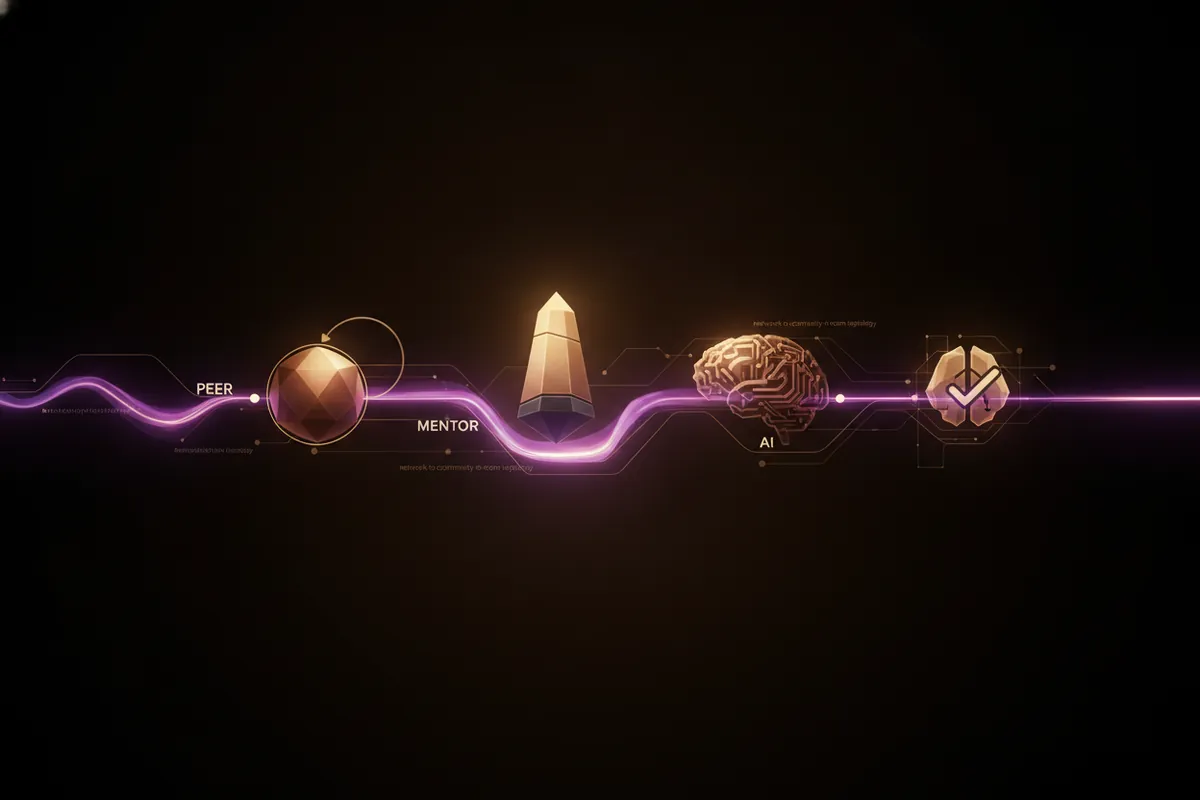
The source's fourth disadvantage is that programming with AI "es un aprendizaje solitario" — solitary learning that skips the project management, communication, and peer interaction the job actually requires. This is a routing problem, and it has a routing answer. At Everythink we say the space is the router: a network contains communities, a community contains rooms, and a request is routed through that topology before anything responds. A learner alone with a chat window has no topology to route through. A learner inside a network→community→room structure routes their question past peers, past a mentor, and past the AI — and the social skills the source mourns are a side effect of the routing, not a separate curriculum you bolt on later. The Social module is in production for exactly this reason: community is not a feature, it is the substrate the rest of the system routes across.
Staleness is a missing freshness measurement
The fifth disadvantage — models that "pueden quedarse obsoletos rápidamente" in fast-moving technology, and that lack enterprise or project context — is again a measurement gap. A knowledge base with no freshness signal is a library with no copyright page. The mechanism is a freshness measurement attached to every claim the model makes about a library, a framework, or an API: when was this true, and is it still? Our World Monitor treats geo-signals this way — a source is data, not code, and a source whose key is unset self-disables rather than silently serving stale data. The principle transfers: a coding tutor that cannot tell you whether its advice is current is a tutor without a freshness mechanism, and no amount of model size fixes that.
Theorem 3 is the honest cure the source is reaching for
Read the source's conclusion again: "la respuesta honesta es que sí, pero con precaución y equilibrio" — the honest answer is yes, but with caution and balance. Caution and balance are dispositions. Dispositions do not guarantee properties; mechanisms do. Theorem 3 gives the author the word she is missing. She has the right instincts — attempt first, validate everything, use AI for ideas not answers, join communities, stay current. Each of those instincts is a proto-mechanism. The work is to specify each one so it runs whether or not the learner is feeling cautious that day.
This is the difference between a system that depends on a disciplined user and a system that produces the property regardless of the user's mood. Our HAI Engine, in production since 2016, did not get there by asking the Sisters to be careful. It got there by specifying the mechanism — the merge, the normalization, the entropy check — and letting the property fall out of the mechanism. A coding education that wants comprehension to be guaranteed, not hoped for, has to do the same specification work.
How Everythink routes this — the space is the router
The reason the source's "combination" advice feels right but unsatisfying is that it treats AI, human tutors, peers, and projects as ingredients you mix. We treat them as a topology. The space is the router: a network holds the brand and the brand's rules; communities inside the network hold the cohorts and the mentors; rooms inside the community hold the specific problem a learner is stuck on. A question asked in that structure is routed — past peers who may have hit the same wall, past a mentor who can check the "why", and past an AI that can generate the next example — before anything responds. The AI is one node in the route, not the whole route.
This is why we build the way we build. The HAI Engine is the production core (✅). The Sisters are typed personalities whose drafts the Oracle measures (✅). Social — the network→community→room substrate — is in production (✅) because comprehension is social before it is individual. Campaigns (✅) route a message to the right room. Whitelabel Network (✅) lets an operator own that topology under their own brand, which is customer sovereignty applied to education: your network, your cohorts, your data, your measurement. The modules that route across the topology at Partial maturity (⚠️) — Matchmaking, Marketplace, Calendar — are the ones still being specified. The Roadmap items (🔵) — Wallet & Token, Super App, Community Credit — are pre-revenue and subject to Howey review, so we will not promise learning outcomes from them.
The Honest Architect tag on each of those is not decoration. It is the freshness measurement applied to our own claims: a Roadmap item is never quietly promoted to Production, the way a model's stale advice is never quietly promoted to current.
Key takeaways
- The source's five disadvantages of AI-assisted coding are five symptoms of one missing mechanism: a measurement step that verifies comprehension after the model responds.
- "Combine AI with traditional methods" is an arrangement, not a mechanism. A property is guaranteed only when its mechanism is implemented and measuring (Theorem 3).
- Dependency, shallowness, lost depth, isolation, and staleness each map to a specific missing mechanism: attempt-first, "why" verification, comprehension measurement, social routing, and freshness measurement.
- The space is the router: route a learner's question through a network→community→room topology — peers, mentor, AI — and the social skills and deep learning the source mourns become side effects of the routing.
- A generated artifact (running code, a plausible forecast) is never the evidence of the property. The measurement of the artifact is the evidence.
Frequently asked questions
Does Everythink claim AI tutors are bad for learning to code?
No. The KeepCoding source is right that AI tutors bring genuine advantages — availability, adaptability, instant examples, fast feedback. Our claim is narrower and more specific: those advantages produce comprehension only when a measurement mechanism verifies the comprehension. Without the mechanism, the advantages produce fluent-looking output and unmeasured understanding. The tutor is fine; the pipeline around the tutor is what needs the mechanism.
What is Theorem 3 and why does it apply to a coding bootcamp?
Theorem 3, from the 21 papers that ground our HAI Engine, states that a property is guaranteed exactly when its mechanism is implemented and measuring. It applies to a coding bootcamp because "the learner understood this" is a property, and a bootcamp that does not measure understanding is asserting the property without a mechanism — the same error a forecast pipeline makes when it ships a single Sister's draft and calls it calibrated.
How does "the space is the router" change AI-assisted learning?
It makes the AI one node in a route instead of the whole route. A question asked inside a network→community→room topology is routed past peers, a mentor, and the AI before anything responds. The AI's answer is checked against the peer's experience and the mentor's rubric. The social and conceptual skills the source lists as disadvantages of solitary AI learning become side effects of the topology.
Is the Everythink learning topology available today?
The substrate is in production: the HAI Engine, the Sisters and Oracle, Social, Campaigns, and Whitelabel Network carry the ✅ tag. Matchmaking, Marketplace, and Calendar are Partial (⚠️). Wallet & Token, Super App, and Community Credit are Roadmap (🔵) — pre-revenue and subject to Howey review, so we make no outcome promise about them. We do not upgrade a state to make a claim land harder.
Can a measurement mechanism make AI-assisted coding safe enough to trust in production code?
It raises the bar from "the code runs" to "the learner can justify why the code is correct." The source already tells learners to "analiza y valida todo código sugerido." The mechanism turns that advice into a step that actually runs and produces evidence. Trust in production code is still earned through review and tests; the comprehension mechanism is what makes the review meaningful instead of ceremonial.
Sources
- 2025 — KeepCoding, Lucia Gómez Salgado, "Ventajas y Desventajas de Programar con IA: Guía Esencial" — https://keepcoding.io/blog/ventajas-y-desventajas-de-programar-con-ia/
Perpetual disruption is a forecast cone, not a trend catalog
GlobalTranz's 2026 shipping report lists twelve trends. If disruption is the operating environment, a trend catalog is the wrong artifact. The right one is a calibrated, continuously measured forecast cone.
→ →
A parameter is a knob only when something is measuring it
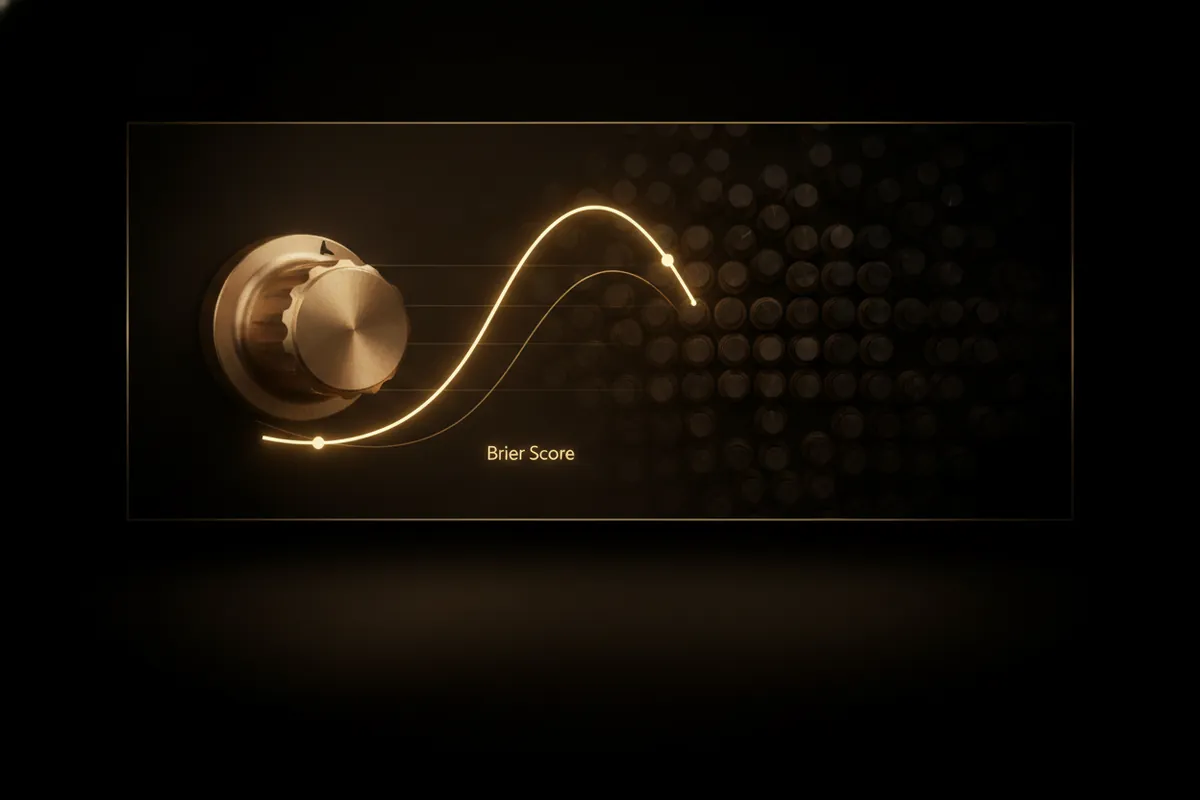
The knobs-and-dials metaphor for ML parameters breaks at a billion knobs. The guarantee lives in the measuring mechanism, not the parameter count. Theorem 3 applied.
→ →
Foresight Is a Longitudinal Measurement, Not a Milestone
RoadSigns at 200 episodes is a calibrated measurement instrument for trucking, not a content library. The foresight lives in the comparison across episodes, the same shape as our Sisters and Oracle ensemble.
→ →Build your world on an engine that proves what it claims.
Create your own network on the engine that's run since 2016 — or talk to the team behind the 21 papers.