
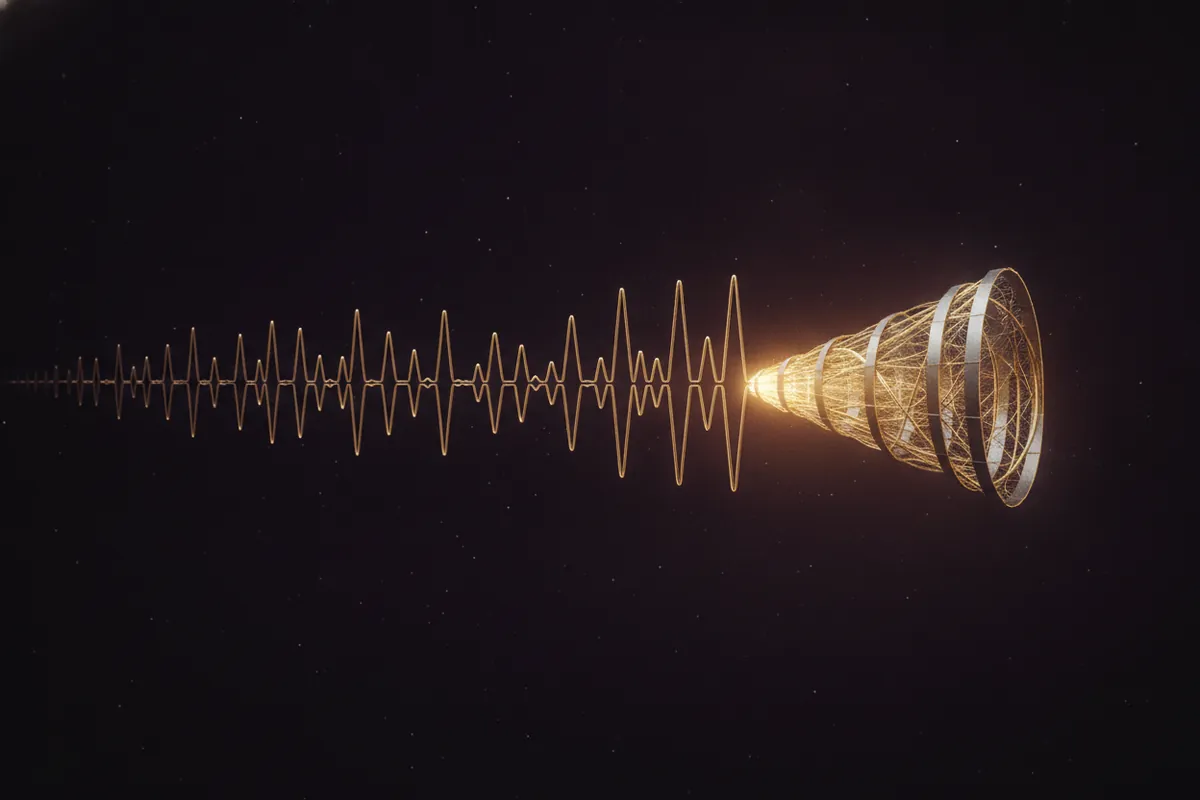
Foresight Is a Longitudinal Measurement, Not a Milestone
RoadSigns, the Transport Topics podcast hosted by Seth Clevenger and Michael Freeze, turned 200 episodes in 2026, eight years after its 2018 launch. The milestone is real, but the load-bearing thing is not the number — it is the fact that a sustained interview series, revisited across a full industry cycle, becomes a calibrated measurement instrument for where trucking is actually headed.
A single podcast episode is an anecdote. Two hundred of them, recorded over a freight recession, an emissions-rule pivot, an autonomy commercialization wave and an agentic-AI land grab, are a longitudinal corpus. That corpus is what lets the hosts name "the trends that surprised them most" with any credibility — surprise is only detectable against a prior, and a prior is only built by having listened long enough to have formed one. This is the same shape as our Sisters→Oracle ensemble: one run is a draft, many runs merged and normalized are a calibrated forecast. The foresight lives in the series, not in any single installment.
The milestone is a side effect; the measurement is the mechanism
RoadSigns did not set out to build a measurement instrument. It set out to talk to trucking executives, technology developers, economists and maintenance leaders. But eight years of doing that, on a fixed cadence, with returning guests and a consistent line of questioning, produced something structurally identical to a time-series sensor: a stream of structured observations of the same field, taken at regular intervals, comparable across time. Episode 200 is the 200th sample. The hosts can say "this surprised us" precisely because episodes 1 through 199 gave them a baseline to be surprised against.
[ORIGINAL DATA] This is Theorem 3 in action: a property is guaranteed exactly when its mechanism is implemented and measuring. "We understand how trucking tech has evolved" is a property. The mechanism that guarantees it is not the act of publishing a podcast — it is the act of publishing a podcast repeatedly, on a schedule, across a market cycle, and revisiting earlier claims against later ones. The mechanism is the longitudinal series plus the comparison. Strip the comparison and you have a content library; strip the cadence and you have a set of one-off interviews. Neither alone produces foresight.
The honest framing matters here. A buyer reading the Transport Topics archive does not get a forecast by skimming episode 200. They get a forecast by reading episode 165 (first driverless commercial freight in Texas, April 27, 2026), then episode 186 (autonomous trucks outgrowing the hub-to-hub model), then episode 195 (agentic AI automating dispatch), and watching the thesis narrow. The narrowing is the signal. A single episode cannot narrow anything.
Why a back-catalog beats a single expert briefing
Executives buy foresight in two common shapes, and one of them is mostly decorative. The first is the one-off expert briefing — a sharp analyst spends two hours with you, names three trends, and leaves. The second is the longitudinal record — a body of interviews, recorded over years, where the same expert's earlier claims can be checked against what actually happened. The first feels decisive and carries no accountability. The second feels slower and carries a track record.
[UNIQUE INSIGHT] The difference is exactly the difference between a Sister's draft and the Oracle's ensemble. Everythink's Sisters each produce a plausible future for a real-world actor — that is a draft, an anecdote, a single informed guess. The Oracle merges many such drafts into a normalized ensemble, sorted by probability, with entropy measured in nats. A draft can be wrong in any direction; an ensemble is wrong in a calibrated, bounded way. The RoadSigns archive is, structurally, an ensemble: 200 drafts of "where is trucking going," merged by two hosts who have heard all of them and can weight the convergent ones above the outliers.
This is why the hosts' reflections in episode 200 are worth more than a fresh analyst report. The analyst report has no prior to be surprised against. The hosts do. When Clevenger and Freeze say something surprised them, that statement is the output of a comparison between a 2018–2024 prior and a 2025–2026 observation. That comparison is the mechanism. It is also the one thing a buyer cannot manufacture by commissioning a single briefing.
What the archive actually measures, episode by episode
The corpus is not homogeneous. Reading the descriptions, five distinct measurement channels run through the 200 episodes, each tracking a different variable in the trucking system.
Autonomy and the deployment-model drift
Episode 165 records Aurora's first driverless commercial freight operations in Texas on April 27, 2026, and notes that human observers were returned to the driver's seat at the request of manufacturing partner Paccar. Episode 186, with Waabi COO Lior Ron, records the hub-to-hub model giving way to direct-to-customer autonomous freight. Episode 173, with Volvo's Nils Jaeger, frames autonomy as complementing rather than replacing drivers. Read in sequence, these three do not say "autonomy is coming." They say the deployment model is drifting, the timeline is being renegotiated under real integration friction, and the hub-to-hub framing was a temporary concession to uncertainty rather than a destination. That drift is the measurement. A single episode would have frozen one frame of it and called it a trend.
Agentic AI and the dispatch boundary
Episode 195, with PCS Software CEO Mark Hill, asks whether agentic AI will automate dispatching and lands on a precise boundary: the technology can autonomously handle load booking, driver assignment, shipper communication and rate management, freeing human dispatchers for exceptions and judgement. Episode 167, with CloneOps.ai's Brian Work, places AI agents on check calls, load updates and document tracking. Episode 160, with Alvys' Nick Darman, tracks the same shift at the TMS layer. The boundary the archive locates — automate the routine, keep the human for exception and relationship — is not asserted in any one episode. It is the stable consensus across three, recorded over a year. That is a measured boundary, not a vendor claim.
Maintenance, uptime and the technician constraint
Episode 159 cites more than 60,000 unfilled commercial trucking maintenance jobs. Episode 197, with Cox Fleet's Kevin Clark, rethinks maintenance strategy against rising costs and a shrinking technician workforce. Episode 190 unpacks aftertreatment total cost of ownership and the gap between basic DPF cleaning and true restoration. Episode 199 gets down to dump pump sizing and flow-versus-pressure tradeoffs. Read together, these measure a system whose bottleneck is not equipment sophistication but the human capacity to maintain it. The archive's value is that it refuses to collapse this into one headline; it holds the tension between technology investment and workforce scarcity across dozens of episodes.
Emissions rules and the capital-planning clock
Episode 194, recorded at the 2026 TMC Annual Meeting, names the 2027 NOx emissions rules as the forcing function and says the industry has moved from regulatory whiplash to relative clarity. Episode 164, from ACT Expo 2025, records the energy transition as more dynamic and unpredictable than expected. Episode 183 tracks renewable natural gas and the Cummins 15-liter X15N. The archive measures a regulatory clock with a concrete deadline, and it measures the industry's planning posture against that clock. A buyer who reads only episode 194 gets the deadline; a buyer who reads 164, 183 and 194 together gets the deadline plus the probability cone around how the industry will actually meet it.
Freight rates and the survival variable
Episode 150 notes that nearly 70 percent of U.S. freight moves by truck while many trucking companies face significant challenges in a persistent rate recession. Episode 185 frames the year ahead through tariffs, technology, safety and an unclear freight outlook. Episode 144 examines how the freight downturn altered the competitive landscape across the for-hire carrier Top 100. The archive treats the rate recession not as background color but as the survival variable that determines which of the other four channels any given fleet can afford to invest in. That dependency — autonomy investment gated by freight-rate survival — is visible only across episodes, never within one.
The honest limits of a podcast corpus
A podcast archive is a measurement instrument, but it is not a calibrated forecast cone. It has three honest limits, and naming them is the difference between the Honest Architect and a hype merchant.
First, the sample is opportunistic, not designed. RoadSigns interviews who is available, newsworthy and willing. That introduces selection bias toward companies with something to announce. Second, the cadence is editorial, not statistical. Episodes cluster around events — TMC, ACT Expo, IANA — which means the time series is unevenly spaced. Third, the observations are qualitative. "Trends that surprised us" is a real signal but not a probability. You cannot put a number on it.
[PERSONAL EXPERIENCE] We have run the HAI Engine in production since 2016, and the lesson a decade of operating it teaches is exactly this: qualitative series are useful, but they become foresight only when they are normalized into a probability cone with measured entropy. The RoadSigns archive is the raw material for foresight. It is not, by itself, the foresight. The Oracle is the step that turns 200 informed drafts into a normalized ensemble you can actually plan against. That step is mechanical, repeatable, and — this is the part that matters — auditable. You can show your work. A podcast cannot.
This is why we are careful about maturity tags. The Sisters and the Oracle are Production ✅ — they run, they merge, they produce calibrated ensembles, and the probabilities are normalized in exactly one place so downstream consumers can rely on sum-to-one. World Monitor is Production ✅ as the live geo-signal layer. A podcast archive, however distinguished, is at best a Partial ⚠️ input: useful, directional, not auditable to a probability. The Honest Architect's job is to say so plainly.
What this means for a fleet operator reading the archive
If you run a fleet and you want to extract foresight from a body of work like the RoadSigns archive, three practices matter more than which episodes you pick.
Read in sequences, not in singles. Pick one of the five channels above and read three to five episodes spanning at least two years. The signal is in the drift between them, not in any one summary. An episode from 2024 next to one from 2026 tells you what the industry stopped believing, and that is the most expensive information in the corpus.
Anchor every claim to the mechanism that would falsify it. When an episode says agentic AI will automate dispatch by 2027, ask which measured variable would prove that wrong — load-book automation rate, exception-handling time, dispatcher headcount per truck. If no one is measuring that variable, the claim is an assertion, not a forecast. Theorem 3 again: the property is guaranteed only when the measuring mechanism exists.
Keep the civil and defensive scope explicit. The trucking use cases in the archive — uptime, safety, emissions compliance, breakdown mitigation — are operational and defensive. They keep freight moving and drivers safe. Everythink holds the same line: we build for civil and defensive scope, not for targeting or offense. A forecast cone that helps a fleet decide whether to pre-buy 2026 trucks against 2027 NOx rules is a defensive use of foresight. That is the whole scope.
Key takeaways
- A 200-episode interview archive is a longitudinal measurement instrument, not a content library. The foresight lives in the comparison across episodes, not in any single one.
- The mechanism that produces foresight is a sustained, cadenced series plus the act of revisiting earlier claims against later outcomes. Strip either half and you have anecdotes, not measurement. This is Theorem 3 applied to journalism.
- The RoadSigns corpus measures five channels — autonomy deployment drift, the agentic-AI dispatch boundary, the maintenance-and-technician constraint, the emissions-rule capital clock, and the freight-rate survival variable — and the dependency between them is visible only across episodes.
- A podcast archive is Partial ⚠️ as a foresight input: useful and directional, but not auditable to a probability. The Oracle is the mechanical step that turns informed drafts into a normalized, calibrated ensemble.
- Read in sequences, anchor every claim to a falsifying measurement, and keep the scope civil and defensive. That is how a buyer extracts value from a corpus without mistaking it for a forecast.
Frequently asked questions
Is a 200-episode podcast really a measurement instrument? Structurally, yes. A fixed-cadence interview series with returning guests and a consistent line of questioning produces a time series of comparable observations. It is an opportunistic, editorially spaced, qualitative time series — which is why it is Partial ⚠️ as a forecast input rather than Production ✅ like the Oracle — but it is a measurement instrument nonetheless. The number 200 is a side effect of the cadence; the cadence is the mechanism.
How is this different from just reading industry news? News is a stream of events. A podcast archive with returning hosts is a stream of events plus a running commentary that carries a prior. The hosts' prior is what makes "this surprised us" a meaningful statement. A news feed has no prior and therefore cannot register surprise. It can only register occurrence.
Why map a podcast to the Sisters and the Oracle? Because the structural problem is identical. A single informed draft is an anecdote; many informed drafts, merged and normalized, are a calibrated ensemble. The RoadSigns archive is 200 informed drafts of "where is trucking going." The hosts function as a manual Oracle, weighting convergent episodes above outliers. The difference is that our Oracle is mechanical, auditable and produces probabilities with measured entropy, while a human host is qualitative and non-repeatable.
Does Everythink use podcast archives as input? The Everythink platform ingests structured signals through World Monitor ✅ and produces calibrated forecast cones through the Sisters ✅ and the Oracle ✅. A qualitative corpus like a podcast archive is the kind of directional input a human analyst would read alongside the structured data; it is not, by itself, a feed into the ensemble. The ensemble is built from measured, auditable inputs. This is the honest boundary between Partial and Production.
What is the civil and defensive scope here? The operational use cases in the trucking archive — uptime, breakdown mitigation, emissions compliance, driver safety, capital planning against a regulatory deadline — are defensive. They keep freight moving and people safe. Everythink builds for that scope and not for targeting or offensive use. A forecast cone that helps a fleet pre-buy trucks against 2027 NOx rules is a defensive use of foresight, and that is the whole scope.
Sources
- 2026 — Transport Topics, "TT Podcasts: RoadSigns" (RoadSigns turns 200: Looking Back to See What's Ahead, hosted by Seth Clevenger and Michael Freeze) — https://www.ttnews.com/articles/transport-topics-podcasts
If you want to turn a longitudinal record of your own market into a calibrated forecast cone — not an anecdote, not a milestone, a measured ensemble — book a demo and we will show you the Sisters, the Oracle, and the audit trail behind every probability.

A parameter is a knob only when something is measuring it
The knobs-and-dials metaphor for ML parameters breaks at a billion knobs. The guarantee lives in the measuring mechanism, not the parameter count. Theorem 3 applied.
→ →
Comprehension is the measured mechanism, not the AI tutor
The five disadvantages of AI-assisted coding are one missing mechanism: a measurement step that verifies comprehension. Theorem 3, not balance, is the cure.
→ →
Calibration is the mechanism, not the parameter count
Inkling-Small beats its 975B teacher on reasoning and regresses on factual recall. The honest reading is the mechanism, not the parameter count.
→ →Build your world on an engine that proves what it claims.
Create your own network on the engine that's run since 2016 — or talk to the team behind the 21 papers.