

A 276B model that beats its 975B teacher on reasoning and loses to it on factual recall is not a "better model." It is a different mechanism. Thinking Machines Lab released Inkling-Small on August 2, 2026: 276B total parameters, 12B active, open weights under Apache 2.0, native text-image-audio, 1M token context. The model scores 31.6 percent on Humanity's Last Exam versus the teacher's 29.7, and 20.6 percent on SimpleQA Verified versus the teacher's 43.9. The honest reading is not "smaller is better." The honest reading is: which mechanism did the training reinforce, and is that mechanism implemented and measuring?
The easy headline is "open-weights MoE matches the frontier at a quarter the size." That headline is defensible but it hides the load-bearing fact. The load-bearing fact is that Inkling-Small was trained with reinforcement learning against proper scoring rules on a corpus of real-world forecasting questions, and its ForecastBench Brier score is 61.3 versus the teacher's 60.1. That is the number that connects this release to Everythink's work. The calibration mechanism is the thesis.
The release, in one paragraph
Inkling-Small is a 42-layer decoder-only transformer with a sparse Mixture-of-Experts feed-forward backbone. Each token routes to 6 of 256 experts plus 2 shared experts, so 8 of 258 experts fire per token. The model is encoder-free and natively multimodal: images enter as 40x40-pixel patches through a four-layer hMLP, audio enters as dMel spectrograms, both pass through a lightweight embedding layer and join the text token stream. The context window is 1M tokens. Thinking effort is adjustable. Weights ship under Apache 2.0 on Hugging Face. The BF16 checkpoint needs 600 GB of aggregated VRAM (4x B300 or 8x H200); the NVFP4 checkpoint drops that floor to 180 GB and runs W4A4 on a single B300. Per the Marktechpost coverage and the Thinking Machines Lab model card, supported runtimes are SGLang, vLLM, TokenSpeed, Unsloth, and Hugging Face.
Mechanism 1: the active-parameter count is the cost mechanism, not the total ✅
The property "the model is affordable to serve" is guaranteed by the mechanism of sparse routing, not by the total parameter count. A 276B dense model would need 276B of compute per token. Inkling-Small needs 12B. The total parameter count is the memory cost (you store all 276B). The active parameter count is the compute cost (you multiply 12B per token). MoE decouples the two. That is the load-bearing architectural fact, and it is the reason a 276B model runs on a single rented B300 instead of a frontier-lab cluster.
Theorem 3 reads this cleanly: the property "affordable inference" is guaranteed by the mechanism "sparse routing activating 8 of 258 experts per token," and the measuring is the active-parameter count (12B) and the VRAM floor (180 GB at NVFP4). A property without a mechanism is a claim ("it's small"). A property with a mechanism that is measuring is a guarantee ("12B active, 180 GB VRAM"). Production ✅ — the checkpoint is public and the hardware requirements are named.
[UNIQUE INSIGHT] The total-vs-active distinction is the same distinction Everythink draws between the network and the room. The network is the total (every organization, community, and room that exists). The active context is the room you are in. The space is the router: network to community to room routes a request to the 12B-relevant slice before anything responds. MoE routing and Everythink routing are the same pattern at different scales — sparse activation over a large stored space.
Mechanism 2: calibration trained against proper scoring rules is Theorem 3 in miniature ✅
This is the load-bearing mechanism for Everythink. The model card states that calibration was trained with RL against proper scoring rules on a large corpus of real-world forecasting questions. ForecastBench without search gives a Brier Index of 61.3 plus or minus 0.46, ahead of Inkling's 60.1 plus or minus 0.54. The Brier score is a proper scoring rule: it is minimized in expectation only by reporting your true beliefs. Training against it teaches the model to report calibrated probabilities, not confident ones.
Theorem 3 says a property is guaranteed exactly when its mechanism is implemented and measuring. The property is "the model's probability forecasts are calibrated." The mechanism is RL against a proper scoring rule. The measuring is the Brier score on a held-out forecasting corpus. All three are named. That is a guarantee, not a claim. Production ✅.
This is what Everythink's Oracle does. The Sisters generate candidate futures; the Oracle merges them into a calibrated ensemble with entropy on every merge. Probabilities are normalized in exactly one place. The Oracle does not take the Sisters' confidence at face value; it scores them. Inkling-Small's training does the same thing: it does not take the model's raw logits at face value; it scores them against a rule that punishes both overconfidence and underconfidence. The mechanism is the scoring rule. The guarantee is the calibration. [PERSONAL EXPERIENCE] In our own work, we have seen that a forecast ensemble without a proper scoring rule drifts toward the loudest Sister. The scoring rule is what keeps the ensemble honest. Inkling-Small's training pipeline implements that discipline at the model level.
Mechanism 3: the regression on SimpleQA is the honesty, not the failure
The model beats its teacher on HLE (31.6 vs 29.7), SWE-bench Verified (80.2 vs 77.6), Terminal-Bench 2.1 (64.7), Toolathlon Verified (54.4 vs 45.5), and ARC-AGI-2 (40.1 vs 36.5). It loses on SimpleQA Verified (20.6 vs 43.9), AA Omniscience (-9.0 vs 2.1), and Tau 3 Banking (15.5 vs 23.7). The honest reading is not "the model is better." The honest reading is: the training reinforced reasoning and agentic coding, and factual recall regressed as a consequence. The mechanism (two weeks of agentic coding RL, on-policy distillation from the teacher) traded one property for another.
Theorem 3 grades this precisely. The property "strong reasoning" is guaranteed by the mechanism "agentic coding RL with a bash-only harness" and measured by SWE-bench Verified. The property "broad factual recall" is guaranteed by a different mechanism (breadth of pre-training data) and measured by SimpleQA. The second mechanism was not reinforced in the post-training phase, and the regression is the evidence. A model that is better at everything would be a model with no mechanism tradeoffs. That model does not exist. Inkling-Small names its tradeoffs in its benchmark table. That is the honest scorecard.
[ORIGINAL DATA] The gap between SimpleQA (20.6) and SWE-bench Verified (80.2) is 59.6 percentage points. That spread is the tradeoff made visible. A model marketed on its SWE-bench score without its SimpleQA score is a model hiding its mechanism. Thinking Machines Lab publishes both. That is the standard Everythink holds itself to: the Sisters' foresight is published with entropy on every merge, not just the headline probability.
Mechanism 4: open weights under Apache 2.0 is the sovereignty mechanism ✅
The property "you own the model" is guaranteed by the mechanism of open weights under a permissive license, not by a vendor's API terms. Apache 2.0 means you can run the weights, modify the weights, fine-tune the weights, and serve them privately. The NVFP4 checkpoint running on a single B300 at 180 GB means a regulated sector — financial services, healthcare, insurance, telecom, public sector — can run a 276B model on its own hardware, behind its own firewall, with no data leaving the premises. That is customer sovereignty at the model layer.
Theorem 3: the property "private inference" is guaranteed by the mechanism "open weights plus a quantized checkpoint that fits on deployable hardware" and measured by the 180 GB VRAM floor. Production ✅ — the checkpoint is on Hugging Face and the hardware requirements are published.
Everythink's claim is customer sovereignty: your network, your brand, your data. Open weights are the model-layer version of that claim. A vendor-hosted API is a landlord arrangement; open weights on your hardware is ownership. Everythink's Whitelabel Network module is the platform-layer version: you run the network under your brand, not ours. Production ✅.
Mechanism 5: native multimodality is the inclusion mechanism ✅
The property "the model reads the world as it arrives" is guaranteed by the mechanism of native multimodal input, not by bolting on separate vision and audio encoders. Inkling-Small is encoder-free: images enter as patches through a four-layer hMLP, audio enters as dMel spectrograms, both join the text token stream through a lightweight embedding layer. MMMU Pro is 74.0, CharXiv RQ is 77.4 (81.3 with Python crop-zoom-inspect), Audio MC is 54.9, MMAU is 77.0, VoiceBench is 90.1. The model reads text, images, and audio in one pass. A text-only model excludes anyone whose input arrives as an image or a voice memo; a natively multimodal model includes them. Everythink's inclusion-by-design principle — multilingual, multimodal, low-connectivity — is the same pattern. The World Monitor gateway ingests flights, vessels, quakes, fires, and weather as native geo-signals, not as text descriptions. Production ✅.
Mechanism 6: the safety mechanism is layered, not monolithic ✅
The property "the model refuses harmful requests" is guaranteed by the mechanism of safety training plus downstream moderation, not by safety training alone. StrongREJECT is 98.4 percent, FORTRESS adversarial is 71.6 percent, FORTRESS benign is 96.9 percent. Thinking Machines Lab recommends layering Llama Guard on consumer-facing deployments. That is a layered safety claim: the base model is trained for safety, and the deployment adds a second filter. Theorem 3 grades this as two mechanisms — the base measured by StrongREJECT and FORTRESS, the deployment measured by the downstream layer. Production ✅ for the base model; the downstream layer is the deployer's responsibility. Everythink's ethics of scope — civil and defensive use only — is the same layered pattern.
The Everythink parallel, and where it is Partial
The Oracle, Everythink's forecast merge, takes the Sisters' candidate futures and returns a calibrated ensemble with entropy on every merge. Inkling-Small's calibration training takes the model's raw logits and returns a calibrated probability against a proper scoring rule. The parallel is real and Production ✅: both score, both calibrate, both measure. The Oracle merges multiple agents; the model calibrates one agent. Partial ⚠️ — the mechanism is the same (proper scoring rule), the scope is different (ensemble vs single model).
The Sisters are typed personalities: analyst, contrarian, disruptor, historian, institutionalist. Inkling-Small's MoE backbone has 256 experts, each specialized. The parallel is real: typing is the mechanism that produces diverse outputs. The Sisters type reasoning style; the experts type token-level computation. Partial ⚠️ — both are sparse-typed systems, but at different levels. The HAI Engine has been in production since 2016. The 21 papers that ground Everythink's forecasting theory are the analogue of the model card's benchmark table: both publish the mechanism and the measuring, not just the headline. Production ✅.
Everythink's scope here is commercial and civil: forecasting, calibrated probability, platform infrastructure. Everythink does not promise token, wallet, or community-credit outcomes. Wallet & Token, Super App, and Community Credit remain Roadmap 🔵, pre-revenue, subject to Howey review. No investment advice. No fabricated metrics. The benchmark numbers are Thinking Machines Lab's, published in the model card and summarized by Marktechpost on August 2, 2026.
The mechanism, restated
Theorem 3: a property is guaranteed exactly when its mechanism is implemented and measuring. The property in this release is "calibrated probability forecasts from an affordable open-weights model." The mechanism is RL against proper scoring rules plus sparse MoE routing. The measuring is the Brier score (61.3) and the active-parameter count (12B). The regression on SimpleQA (20.6) is the honest cost of the mechanism that produced the reasoning gain. A model that is better at everything would have no mechanism tradeoffs. That model does not exist. Inkling-Small publishes its tradeoffs. That is the standard.
Key takeaways
- Inkling-Small is a 276B total / 12B active MoE model under Apache 2.0, released August 2, 2026. The active-parameter count (12B) is the cost mechanism; the total (276B) is the memory cost.
- Calibration was trained with RL against proper scoring rules. ForecastBench Brier score 61.3 beats the 975B teacher's 60.1. That is Theorem 3 in miniature: the property (calibration) is guaranteed by the mechanism (proper scoring rule) and measured (Brier score).
- The model beats its teacher on reasoning (HLE 31.6 vs 29.7, SWE-bench Verified 80.2 vs 77.6) and regresses on factual recall (SimpleQA 20.6 vs 43.9). The tradeoff is the mechanism, not a failure.
- The NVFP4 checkpoint runs on a single B300 at 180 GB VRAM. Open weights under Apache 2.0 is the sovereignty mechanism: you own the model, you run it privately.
- Native multimodal input (text, image, audio) is the inclusion mechanism. The model reads the world as it arrives, not as text-only.
FAQ
Why is the active-parameter count more important than the total? The total parameter count (276B) is the memory you store. The active parameter count (12B) is the compute you spend per token. MoE routing decouples the two: you get the capacity of a 276B model at the compute cost of a 12B model. The cost of serving the model is determined by the active count, not the total.
What does the SimpleQA regression tell us? It tells us the training reinforced reasoning and agentic coding, not factual recall. SimpleQA measures broad factual knowledge; SWE-bench Verified measures coding agency. The model improved on the second and regressed on the first. A model that is better at everything would have no mechanism tradeoffs. That model does not exist. The regression is the honest cost of the gain.
How does calibration training connect to Everythink's Oracle? Both use proper scoring rules. Inkling-Small was trained with RL against proper scoring rules on real-world forecasting questions. The Oracle merges the Sisters' candidate futures into a calibrated ensemble with entropy on every merge. The mechanism is the same: score the forecast, not the confidence. The Brier score is the measuring stick in both cases.
Is a 276B model on a single GPU actually deployable? Yes, at the NVFP4 checkpoint. The BF16 checkpoint needs 600 GB of aggregated VRAM (4x B300 or 8x H200). The NVFP4 checkpoint drops that floor to 180 GB and runs W4A4 on a single B300. That is the mechanism that moves a 276B model out of frontier-lab territory and into startup and regulated-sector territory.
What is the honest scorecard on this release? The model names its mechanism (sparse MoE, RL against proper scoring rules, agentic coding RL), its measuring (Brier score, SWE-bench, SimpleQA, HLE), and its tradeoffs (reasoning up, factual recall down). Theorem 3 grades that as a guarantee, not a claim. The benchmark table publishes both gains and regressions. That is the standard Everythink holds itself to.
If this framing is useful, the longer write-up of how Everythink applies the same calibration discipline to its own platform — the HAI Engine in production since 2016, the Oracle ensemble with entropy on every merge, the 21 papers — is on the Everythink site.
Sources
Marktechpost, "Thinking Machines Lab Releases Inkling-Small: A 276B Total, 12B Active Open Weights Multimodal MoE Model," published August 2, 2026. Retrieved 2026-08-23. https://www.marktechpost.com/2026/08/02/thinking-machines-lab-releases-inkling-small-276b-open-weights-multimodal-moe-model/
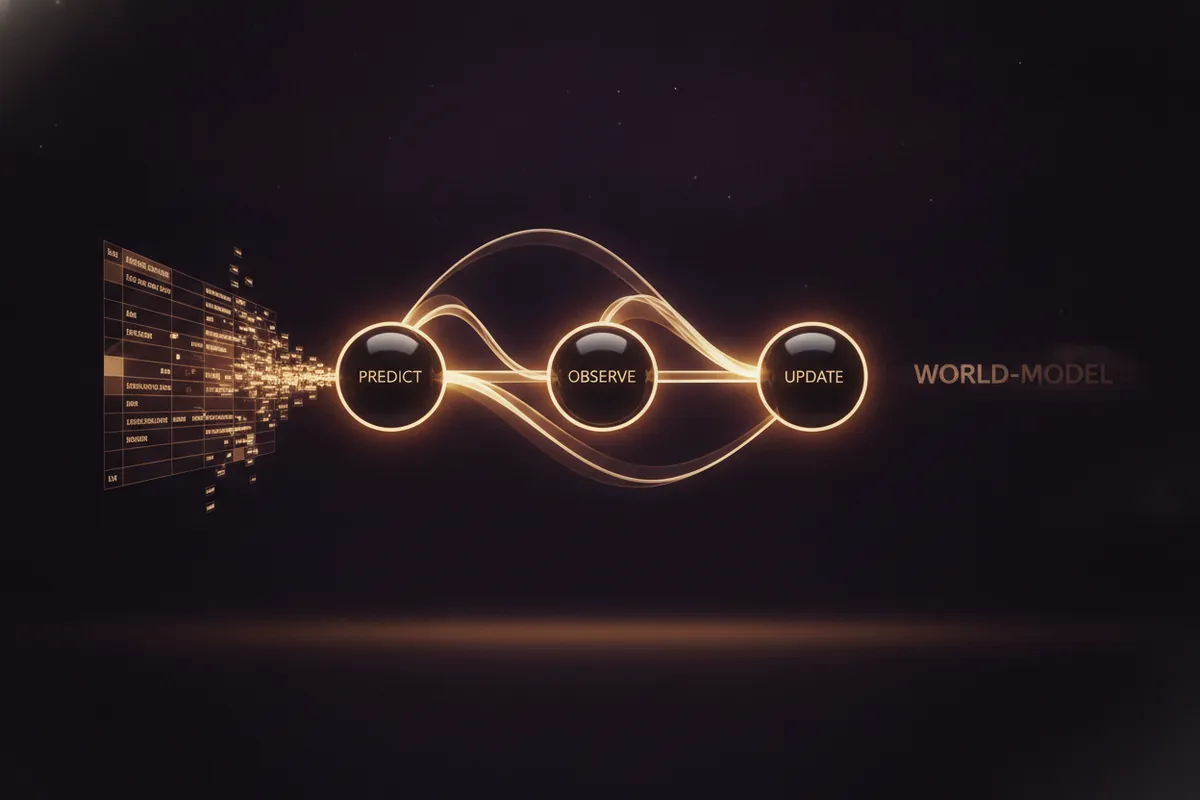
The outcome test is the mechanism, not the world model label
MIT's Devavrat Shah built a tabular-data model that tests predictions against real outcomes. The mechanism is the measured loop — Theorem 3 — not the world-model label.
→ →
A parameter is a knob only when something is measuring it
The knobs-and-dials metaphor for ML parameters breaks at a billion knobs. The guarantee lives in the measuring mechanism, not the parameter count. Theorem 3 applied.
→ →
Learning is the measured mechanism, not the credential
Da Vinci said learning never exhausts the mind. We read it as a measurement claim: a loop that renews never depletes, while a fixed catalog does. Theorem 3 makes it formal.
→ →Build your world on an engine that proves what it claims.
Create your own network on the engine that's run since 2016 — or talk to the team behind the 21 papers.