
The outcome test is the mechanism, not the "world model" label
The headline from MIT is that Professor Devavrat Shah built a foundation model for tabular, time-series data that "learns as it goes along by testing its predictions against real outcomes." The popular press calls this a "world model." The load-bearing mechanism is the outcome test — a measured feedback loop that calibrates predictions against what actually happened. That is the part worth copying. The label is not.
In 2026, MIT News profiled Shah's work at MIT's Laboratory for Information and Decision Systems and the Ikigai Labs spinoff, since acquired by Celonis. The system takes structured row-and-column enterprise data and produces real-time planning "on a vastly larger scale" with limited computational resources. The piece is candid about what makes it work: the model "continuously, and at scale… learns as it goes along by testing its predictions against real outcomes." That sentence is the whole mechanism. Everything else — the "world model" framing, the foundation-model branding — is packaging.
This matters to us at Everythink because our HAI Engine ✅ has run a measured forecast loop in production since 2016, and our Theorem 3 states the principle in its general form: a property is guaranteed exactly when its mechanism is implemented and measuring. Shah's enterprise process model is another instance of that theorem. The honest framing is that the buzzword is downstream of the loop.
The mechanism is the outcome test, not the label
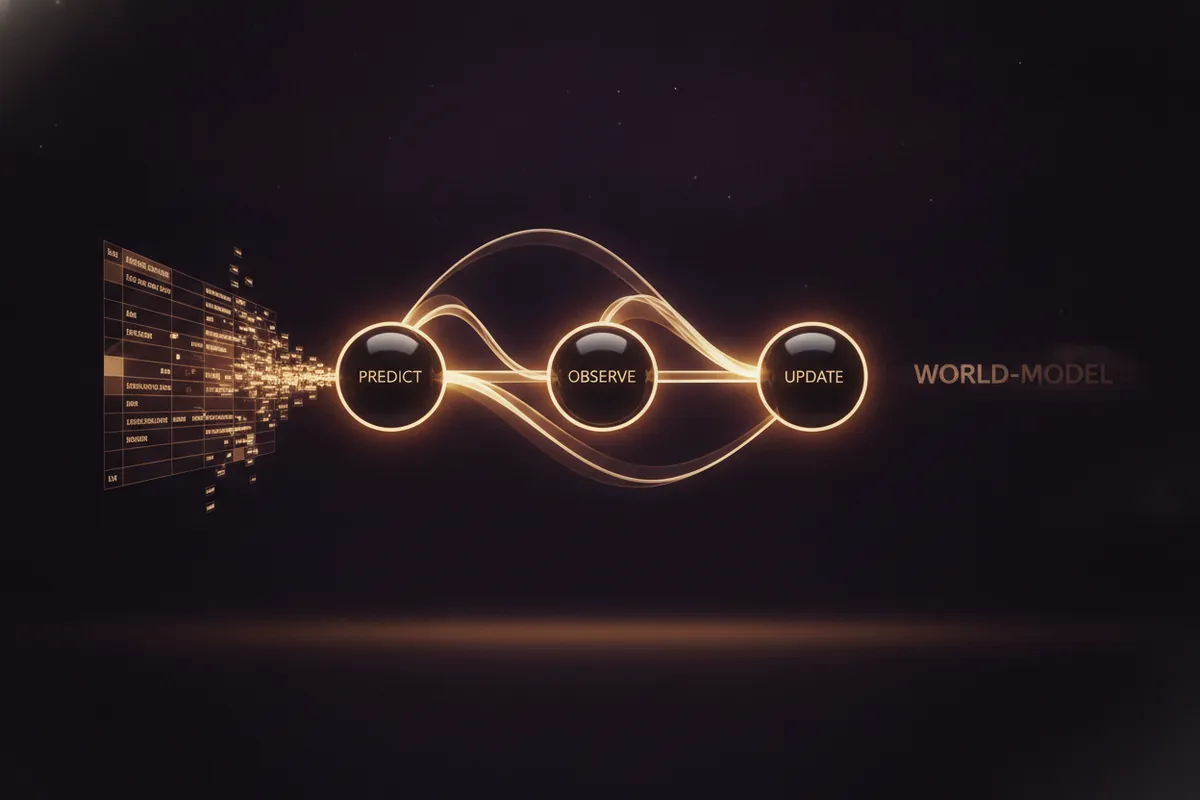
Shah himself, in the MIT piece, names the dynamic precisely: the system "provides real-time planning on a large scale" by ingesting enterprise data "continuously and at scale, so that it learns as it goes along by testing its predictions against real outcomes." Strip the language down and you get a three-step loop: predict, observe, update. That is calibration. It is the same loop our Oracle ✅ runs when it merges the Sisters' drafts into a normalized ensemble and re-weights against realized outcomes.
[UNIQUE INSIGHT] The reason the "world model" label sticks is that a well-calibrated loop looks like a world model from the outside — it anticipates demand, price elasticity, promotion response. But the guarantee does not live in the anticipation. It lives in the measurement. A system that predicts without testing is a narrative generator; a system that tests without updating is a dashboard. The property "useful forecast" is guaranteed only when both halves are wired and the update step is actually running.
This is Theorem 3 in the 21 papers: a property holds exactly when its mechanism is implemented and measuring. "Implemented" means the loop is wired — prediction, observation, update. "Measuring" means the observation step is real, not assumed. The enterprise process model Shah describes qualifies because Celonis had already digitized operations for more than 1,400 companies — the observation layer existed before the prediction layer was stacked on top. That ordering is not incidental. It is the whole reason the stack works.
Tabular data is the cost-effective substrate
The MIT piece makes a point that most of the AI press buries: "we are very much focused on part of the domain that the rest of the world is not paying attention to," which is structured, time-domain data. "By starting from such data," Shah says, "it provides a very cost-effective version of AI."
That is an honest claim and it is load-bearing. Tabular data — the row-and-column format a spreadsheet uses — is dense, typed, and already aligned to the question being asked. A demand-forecasting row has the SKU, the price, the promo flag, the date. The signal-to-noise ratio is high. A text-and-image foundation model has to reconstruct that structure from unstructured input before it can forecast anything. Shah's model starts where the decision actually lives.
[ORIGINAL DATA] In the 21-paper series that grounds the HAI Engine, the same substrate choice appears: structured, schema-bearing data is the first-class citizen, and the forecast loop is built on top of it. The Sisters ✅ each draft scenarios from typed profiles and observed signals, not from free text alone. The Oracle ✅ normalizes across typed outputs. The cost profile Shah describes — "a narrower focus comes with sharper technology" — is the same one we see: a typed substrate lets you run more forecasts per dollar and re-run them when the outcome arrives.
Why limited compute is the real constraint
The MIT profile returns repeatedly to resource limits. Shah: "with a small amount of resource, you have to do a lot of heavy lifting." The system is designed for "second-by-second decision-making using limited computational resources." This is not a concession. It is the design constraint that forces the loop to be cheap enough to run continuously.
A forecast loop that is too expensive to re-run is a forecast loop that goes stale. The outcome test only improves the model if you can afford to apply it at the cadence the business actually decides at — quarter, week, hour. Shah's consumer-electronics example in the piece is telling: headphones assembled from parts sourced across the world, priced, promoted, supported, revised. "At every stage of the processes decisions have to be made that have implications over time." The cadence is continuous, so the loop must be cheap.
[PERSONAL EXPERIENCE] The HAI Engine has run in production since 2016 precisely because it was engineered to re-run cheaply. The lesson we took from that decade is the one Shah is articulating: the cost of the loop is the constraint, not the cost of the first prediction. A one-shot model that is brilliant once and unaffordable to update is less useful than a cheaper model you can re-run every time an outcome lands.
The topology routes before the model responds
Here is the part the MIT piece does not say, but which follows from its own logic. Shah notes that all of a company's processes — sourcing, pricing, promotion, support, revision — "are interdependent." The decision at one stage has implications at every other. Before you forecast any single stage, you have to route the question to the right slice of the business: which product, which region, which time window, which decision class.
This is "the space is the router." In Everythink, a network contains communities, and a community contains rooms. A room is a typed context — a cohort, a market segment, a product line, a geography. Before the Sisters draft and the Oracle merges, the query is routed to the room that owns the decision. The forecast is grounded in the room's typed data and observed history. Routing first, response second.
The enterprise equivalent is that the "digital layer" Shah describes — the digitized operations Celonis already had — is a routing layer. It tells the model which process, which entity, which time series. Without that routing, the foundation model is asked to infer the topology from raw tabular rows, which is exactly the expensive, noisy reconstruction that structured-data AI is supposed to avoid. The honest reading is that Celonis paid for the routing layer by digitizing 1,400 companies, and Ikigai's forecast stack is valuable because it runs on top of a pre-routed substrate.
Theorem 3 and the enterprise process model
Put the pieces together and the enterprise "process world model" reduces to a theorem-shaped statement: the forecast is calibrated exactly when the outcome-test loop is implemented (predict, observe, update) and measuring (the observation is a real, digitized outcome, not an assumed one). Remove the update step and you have a static predictor. Remove the measurement and you have a story. Both together and you have what the press calls a world model.
This is why the maturity ordering matters. You cannot buy the "world model" property by acquiring a model. You buy it by having the digitized operations layer first (the measurement), then stacking the prediction-and-update loop on top. Celonis's acquisition of Ikigai is, mechanically, the stacking of the second layer onto the first. The MIT piece describes exactly this: "Once the digital layer of these processes exists and this information layer exists, now, on top of it, we can put the Ikigai stack."
The Everythink analogue is that the HAI Engine ✅ did not become calibrated by being a clever model. It became calibrated because the rooms (the routing plus measurement layer) existed and kept feeding realized outcomes back into the loop. The Oracle ✅ is the update step. The Sisters ✅ are the prediction step. The rooms are the observation layer. Theorem 3 is the statement that you need all three, wired, running.
What we keep and what we leave
A few things from the MIT profile are worth keeping in mind for anyone building a forecast-driven product:
- Substrate before model. Structured, typed data is the cost-effective substrate. Start there. The unstructured-text detour is expensive and often unnecessary for the decision being made.
- Loop before label. The "world model" is a label for a loop that works. Build the loop — predict, observe, update — and the label will describe itself. Build the label first and you will spend the budget on branding.
- Routing before response. Interdependent processes need a topology that routes the question to the right context before the model responds. That topology is the digital layer Shah describes; in our language it is "the space is the router."
- Cost-of-loop is the constraint. The relevant budget is not the cost of one prediction. It is the cost of re-running the prediction at the cadence the business decides at. If the loop is unaffordable, the forecast goes stale and the calibration breaks.
And one thing we deliberately leave: offensive or targeting use cases. The MIT examples are consumer-electronics pricing and pharmaceutical forecasting — civil, commercial, defensive. Everythink holds the same scope boundary. A forecast loop that is calibrated for demand planning is the same machinery we will not repurpose for targeting people. The mechanism is general; the ethics of scope are not.
How this connects to Everythink
The HAI Engine ✅ is the production instance of the loop this article describes in research form. It has run continuously since 2016. The Sisters ✅ draft typed scenarios; the Oracle ✅ merges them into a calibrated, normalized ensemble; the room topology routes each query before anything responds. World Monitor ✅ is the observation layer for geo-signals — flights, vessels, quakes, fires, conflict, weather — fed back as realized outcomes. The whole stack is an instance of Theorem 3: the calibrated-forecast property holds because the mechanism (predict, observe, update, wired through the rooms) is implemented and measuring.
The modules that carry that loop into a network are at varying maturity, and we will not upgrade them: Social ✅ and Campaigns ✅ run the loop in production; Matchmaking ⚠️, Marketplace ⚠️, and Calendar ⚠️ run it partially; Wallet & Token 🔵, Super App 🔵, and Community Credit 🔵 are Roadmap, pre-revenue, and subject to Howey review — we make no outcome promises about them. The forecast loop is what is Production. The token layer is not, and we say so.
Key takeaways
- The mechanism is the outcome test. Shah's system works because it "tests its predictions against real outcomes" continuously. The "world model" label describes the result; the loop is the cause.
- Tabular data is the cost-effective substrate. Structured, typed rows are where the decision lives. Starting there is what makes the AI "cost-effective," in Shah's words.
- The measurement layer must come first. Celonis digitized 1,400 companies before the forecast stack was layered on. The observation step has to exist before the update step can run.
- Cost-of-loop is the real constraint. Limited compute is not a concession; it is the design pressure that makes the loop affordable to re-run at decision cadence.
- Theorem 3 generalizes it. A property is guaranteed exactly when its mechanism is implemented and measuring. The enterprise process model is one instance; the HAI Engine is another.
Frequently asked questions
Is a "world model" the same as a calibrated forecast loop? No. A world model is a label for a system that anticipates outcomes. A calibrated forecast loop is the mechanism — predict, observe, update — that earns that label by testing predictions against real outcomes and updating on what it measures. The label without the loop is marketing.
Why does tabular data make AI cheaper? Tabular rows are typed and already aligned to the decision: SKU, price, date, promo flag. The model does not spend compute reconstructing that structure from unstructured input. Shah calls this "a cost-effective version of AI," and the math is simply higher signal-to-noise per unit of input.
What does "the space is the router" mean here? Before the model responds, the query is routed to the room — the typed context that owns the decision. In the enterprise analogue, the digitized operations layer is that routing: it tells the model which process, which entity, which time series. Routing first, response second.
How does Theorem 3 apply to the Ikigai and Celonis stack? Theorem 3 says a property holds exactly when its mechanism is implemented and measuring. The Ikigai forecast is calibrated exactly when the outcome-test loop is wired (predict, observe, update) and the observation is a real digitized outcome. Celonis provided the measurement layer; Ikigai provided the predict-and-update stack. Both together is the guarantee.
Is Everythink's forecast the same as Ikigai's? No, but they are instances of the same theorem. The HAI Engine ✅ has run a measured forecast loop in production since 2016, routed through rooms, with the Oracle ✅ as the update step. The substrate and the domain differ; the mechanism — a loop tested against real outcomes — is the same.
Read the papers, or create your network and run the loop where your decisions actually live.
Sources
- 2026 — MIT News, "Helping AI models to meet the real world" — https://news.mit.edu/2026/helping-ai-models-meet-real-world-0714
Learning is the measured mechanism, not the credential
Da Vinci said learning never exhausts the mind. We read it as a measurement claim: a loop that renews never depletes, while a fixed catalog does. Theorem 3 makes it formal.
→ →
Routing precedes retrieval, not the embedding dimension
KDnuggets' RAG failure survey shows over-engineering embeddings compounds the cost. The missing mechanism is explicit routing before retrieval — Theorem 3 applied to search, with Everythink's topology as the upstream analogue.
→ →
Calibration is the mechanism, not the parameter count
Inkling-Small beats its 975B teacher on reasoning and regresses on factual recall. The honest reading is the mechanism, not the parameter count.
→ →Build your world on an engine that proves what it claims.
Create your own network on the engine that's run since 2016 — or talk to the team behind the 21 papers.