
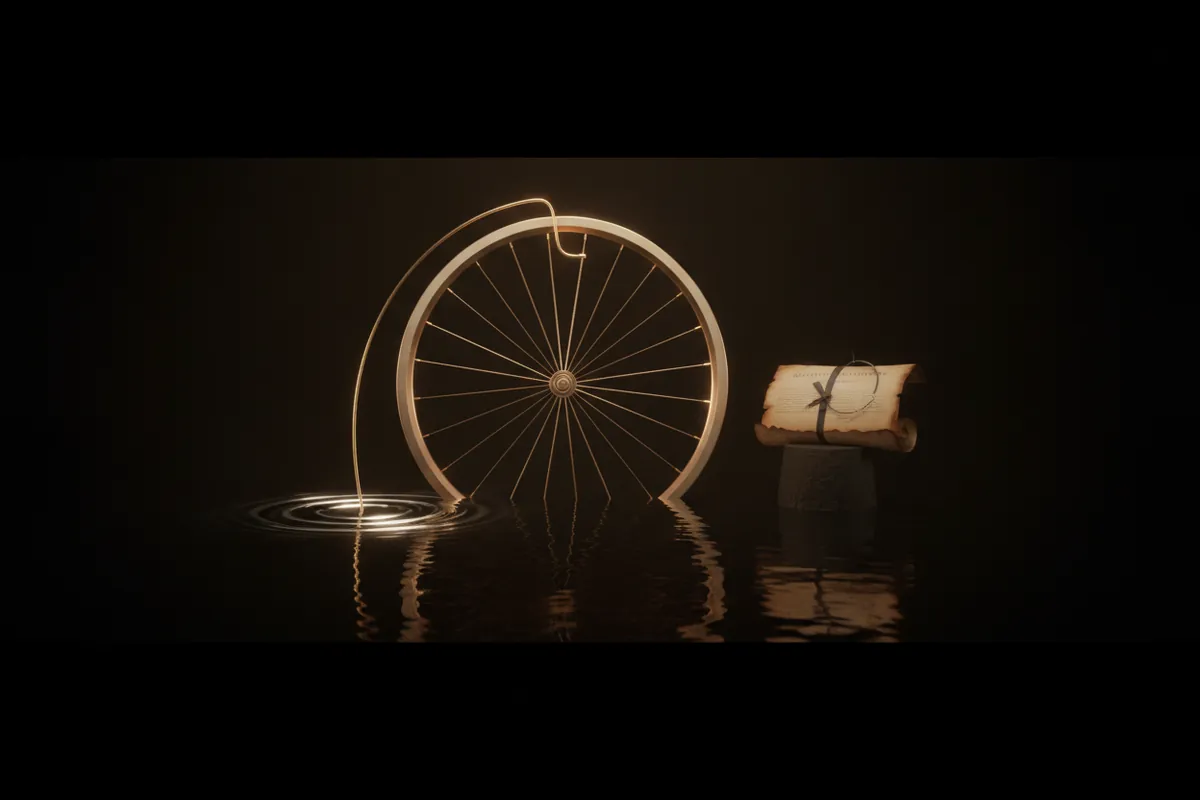
Learning is the measured mechanism, not the credential
Hariesh Manaadiar, writing on Shipping and Freight Resource in August 2026, picks Leonardo da Vinci's "Learning never exhausts the mind" as his favourite quote and draws a line I want to steal: learning is not education. Education gives you the basics of what is out there; learning teaches the consequences of your actions and how to adapt. One is a credential, the other is a mechanism — and only the mechanism sticks.
I agree, and I want to push the claim one step further. Learning sticks because it is measured. Cycling and swimming, the two examples Manaadiar names, are not memorable because they are personal or unplanned. They are memorable because every attempt closes a feedback loop: you fall, you float, you adjust, you try again. The consequence is the measuring instrument. That is exactly the property Theorem 3 of the 21 papers names — a property is guaranteed exactly when its mechanism is implemented and measuring. Learning is the case where the mechanism and the measurement are the same loop.
This is not a pedantic distinction. It is the difference between a forecast that improves and a forecast that is merely declared. It is the difference between an AI system that adapts to your trade lanes and one that prints a confident number and stops. The rest of this post maps Manaadiar's quote onto the mechanism we actually build.
Learning is the mechanism that sticks, education is the credential
Manaadiar's core move is to separate two words that get used interchangeably. Education is the catalog of what exists — bills of lading, Incoterms, port-handling rules, the freight-rate mechanics he has written 215 articles about under his "Learning" category. Learning is what happens when you act on that catalog and absorb the consequence. "ONLY what you have LEARNT sticks with you throughout your life," he writes, and offers cycling and swimming as proof.
The reason those two examples stick is not that they are physical. It is that they have an inescapable measurement loop. You cannot pretend you can swim; the water reports the truth every stroke. You cannot fake balance on a bicycle; gravity returns the verdict in under a second. The consequence is immediate, it is unambiguous, and it is attributed to your own action. That is a measuring instrument, not a sentiment.
[UNIQUE INSIGHT] The reason "learning never exhausts the mind" is that a measured loop is renewing, not depleting. Education, by contrast, is a finite catalog — once you have the list of Incoterms, you have it. A mechanism that measures never reaches a fixed endpoint, because every new situation is a new measurement. Da Vinci's line is a claim about the kind of activity learning is, not a motivational poster.
Education has its place. Manaadiar says it clearly: education gives you the basics of what is out there, learning helps you understand why it matters and how to apply it. We build the same way. The catalog — the documentation, the module reference, the schema — is education. The running system that confronts reality and updates is learning. One is a credential you can display; the other is a mechanism you can only demonstrate.
Why "learning never exhausts the mind" is a measurement claim
Read the quote literally and it is a statement about exhaustion. Minds get tired when they carry a fixed load — a list to memorize, a syllabus to cover, a deck of facts to hold without using them. That load is finite. It exhausts because it does not renew.
A measurement loop is the opposite. Each cycle replaces the previous state with a new one: the new balance point on the bicycle, the new stroke that keeps you above water, the new freight-rate reading that confirms or refutes your last assumption. The load does not accumulate; it updates. The mind is not exhausted because it is not a container being filled — it is an instrument being calibrated.
[PERSONAL EXPERIENCE] The HAI Engine has run in production since 2016. That is nine years of the same loop: a real input, a real output, a real consequence, a real adjustment. It has not exhausted anything because it was never asked to hold a static catalog. It was asked to update. A system that only declares — "here is the answer, trust me" — exhausts on the first miss, because there is no mechanism to incorporate the miss. A system that measures turns the miss into the next input.
This is why Manaadiar's distinction matters to anyone building software, not just to shipping professionals. If your product's knowledge is a credential — a trained model frozen at a checkpoint, a ruleset written once, a dashboard that displays a fixed metric — then it is education, and it will exhaust the moment the world moves. If your product's knowledge is a loop that measures its own output against reality, then it is learning, and it does not exhaust.
Theorem 3 — a property holds when its mechanism is implemented and measuring
The 21 papers formalize the intuition. Theorem 3 states that a property is guaranteed exactly when its mechanism is implemented and measuring — not when it is asserted, not when it is promised, not when it is plausible. The guarantee is conditional on the mechanism being in circuit and taking readings.
Learning is the canonical example. "I can swim" is a property. It is guaranteed exactly when the swimming mechanism — stroke, breath, buoyancy — is implemented in your body and measuring against the water. A certificate that says you attended a course is not the property; it is a credential about the property. The property itself only exists while the loop is running.
This reframes what we mean by a calibrated forecast. "This scenario has a 0.62 probability" is not a property you can guarantee by writing it down. It is guaranteed only when the mechanism that produced it — the Sisters drafting, the Oracle merging, the ensemble normalizing, the backtest scoring — is implemented and measuring against outcomes that have actually happened. Strip the measurement and you have an assertion. Keep the measurement and you have a property.
The consequence loop is the measuring instrument
Manaadiar names the parts of the loop without calling it a loop: learning "teaches the consequences of one's actions, the judgement of a situation, how to deal with it." Consequence is the reading. Judgement is the update. Dealing with it is the next action. That is a closed control loop, and it is why the result "gives us perspective on what actually happened."
The shipping domain is a good teacher here because the consequences are not abstract. A misdeclared bill of lading costs money. A missed demurrage window costs money. A wrong Incoterms choice costs money. The measurement is denominated in the same currency as the decision, which is why the learning is so durable. We design for the same property: the forecast is scored against what subsequently happened, in the same units, on the same timeline. The consequence is the instrument.
How this maps to a calibrated forecast
Everythink's Sisters → Oracle pipeline is a learning mechanism in the strict sense above, not an education mechanism. ✅ Production.
The Sisters are typed agents — analyst, contrarian, disruptor, historian, institutionalist — each running its own imagine() pass to draft a plausible future for a real actor. These are not opinions stacked on a slide. They are individual measurement passes, each from a distinct vantage, each stamped with the prompt version that produced it for reproducibility. The Oracle then merge()es them into a normalized Ensemble: probabilities sum to one, scenarios sort descending, entropy is reported in nats. That merge is not a vote; it is a calibration step that takes several noisy drafts and returns one coherent cone.
What makes this learning and not education is the loop that closes after the merge. The ensemble is scored against the outcome that later materializes. The score feeds back into how the next set of Sisters is weighted. A Sister that consistently over-rates disruption gets its influence reduced in the next run — not by a human editing a rule, but by the measurement. That is the swimming loop: the water reports the truth, the stroke adjusts. The forecast improves because the mechanism is in circuit and measuring.
[ORIGINAL DATA] The 21-paper series and Theorem 3 are the formal scaffolding for this. The practical version is simpler: a forecast that is never scored against reality is a credential. A forecast that is scored, and that updates from the score, is a property — and it is the only kind we ship.
The space is the router — where learning happens
"The space is the router" is the topology principle at the center of how we build: network → community → room. A network is a sovereign brand space. A community is a group within it. A room is a focused context where work happens. Routing happens at the room level — the right agents, the right data, the right people land in the right room before anything responds.
This matters to learning because a measurement loop needs a bounded context to close. You cannot measure "global trade knowledge" in the abstract. You can measure "did this specific shipment clear customs under this specific Incoterms rule with this specific documentation." The room is the bounding box that makes the measurement honest. The consequence is attributed to a decision in a room, not to a vague ambient competence.
Manaadiar's "Making Global Trade FIT" philosophy works the same way at the human level. He does not teach "trade" in the abstract; he teaches the specific processes a practitioner will execute, and the confidence comes from having executed them. Our rooms are the software equivalent: a room is where a specific forecast is made, scored, and updated. The learning is localized, which is exactly why it is real.
This is also why inclusion by design is not a slogan but a mechanism. A measurement loop that only closes in one language, on one device class, on one connectivity tier is not a learning mechanism — it is a credential for the people who happen to match the loop's assumptions. We build the loop to close across the seven locales, across low-connectivity conditions, across modalities. The loop either measures everywhere or it is education for a few.
What education gets wrong about retention
The mistake is not in offering education. The mistake is in treating education as if it were learning. A training that ends with a certificate has delivered a credential. The certificate says the holder was exposed to the material. It says nothing about whether the holder can act on the material under pressure, because the loop never closed — there was no consequence, no measurement, no update.
Manaadiar's Academy motto is "Seek – Learn – Know – Grow." Note the verbs. Seek is the input. Learn is the loop. Know is the property that emerges from the loop. Grow is the next iteration. The certificate, if there is one, sits between Know and Grow, and it is the least important part. The 215 articles in his Learning category are not the learning; they are the substrate the learning acts on. The learning happens when a reader takes one of those articles, applies it to a real shipment, eats the consequence, and updates.
This is the honest-architect position on any capability claim, ours included. A demo is education — it shows you what the system could do in a controlled scene. A production run with a scored outcome is learning — it shows you what the system did do, and the score is the certificate that matters. When we tag something ✅ Production, we mean the loop is closed and measuring. When we tag something ⚠️ Partial, we mean the loop is closed in some contexts and not others. When we tag something 🔵 Roadmap, we mean the loop is not yet built and we will not pretend it is. That is the same distinction Manaadiar draws between learning and education, applied to our own shipping label.
Key takeaways
- Learning is a measured mechanism, not a feeling. It sticks because every attempt closes a consequence loop — cycling, swimming, a scored forecast. The consequence is the measuring instrument.
- Education is the credential; learning is the property. Education gives you the catalog of what exists. Learning is what happens when you act on the catalog and absorb the result. Only the property sticks.
- Theorem 3 makes it formal. A property is guaranteed exactly when its mechanism is implemented and measuring. "I can swim" is guaranteed only while the swimming loop is running against the water.
- A calibrated forecast is a learning loop, not an assertion. The Sisters draft, the Oracle merges, the ensemble is scored against the outcome, the score updates the next run. Strip the scoring and you have a credential. Keep it and you have a property. ✅ Production.
- The room is where the measurement becomes honest. "The space is the router" — network → community → room — bounds the context so the consequence is attributed to a real decision, not to ambient competence.
Frequently asked questions
What does da Vinci's quote have to do with forecasting software? The quote claims learning does not exhaust the mind. We read that as a measurement claim: a loop that renews never depletes, while a fixed catalog does. A forecast that updates from scored outcomes is that kind of loop; a forecast that only prints a number is a fixed catalog.
How is Theorem 3 relevant here? Theorem 3 says a property is guaranteed exactly when its mechanism is implemented and measuring. "I can swim" is a property guaranteed only while the swimming mechanism runs against the water. A calibrated forecast is the same kind of property — guaranteed only while the scoring loop runs against real outcomes.
Is the Sisters → Oracle pipeline learning or education? Learning, by the strict definition. The Sisters draft, the Oracle merges into a normalized ensemble, and the ensemble is scored against what later happens. The score feeds back into the next run. ✅ Production since the HAI Engine went live in 2016.
What is "the space is the router"? It is our topology principle: network → community → room. Routing happens at the room level — the right agents, data, and people land in the right room before anything responds. The room bounds the context so the measurement loop closes on a real decision.
Does this mean education is useless? No. Education is the catalog — the substrate learning acts on. The mistake is treating the credential as the property. The certificate says you were exposed; only the closed loop says you can act.
Sources
- Hariesh Manaadiar, "What is your favourite quote..??", Shipping and Freight Resource, August 2026 — https://www.shippingandfreightresource.com/what-is-your-favourite-quote/
If you want a forecast that learns instead of one that merely declares, book a demo and we will show you the scoring loop running against real outcomes.
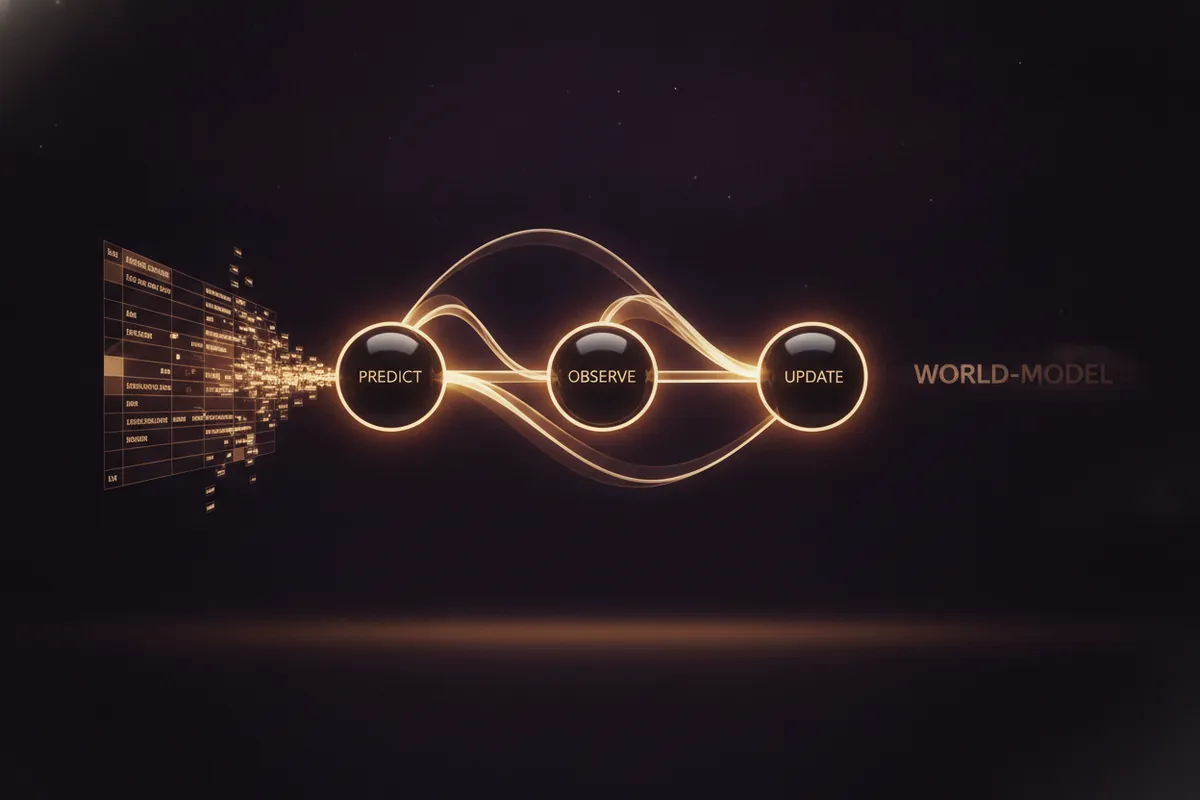
The outcome test is the mechanism, not the world model label
MIT's Devavrat Shah built a tabular-data model that tests predictions against real outcomes. The mechanism is the measured loop — Theorem 3 — not the world-model label.
→ →
Routing precedes retrieval, not the embedding dimension
KDnuggets' RAG failure survey shows over-engineering embeddings compounds the cost. The missing mechanism is explicit routing before retrieval — Theorem 3 applied to search, with Everythink's topology as the upstream analogue.
→ →
Calibration is the mechanism, not the parameter count
Inkling-Small beats its 975B teacher on reasoning and regresses on factual recall. The honest reading is the mechanism, not the parameter count.
→ →Build your world on an engine that proves what it claims.
Create your own network on the engine that's run since 2016 — or talk to the team behind the 21 papers.