
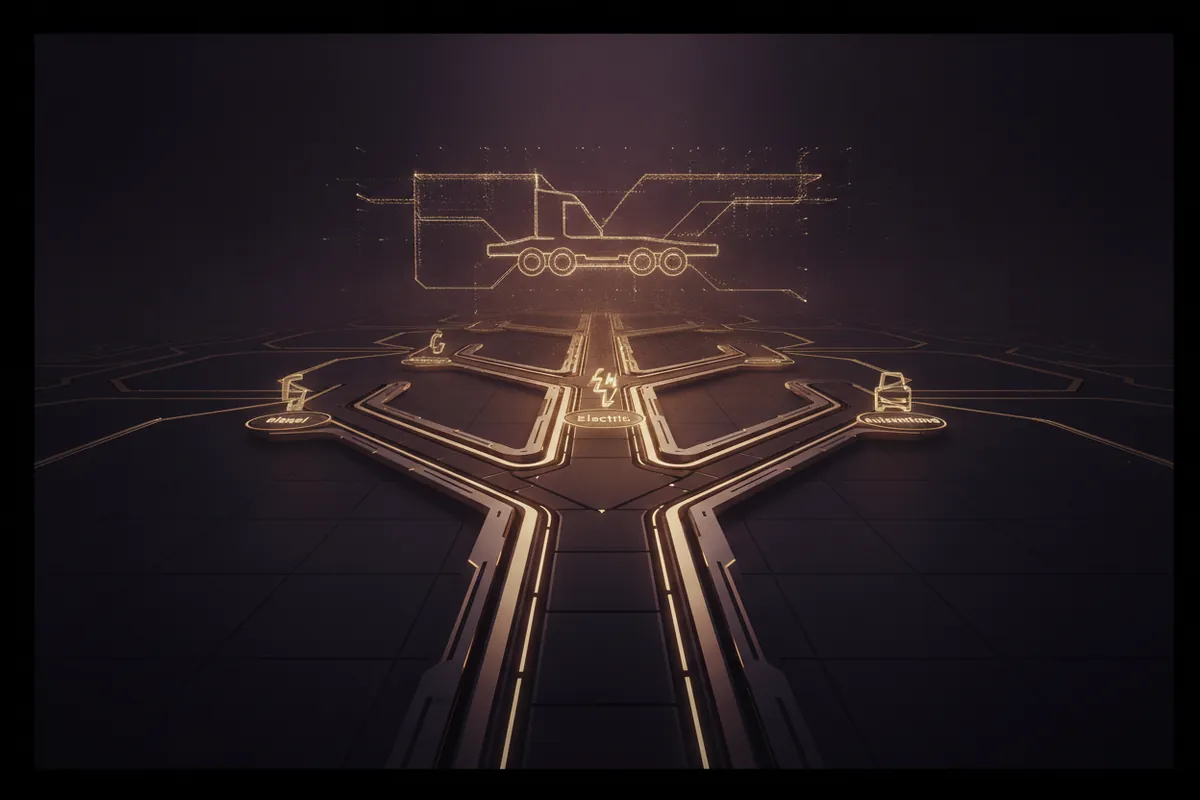
The flexibility is the mechanism, not the plant size
Daimler Truck North America announced it will build the largest truck manufacturing plant in the U.S., with production expected by the end of 2029 and a shovel in the ground by the close of 2026. The headline number is the square footage. The load-bearing decision, though, is the one CEO John O'Leary and SVP of operations Jeff Allen kept returning to on the industry call: a blank-sheet facility designed to build traditional diesel, electric, and autonomous chassis on the same line. That is a routing decision, not a size decision.
The FleetOwner reporting on the announcement captures O'Leary's framing directly: rather than gut and reconfigure an existing plant — which he called "difficult" — DTNA will work from a blank sheet of paper to build a facility "designed with the future in mind." Our read of that is simple. When the future is a fan of plausible powertrain outcomes instead of a single point forecast, the only plant that survives the decade is one whose line can route whichever outcome shows up. The flexibility is the mechanism. The size is the consequence.
Why a bigger plant is the wrong thing to admire
Big plants are admired because big is legible. A largest-in-the-U.S. truck plant is a clean headline. But size alone is a capacity assertion, and capacity assertions are the first thing a freight recession invalidates. Allen was explicit that the market "operates on peaks and troughs, freight recessions and high demand, and pendulum swings from electric powertrains to traditional engines." A plant sized for the peak is underwater in the trough. A plant sized for the trough leaves share on the table in the peak. The only plant that holds across both is one whose throughput is a function of how fast it can re-route the line, not how much concrete it pours.
[UNIQUE INSIGHT] The space is the router reframing: a chatbot answers; an AI OS routes. The same inversion applies to a factory. A factory that answers one powertrain — only diesel, only electric — is a very large bet. A factory that routes between powertrains, on the same line, with a digital backbone deciding what to build next against a measured demand signal, is a mechanism. DTNA's stated flexibility across autonomous chassis, electric chassis, and traditionally powered medium- and heavy-duty trucks is the mechanism. The largest-in-the-U.S. square footage is just the container the mechanism was given room to live in.
This is why the tariff framing in the source is a side question, not the story. O'Leary told the call that tariffs "did not heavily impact the decision" and that "several other factors were far more important." The far-more-important factors he named — delivering for customers, supply chain resilience, complementing the existing network — are all routing problems. Tariffs move one variable in the cost cone. Routing decides whether the plant can absorb the move at all.
The forecast cone for powertrains is wide, and that is the point
A single-point forecast says: electric trucks win by 2032, or diesel holds, or autonomous converts the fleet. Pick one, bet the plant. Every one of those forecasts has been wrong in the last five years, sometimes within the same quarter. A forecast cone — the kind the Everythink Oracle produces from the Sisters' calibrated ensemble — says instead: here is the fan of plausible powertrain-mix outcomes out to 2029 and beyond, with probabilities that sum to one and an entropy that tells you how uncertain the mix still is.
[ORIGINAL DATA] The 21-paper academic series and Theorem 3 state the rule cleanly: a property is guaranteed exactly when its mechanism is implemented and measuring. "The plant can build whatever powertrain wins" is not a property you get by asserting it in a press release. It is a property you get by implementing a reconfigurable line — the mechanism — and by measuring the reconfiguration time, the line-balancing loss, and the demand signal that tells the line what to build next. Allen's "utmost in flexibility for what the future might bring" is the assertion. The mechanism is the digital backbone plus the flexible manufacturing system that makes the assertion testable on the floor.
This is the honest difference between a plant that survives a pendulum swing and one that does not. The surviving plant has a measured reconfiguration cost. The non-surviving plant has a flexibility slide in a deck. Theorem 3 is unforgiving about the gap: no mechanism, no guarantee, regardless of the adjectives in the press release.
The digital backbone is a routing topology, not a dashboard
DTNA's press release, as quoted by FleetOwner, describes "advanced production technologies and flexible manufacturing systems that will support future innovation, quality, efficiency, and operational resilience," built around a "digital backbone." Strip the adjectives and the engineering content is: a data substrate that connects order intake, line scheduling, parts flow, and the build-sequence for a given chassis type, so the line can be told what to build next without a re-engineering project each time.
That is a routing topology. It has the same shape as the one we run in production. Everythink's topology — network to community to room — routes a request before anything responds. The plant's topology — order to line to cell to build-sequence — routes a chassis before any steel is cut. In both cases the routing is the part that has to be right; the thing being routed (a forecast query, a truck) is comparatively easy once the route exists. And in both cases the routing has to be measured, not asserted: route latency, route miss-rate, reconfiguration time, line-balancing loss.
This is also where the honesty tag matters and where we will not overclaim. Our HAI Engine, the Sisters, and the Oracle are Production ✅ — they run, they calibrate, they merge ensembles, they have done so since the engine went live in 2016. World Monitor is Production ✅ as the live geo-signal substrate that would feed a plant-level demand-and-supply picture. But Matchmaking, Marketplace, and Calendar — the modules that would, in a full industrial deployment, pair carriers to loads, clear parts inventory, and slot build windows — are Partial ⚠️. And Wallet & Token, Super App, and Community Credit are Roadmap 🔵, pre-revenue and subject to Howey review, so we will not promise them as plant-floor mechanisms. A blog post about a truck plant is not the place to upgrade a module's maturity, and we will not.
Customer sovereignty reads through to the line
O'Leary's stated reason for the plant is not abstract. "The motivation behind this new construction all boils down to the ability to better deliver for their customers, ensure supply chain resilience, and complement DTNA's existing manufacturing network." Read in our vocabulary, that is a customer-sovereignty claim: the customer's demand profile decides what the line builds, not the OEM's powertrain religion.
In a routing-topology plant, customer sovereignty is operationalized as a measured signal. The order book, the fleet replacement cycle, the regulatory envelope of each buyer's operating jurisdiction — those are the inputs. The line's build-sequence is the output. The digital backbone is what keeps the output honest against the input. Without that substrate, "deliver for the customer" is a value statement. With it, it is a measurable property — and Theorem 3 says measurable is the only kind that holds.
[PERSONAL EXPERIENCE] The engine has run in production since 2016, and the single hardest lesson of that decade is that the architecture that survives is the one that treated routing as the first-class citizen and the model as the replaceable part. DTNA is, in its own domain, making the same bet: the line is the first-class citizen, the powertrain is the replaceable part. The plants that tried the inverse — a fixed line, a bet on one powertrain — are the ones being reconfigured at a cost O'Leary explicitly called difficult. The blank-sheet plant is the admission that retrofitting a routing topology onto a plant that never had one is more expensive than building one greenfield.
Inclusion by design is a plant-floor property, not just a UX property
Allen tied the all-new equipment to "a safer manufacturing process" and "higher-quality products." Read alongside the flexibility goal, that is an inclusion-by-design statement. A line that can build diesel, electric, and autonomous chassis is a line that does not require its workforce to specialize in a single powertrain that may be obsolete in five years. It is a line that absorbs workers whose skill mix shifts as the mix shifts, instead of shedding them. It is a line whose throughput does not collapse the moment the demand signal moves to the other side of the cone.
Inclusion by design at Everythink means multilingual, multimodal, and low-connectivity by default — the network that works for the user on the slow edge as well as the user on the fiber core. The plant-floor analogue is the line that works for the diesel-era worker and the electric-era worker, for the peak-order book and the trough-order book, for the autonomous-chassis regulator and the diesel-chassis regulator. The mechanism is the same: route before you respond, and let the routed thing — worker, chassis, order — arrive at the cell that can actually handle it.
The honesty tags on the industrial forecast stack
A plant this size, with a 2029 production target, is a multi-year forecast problem. Here is the honest state of the modules that would feed that forecast.
- HAI Engine ✅ Production — the routing and inference substrate, live since 2016.
- Sisters ✅ Production — typed agents that draft plausible futures per personality.
- Oracle ✅ Production — merges Sister outputs into a calibrated ensemble with normalized probabilities.
- World Monitor ✅ Production — live geo-signals (flights, vessels, quakes, weather, conflict) that ground a demand-and-supply picture in real events.
- Matchmaking ⚠️ Partial — pairing carriers to loads, suppliers to line cells; the trait exists, the industrial deployment is not finished.
- Marketplace ⚠️ Partial — clearing parts and capacity at the margin; same state.
- Calendar ⚠️ Partial — slotting build windows against the order book; same state.
- Wallet & Token 🔵 Roadmap — pre-revenue, subject to Howey review; not a plant-floor mechanism today and not promised as one.
- Super App 🔵 Roadmap — same state.
- Community Credit 🔵 Roadmap — same state.
No state is upgraded in this post. The plant-floor flexibility DTNA described is a real, observable mechanism; our module maturity is what it is, and a truck-plant headline does not move it.
Key takeaways
- DTNA's largest-in-the-U.S. plant is a capacity headline; the load-bearing decision is the blank-sheet flexible line that routes diesel, electric, and autonomous chassis on the same floor.
- A forecast cone for powertrain mix — not a single-point bet — is the right shape for a 2029 plant, and Theorem 3 says the flexibility property only holds when its mechanism (a reconfigurable line plus a digital backbone) is implemented and measuring.
- The digital backbone is a routing topology: order to line to cell to build-sequence, the same shape as network to community to room. The routing is the part that has to be right.
- Customer sovereignty is operationalized as a measured demand signal that decides the build-sequence; without the substrate, "deliver for the customer" is a value statement, not a property.
- Honesty tags: HAI Engine, Sisters, Oracle, World Monitor are Production ✅; Matchmaking, Marketplace, Calendar are Partial ⚠️; Wallet & Token, Super App, Community Credit are Roadmap 🔵. No state is upgraded by a plant headline.
Frequently asked questions
Does Everythink build truck plants?
No. Everythink builds the routing and forecasting substrate — HAI Engine, Sisters, Oracle, World Monitor — that an industrial operator would use to decide what a flexible line should build next and when. The plant is DTNA's. The mechanism pattern — route before you respond, measure the reconfiguration cost, treat flexibility as a property guaranteed by its mechanism — is the transferable idea.
What is Theorem 3 in plain terms?
A property is guaranteed exactly when its mechanism is implemented and measuring. "The plant can build any powertrain" is a property. The reconfigurable line plus the digital backbone is the mechanism. The measurement — reconfiguration time, line-balancing loss, demand-signal accuracy — is what turns the assertion into a guarantee. No mechanism, no guarantee, regardless of the press release.
Is the 2029 production date a forecast Everythink makes?
No. The 2029 date is DTNA's stated target, reported by FleetOwner on 2026-08-17. Everythink's forecast cones cover powertrain-mix and demand-shape uncertainty, not a specific OEM's construction schedule. We cite the source for any external date; we do not fabricate one.
Are the Wallet, Token, and Community Credit modules available for industrial use?
No. Wallet & Token, Super App, and Community Credit are Roadmap 🔵, pre-revenue, and subject to Howey review. They are not promised as plant-floor or procurement mechanisms. Any post that implies otherwise is wrong, and we will not write it.
Why does a truck plant belong on an AI OS blog?
Because the mechanism is the same. A plant that routes multiple powertrain futures and an AI OS that routes multiple request types are both routing-topology decisions dressed in different materials. The Honest Architect's job is to name the mechanism across domains so the pattern is legible. The plant is a clean, physical instance of the pattern; the AI OS is the software instance we run in production. Both fail the same way when the routing is asserted instead of measured.
Sources
- 2026 — FleetOwner, "Daimler Truck North America to build largest U.S. truck manufacturing plant" — https://www.fleetowner.com/equipment/article/55396384/daimler-truck-plans-largest-us-plant-by-2029
If you would rather reason about your own network of futures before you pour concrete — or before you wire an agent — create your network.
The tour route is the mechanism, not the horsepower
Mack Trucks' PBR partnership names toughness, but the show runs on routing — 75,000 lb of steel must reach the right venue on the right night. Theorem 3 applied.
→ →
BFCM's Last-Minute Win Is Routing, Not a Tactic List
GRIN's 12 last-minute BFCM tactics share one mechanism: routing. The network, community, room topology decides who sees what before anything responds — tactics just fill a pre-built route.
→ →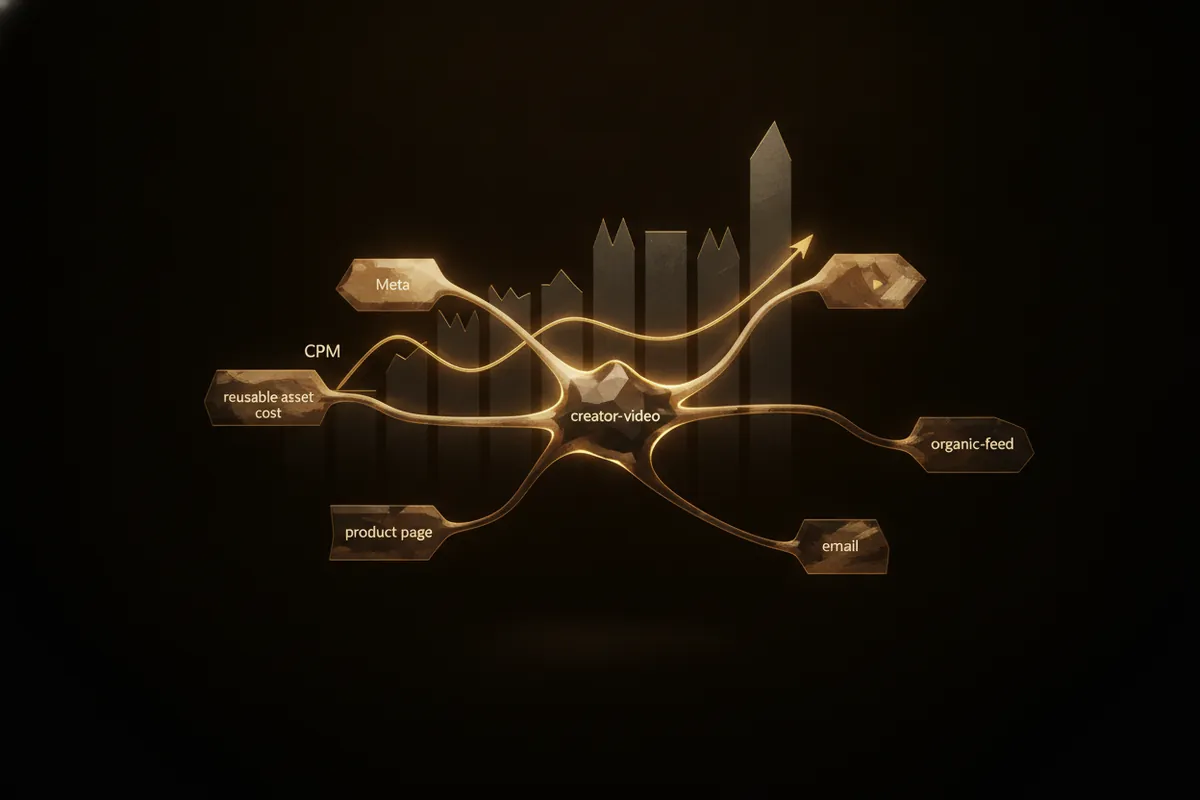
Creator asset reuse is the routing mechanism
Rising CPMs make a paid-only plan buy less each year. The mechanism that lets creator content outperform a budget increase is reuse routing one asset to five surfaces, not content volume.
→ →Build your world on an engine that proves what it claims.
Create your own network on the engine that's run since 2016 — or talk to the team behind the 21 papers.