
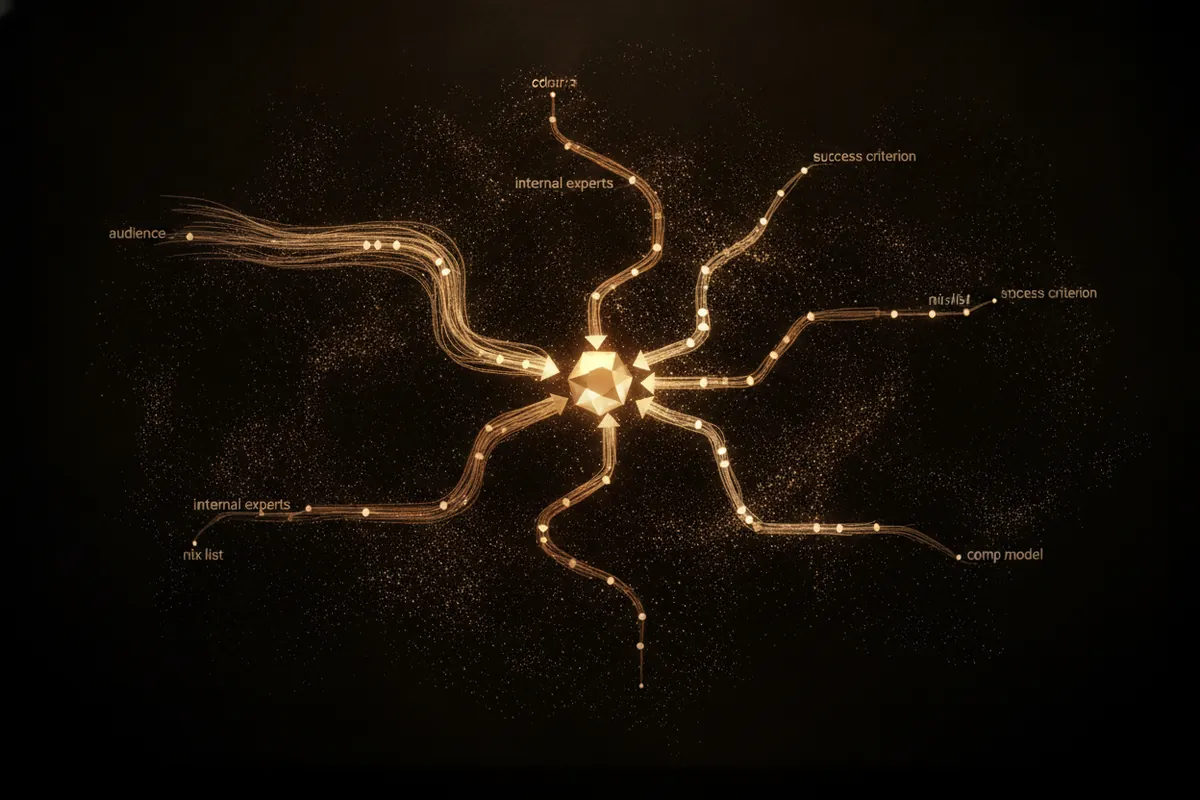
The brief is the routing mechanism, not the agency network
A B2B influencer marketing agency sells you its network, but the network is not what makes the program work. According to TopRank Marketing's 2026 B2B Influencer and Creator Marketing report, 86% of B2B brands are running or maturing an influencer program, yet only 46% rate theirs as very effective. The gap is not relationship scarcity. The gap is a routing topology the client owns, not the agency.
Why the agency's network underdelivers without your brief
The agency arrives with a Rolodex of creators it has placed before. That Rolodex is a substrate, not a route. A substrate becomes a route only when someone specifies the destination: which buyer, in which community, hearing which message, against which evidence. TopRank's own data makes the point sharply — the top challenge practitioners cite is "identifying, qualifying and connecting with the right influencers" at 41%, ahead of measurement (37%) and relationship management (33%). The hardest step is selection, and selection is a routing problem, not a sourcing problem.
This is the same shape we see at Everythink. "The space is the router": a network→community→room topology routes a request before anything responds. The agency's creator network is the network layer; your brief is the community and room layer. Hand the agency a network and no community definition and it routes to whoever is loudest — the B2C reflex TopRank warns against.
[UNIQUE INSIGHT] The agency is a substrate, not a route. The route is the routing constraints you bring: audience precision, internal expert inventory, the nix list, the compensation model, the success criterion. Without those, the agency's relationships route to the wrong buyers — and the 54% of programs that are not "very effective" are mostly paying for the substrate while leaving the route undefined.
The brief is a routing topology, written before the kickoff
Define the audience with more precision than feels comfortable
TopRank's advice is to push past "senior marketing leaders" toward "director-level demand-gen marketers at mid-market SaaS companies navigating budget scrutiny and attribution gaps." That is not copywriting advice. It is a routing specification. Each clause narrows the community the creator must reach: role, seniority, company stage, and the specific pain that makes them act. Drop any clause and the route widens until it routes to no one in particular.
In our terms, the audience definition is the community boundary. The agency's audience-research tools can tell you what that cohort reads and who they listen to, but only after you have bounded the cohort. A brief that says "demand-gen marketers" leaves the agency to guess the community; a brief that names the attribution-gap pain hands the agency a room it can route creators into.
Inventory your internal experts before the first call
TopRank identifies internal employees, executives, and subject-matter experts as underused assets, and folds them into its "Best Answer" Trust System: original research plus external influencer collaboration plus internal executive and employee voices. The mechanism is that internal voices co-create with external ones, so the external creator's credibility attaches to your house signal rather than dissipating after the post.
Mechanically, this is the network→community→room topology again. Your internal experts are the rooms inside your own community. An external creator who posts into a room where your own expert already speaks gets amplified by a second voice in the same room, and the room's audience can verify the claim against the expert they already follow. Without that internal room, the creator's post is a guest post in someone else's community — it lands, then it leaves.
Come to the kickoff with three to five internal people who are already quotable on social, comfortable representing the brand, and ideally building a following. The agency sharpens their positioning and weaves their perspectives into the content. You are not asking the agency to invent your authority; you are handing it rooms it can route creators through.
Build a wish list and a nix list
TopRank asks clients to document both sides: the creators you admire and the attributes that make them a fit, plus what you do not want — creators who have worked with direct competitors, topics or tones that conflict with your values, audience profiles that do not map to your buyer.
The nix list is the more load-bearing half. A positive list describes a destination; a nix list describes the constraint that keeps the route from drifting. In routing terms, the nix list is the set of edges the agency must not traverse. Without it, the agency optimizes for the closest fit in its existing network, which is often a competitor-adjacent creator with the right follower count. The 41% who cite "finding the right creators" as their top challenge are mostly missing the nix list, not the candidate pool.
Compensation is a routing signal, not a budget line
TopRank's 2026 survey finds 51% of B2B organizations pay creators a flat fee per deliverable and 48% use performance-based models. Best-in-class programs are more likely to use credibility- and reach-based compensation (47% vs 30% of less effective programs) and performance-based pay (56% vs 41%).
Read that as a routing signal, not a procurement line item. Flat-fee-per- deliverable tells the creator "produce the artifact"; performance-based pay tells the creator "move the buyer." Credibility- and reach-based compensation tells the creator "the route that matters is the one where your audience trusts you on this topic." The best-in-class programs are not spending more — they are encoding the route they want the creator to take into the comp structure.
[PERSONAL EXPERIENCE] We have run the HAI Engine in production since 2016, and the lesson is the same: incentives are routing constraints. The Sisters do not produce better forecasts because we ask them to; they produce better forecasts because the Oracle's ensemble math rewards the Sisters whose scenarios calibrate against outcome. Pay a creator on a metric you cannot measure and you have paid for a substrate with no route.
The success criterion is the mechanism that gets measured
TopRank reports that B2B influencer programs now deliver across a wider range of outcomes than marketers expect — beyond top-of-funnel awareness into LLM visibility and down-funnel results — and that programs which intertwine influencer activity with paid media, AI search optimization, and sales enablement outperform siloed ones.
The unifying mechanism is that the success criterion is decided before the program launches, and the program is wired so that criterion can be measured. "Brand awareness" is a goal, not a mechanism. "Citations of our expert in buyer-side LLM answers, counted weekly" is a mechanism: it names the route (buyer asks an LLM, LLM cites a source, source is our expert) and the measurement (count the citations).
This is Theorem 3 in our 21-paper series: a property is guaranteed exactly when its mechanism is implemented and measuring. Awareness is not guaranteed by spending on creators; it is guaranteed when the citation route is implemented (the expert is publishable, cited, indexable) and measuring (the citation count is tracked). TopRank's finding that 86% of B2B marketers say improving visibility in generative AI tools will be important this year is the same finding — the route that matters now runs through the LLM, and the LLM cites the trusted expert voice, which is the same voice the human buyer cites.
AI visibility is a routing problem, not a search problem
TopRank cites Semrush data that 92% of B2B buyers say AI shapes their vendor shortlist. The implication TopRank draws — that the trusted expert voices influencing human buyers are often the same ones cited by AI systems — is a routing claim, not a coincidence. The LLM is a router: it routes a buyer query to the source it can verify and attribute. A creator program that puts your expert's name on a verifiable, indexable claim builds the route the LLM will take; one that buys a post on a closed platform with no citable artifact builds a route the LLM cannot take.
The World Monitor ✅ and HAI Engine ✅ we run at Everythink are built on the same insight: the source that gets cited is the source whose provenance is machine-checkable. A B2B creator program that wants AI visibility has to produce citable artifacts, not just impressions.
Why 54% of programs are not "very effective"
The 46% "very effective" number in TopRank's report is the headline; the mechanism behind it is more useful. The programs that work are the ones where the client brought the routing topology and the agency populated it with creators. The programs that do not work are the ones where the client bought the network and left the topology undefined.
This is why "finding the right creators" (41%) outranks "measuring results" (37%). Sourcing creators is the part the agency can do for you; defining the route the creators must take is the part only you can do. Outsourcing the route leaves the agency to guess toward its own network's strengths — rational on its part, ineffective on yours.
[ORIGINAL DATA] The 21-paper series formalizes this as the separation between the substrate (the network of creators available) and the route (the topology that decides which creator responds to which buyer). Theorem 3 says the property you want — effective creator-audience fit — is guaranteed only when the routing mechanism is implemented and measuring. The agency can supply the substrate. Only the client can supply the route.
What to bring to the kickoff, concretely
Before the first agency call, bring five things:
- An audience definition narrow enough to feel uncomfortable. Role, seniority, company stage, and the specific pain that triggers a buying conversation. This is the community boundary.
- Three to five internal experts who are quotable on social and comfortable representing the brand. These are the rooms the agency can route creators through.
- A wish list and a nix list. The wish list names the destination; the nix list names the edges the route must not traverse. The nix list saves the most back-and-forth.
- A budget range separate from agency fees, and a comp model. Decide whether you are paying for deliverables, performance, or credibility. The comp model is the routing signal you send the creator.
- A success criterion you can measure. Not "awareness" — a countable route, like "expert cited in buyer-side LLM answers, weekly."
Bring those five and the agency's network becomes a route. Bring none and you have bought a Rolodex.
What Everythink builds on the same principle
Everythink is built on the same separation. The HAI Engine ✅ has run in production since 2016. The Sisters ✅ draft plausible futures for real-world actors; the Oracle ✅ merges them into a calibrated ensemble. The World Monitor ✅ routes live geo-signals through a network→community→room topology so a client only receives deltas for its viewport tiles. Social ✅, Campaigns ✅, and Whitelabel Network ✅ are the production modules a brand uses to run its own creator and community programs on the same routing substrate. Matchmaking ⚠️, Marketplace ⚠️, and Calendar ⚠️ are Partial. Wallet & Token 🔵, Super App 🔵, and Community Credit 🔵 are Roadmap, pre-revenue, subject to Howey review; we do not promise outcomes from them.
The principle is the same one TopRank is gesturing at: the network is the substrate, the brief is the route, and the route is the client's to define. Customer sovereignty means your network, your brand, your data, your routing constraints — not the agency's. The agency is a fine shortcut to a populated network. It is a poor substitute for a defined route.
Key takeaways
- The agency's network is a substrate, not a route. 86% of B2B brands are in the influence game and only 46% are very effective because most buy the substrate and leave the route undefined.
- The brief is the routing topology. Audience precision, internal experts, the nix list, the comp model, and the success criterion are the network→community→room constraints that make the agency's creators route to the right buyers.
- Compensation is a routing signal. Best-in-class programs pay on credibility and performance (47% vs 30%, 56% vs 41%) because the comp model tells the creator which route to take.
- AI visibility is a routing problem. 92% of B2B buyers say AI shapes their shortlist; the LLM cites the trusted, verifiable expert voice, so the creator program must produce citable artifacts, not just impressions.
- Theorem 3 applies. Effective creator-audience fit is guaranteed only when the routing mechanism is implemented and measuring. The agency can supply the substrate; only the client can supply the route.
Frequently asked questions
Doesn't the agency's network matter at all? It matters as a substrate. A populated network gets you to a creator shortlist faster than cold outreach — which is why 41% of practitioners cite "finding the right creators" as their top challenge and agencies exist to solve it. But the network only routes correctly once the client's brief bounds the community and the room. A great network with a vague brief routes to the loudest creator, not the right one.
How precise should the audience definition be? Precise enough to feel uncomfortable. "Senior marketing leaders" is a starting point; "director-level demand-gen marketers at mid-market SaaS companies navigating budget scrutiny and attribution gaps" is a routing specification. Each clause you drop widens the route until it routes to no one in particular.
Why is the nix list more load-bearing than the wish list? The wish list describes a destination. The nix list describes the constraint that keeps the route from drifting toward the agency's easiest placement — often a competitor-adjacent creator with the right follower count. Without it, the agency optimizes for the closest fit in its existing network, which is rational for the agency and ineffective for you.
Is performance-based pay always better than flat-fee? Not always — it depends on the route you want the creator to take. Flat-fee-per-deliverable says "produce the artifact"; performance-based pay says "move the buyer." The best-in-class programs in TopRank's 2026 survey use both, weighted toward the route that matters for the goal. The comp model is a routing signal, not a procurement decision.
How does this connect to AI visibility? The LLM is a router. It routes a buyer query to the source it can verify and attribute. A creator program that puts your expert's name on a verifiable, indexable claim builds the route the LLM will take. A program that buys a post on a closed platform with no citable artifact builds a route the LLM cannot take.
If you are preparing a brief for a B2B influencer agency — or building the routing topology for your own creator program — the substrate is the easy part. The route decides whether the program lands in the 46% or the 54%. Create your network and define the route yourself.
Sources
- 2026, TopRank Marketing, "How to Best Work with a B2B Influencer and Creator Marketing Agency" — https://www.toprankmarketing.com/blog/work-with-b2b-influencer-marketing-agency/
- 2026, Semrush, "How AI Shapes B2B Buying" (cited in TopRank for the 92% figure) — https://www.semrush.com/blog/how-ai-shapes-b2b-buying/

BFCM's Last-Minute Win Is Routing, Not a Tactic List
GRIN's 12 last-minute BFCM tactics share one mechanism: routing. The network, community, room topology decides who sees what before anything responds — tactics just fill a pre-built route.
→ →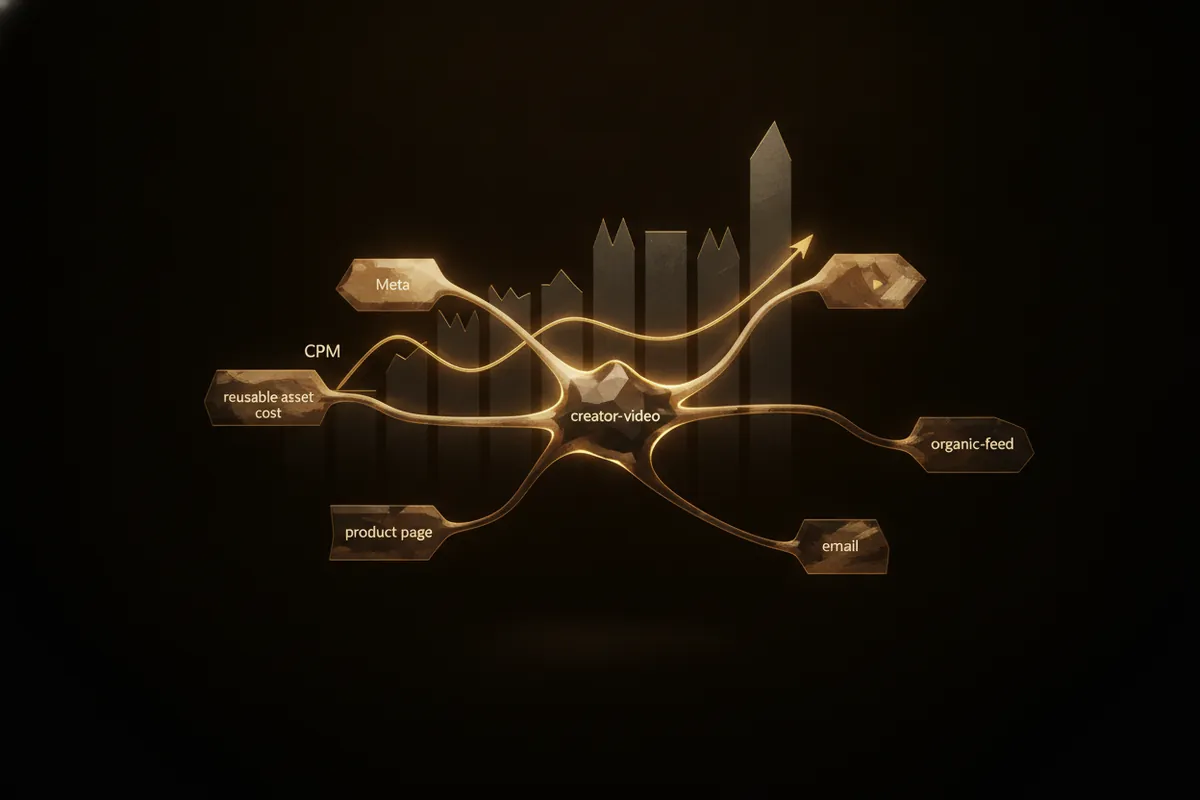
Creator asset reuse is the routing mechanism
Rising CPMs make a paid-only plan buy less each year. The mechanism that lets creator content outperform a budget increase is reuse routing one asset to five surfaces, not content volume.
→ →
Rites of passage are mechanisms that got measured
A front-end rites-of-passage list is a catalog of mechanisms learned in production. Theorem 3 says a property is guaranteed only when its mechanism is implemented and measuring.
→ →Build your world on an engine that proves what it claims.
Create your own network on the engine that's run since 2016 — or talk to the team behind the 21 papers.