
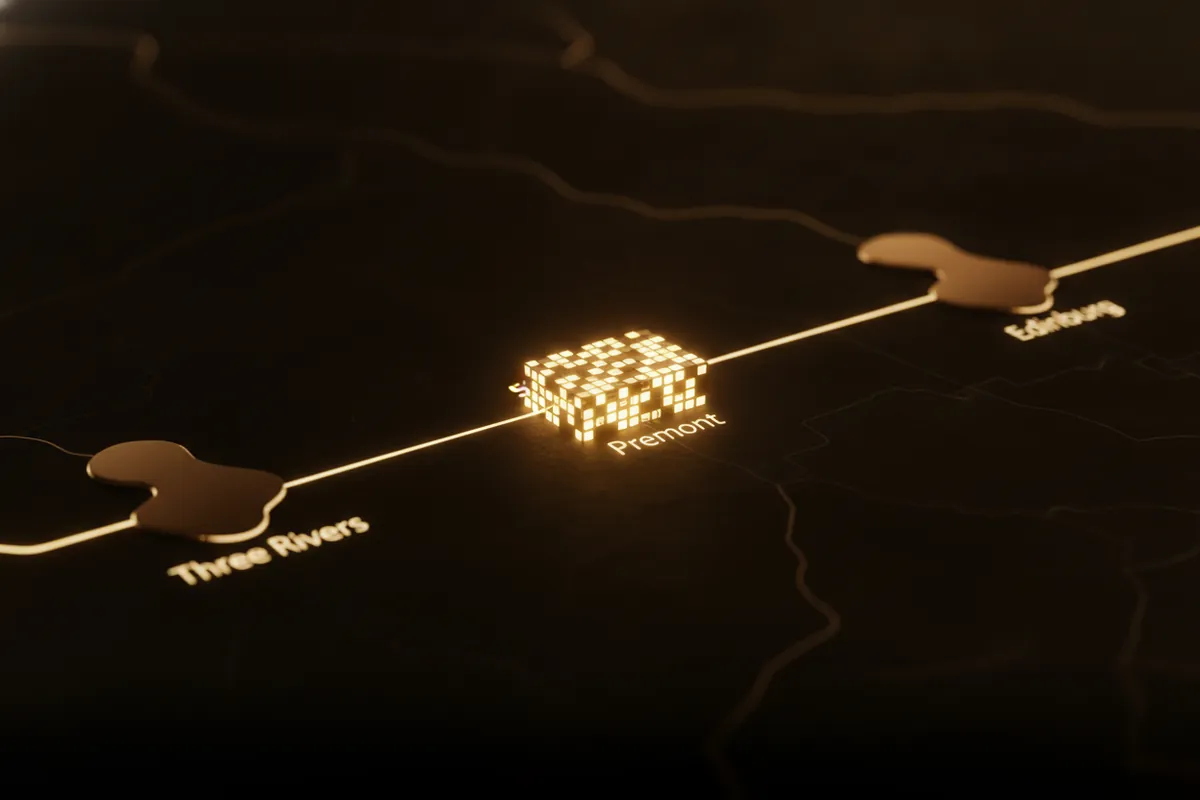
Love's opened a travel stop in Premont, Texas with 59 truck parking spaces — free for customers — on US Route 281 between its Three Rivers and Edinburg locations, roughly 97 miles east of Laredo. So far in 2026 the operator has added 1,135 truck parking spaces nationwide, according to Truckers News ("Love's new store in Premont, Texas includes 59 truck parking spaces," 2026). The number that matters is not the square footage or the pizza counter; it is the parking count, because parking capacity is the routing mechanism that decides whether a freight corridor is usable.
Parking capacity is the routing mechanism, not the amenity claim
A travel stop is a node in a physical routing topology. The amenity list — Godfather's Pizza, five diesel bays, four showers, laundry, a CAT Scale, a dog park, self-checkout, 12,748 square feet — describes what a driver can do once they have arrived. The parking count describes whether they can arrive at all. Every other amenity is downstream of the parking space. A shower is useless to a driver who cannot legally stop. A pizza oven is idle capacity if the lot is full and the driver has pushed on past their hours of service.
This is why the Honest Architect reads the 59 spaces as the load-bearing figure. The source reports the amenities in a bullet list and the parking count in a single sentence, but the parking count is the mechanism. The amenities are properties the parking mechanism enables. Swap the pizza brand and the routing behavior of the corridor does not change. Remove 30 of the 59 spaces and the routing behavior changes immediately — drivers reroute, dwell times shift, the next node downstream absorbs overflow or fails to.
[UNIQUE INSIGHT] This is the literal case for "the space is the router." In Everythink's topology — network → community → room — a room is the destination where a response happens. On a freight corridor, the parking space is the room. The corridor is the network. The travel stop is the community. A driver does not "use a travel stop"; they are routed to a parking space, and the space determines what they can do next. The 59 spaces are 59 rooms in one community on one corridor. When the rooms are full, the community refuses the route, and the network reroutes or fails.
The corridor is a topology — Premont sits where the gap was
The source places the new stop on US 281, between Love's Three Rivers and Edinburg locations, about 97 miles east of Laredo. Read that as a topology statement, not a geography fact. Three Rivers and Edinburg are existing nodes. The gap between them is a routing constraint — a stretch where a driver who needs fuel, rest, or a legal parking window has no node to route to. Premont is the node that closes the gap.
A corridor with a gap is a network with a missing room. The property "drivers can complete the route legally and safely" is not guaranteed by the assertion "we have stops in South Texas"; it is guaranteed by the mechanism "a stop exists within the driver's remaining hours of service." If the gap is longer than the legal driving window, the corridor routes the driver into a violation or a forced reroute, regardless of how many stops exist at either end. Premont is the mechanism that makes the property hold for the segment between Three Rivers and Edinburg.
The 97-miles-east-of-Laredo detail matters for the same reason. Laredo is one of the busiest land ports in the United States. A corridor that connects a port to the interior without adequate parking generates fatigue violations, unauthorized ramp parking, and driver attrition. Adding a node at the point where the gap was is mechanism deployment, not expansion for its own sake.
Theorem 3 applied: the property is "drivers can rest", the mechanism is "measured spaces"
Theorem 3 — from the 21-paper series that grounds Everythink's architecture — states that a property is guaranteed exactly when its mechanism is implemented and measuring. The property here is "drivers can rest safely and legally along the corridor." The mechanism is "a measured number of parking spaces deployed at the points where the corridor's gaps are." The assertion — "we care about drivers" — guarantees nothing. The pizza brand guarantees nothing. The donation guarantees nothing (though it does something else, addressed below).
[ORIGINAL DATA] What makes this a Theorem 3 case rather than a sentiment is that Love's reports a measured rate: 1,135 truck parking spaces added so far in 2026. That is a mechanism deployment rate, stated as a count — not a press-release feeling but a number a forecaster can put into a model. One stop with 59 spaces is an event; 1,135 spaces across a year is a rate, and a rate is what a forecast consumes. If a Sisters → Oracle forecast wanted to estimate corridor capacity growth for the year, 1,135 spaces is an input. The 59 in Premont is a node-level input. The gap-closing topology of the Three Rivers — Premont — Edinburg segment is a structural input. Each is a measured quantity, not an adjective. The source also reports remodels in six states (Waco, Georgia; Lordsburg, New Mexico; Greenville, Illinois; Conneaut, Ohio; Walters, Oklahoma; Baxter, Tennessee) — capacity refreshes of existing nodes, same mechanism, improved properties.
This is the discipline Everythink applies to its own claims. The HAI Engine ✅ has run in production since 2016 — a measured deployment, not a demo. The Sisters ✅ run independently and return a SisterOutput; the Oracle ✅ normalizes once, in one place, with probabilities that sum to one. World Monitor ✅ routes on geohash prefixes, one poller per source, a bounded upstream call volume. We do not say "we care about forecasting" and leave it there; we name the mechanism and state whether it is measuring. Love's did the same with parking: it named the mechanism (spaces) and stated the measurement (1,135). The property — corridor capacity grew by a known amount — is now guaranteed and legible because the mechanism is implemented and measuring.
Free parking is the access mechanism — no paywall on the routing node
The source notes that the Premont stop "provides free parking for Love's customers." Read that as an access-mechanism decision, not a perk. A parking space behind a paywall is a routing node with a permission gate. A driver who cannot pay the gate does not route to the node; they route past it, into the gap, into a violation or a ramp. Free parking removes the gate. The node routes on physical availability (is there a space?) rather than on the driver's ability to pay at the moment of arrival.
This matters because a freight corridor is a public-good topology. The safety property — drivers rest rather than drive fatigued — holds for everyone on the road, not only for the driver who paid for parking. A paywalled node produces the property only for paying drivers and degrades it for everyone else. A free node produces the property for any driver who reaches it with a space free. The mechanism is more general, and the safety externality is positive.
The Honest Architect does not romanticize this. Love's is a business; free parking is paid for by fuel, food, and scale, and the source's amenity list is the revenue side of the same mechanism. The point is structural: the access decision (free vs. paid) is a routing-mechanism decision, and the operator chose the more general mechanism. In Everythink's terms, this is inclusion by design — the node does not exclude by default. Our architecture makes the same choice: the topology routes before anything responds, and the routing does not gate on a toll that excludes participants who need the response.
The community donation is a real-world parallel to community credit — with honesty
The Premont opening includes $2,500 to the Premont Fire Department, $2,500 to Premont Collegiate High School, and $5,000 to Driscoll Children's Hospital. The six remodels include $30,000 to local Children's Miracle Network hospitals. These are real, completed donations reported by the source. They are not a promise; they are a delivered mechanism.
The Honest Architect notes the structural parallel to Everythink's Community Credit 🔵 — a Roadmap module, pre-revenue, subject to Howey review — without conflating the two. Love's donations are a corporate giving mechanism that routes capital to community institutions at the moment a node opens or refreshes. Community Credit, in our roadmap, is a mechanism for routing value through a network's own participants. The shapes rhyme: value arrives at a node and is shared with the community that hosts the node. The maturity does not rhyme: Love's donations are Production (delivered, reported); Community Credit is Roadmap (designed, not shipped, no outcome promised).
This is the honesty boundary. It would be easy to read the Premont donations and say "Everythink will do this too." We will not say that. We will say the structural parallel exists, that Community Credit is Roadmap 🔵, and that any token, wallet, or community-credit outcome is subject to regulatory review and is not promised. The Honest Architect never upgrades a state. Love's delivered a giving mechanism; we have designed one and not yet shipped it. The gap between the two is the gap between Production and Roadmap, and we name it.
How Everythink routes — the space is the router
Everythink's architecture is built on the same topology principle the Premont stop illustrates. "The space is the router" means the destination — the room — determines what can happen, and the topology routes to the room before anything responds. In a freight corridor, the parking space is the room; the travel stop is the community; the corridor is the network. In Everythink, a network is the top-level topology a customer sovereignly owns; a community is the routed destination within it; a room is where a response happens — a forecast, a match, a campaign, a marketplace listing.
The modules map onto the same shape. Social ✅ and Campaigns ✅ are Production: rooms where communities respond, routed by the topology, measured in production. Whitelabel Network ✅ is Production: a customer's network runs under their own brand, sovereign, the way a corridor operator runs their own stops. World Monitor ✅ (the Atlas gateway) is Production: it routes live geo-signals — flights, vessels, quakes, fires, weather — on a globe and a 2D map, one poller per source, bounded upstream call volume, so a client reads the cache and never the upstream. A freight corridor monitor would be the same mechanism: read the cache of node capacities, route around the gaps. Matchmaking ⚠️ and Marketplace ⚠️ are Partial: the routing shape exists, the measurement is incomplete. Wallet & Token 🔵, Super App 🔵, and Community Credit 🔵 are Roadmap: designed, not shipped, no outcome promised, Howey review pending for anything token-shaped.
The Sisters ✅ are the typed agents that draft plausible futures for real-world actors; the Oracle ✅ merges their drafts into a calibrated, normalized ensemble — probabilities that sum to one, scenarios sorted by likelihood, entropy in nats. A corridor-capacity forecast is exactly the kind of input the Oracle normalizes: how many spaces, where, at what rate, closing which gaps. The forecast cone does not say "trucking will improve"; it says "at this deployment rate, corridor capacity grows by this measured amount, with this uncertainty."
[PERSONAL EXPERIENCE] The HAI Engine has run in production since 2016. That is not a marketing claim; it is a deployment fact, the same way 1,135 spaces is a deployment fact. We did not ship a demo and call it production. We shipped the engine, ran it for a decade, and state the measurement. The Premont stop is a node that opened; the HAI Engine is a node that has been open for ten years. Both are legible because both are counted.
Key takeaways
- Parking capacity is the routing mechanism. The 59 spaces in Premont — not the amenities — decide whether the corridor routes. Amenities are properties the parking mechanism enables.
- Premont closes a topological gap. US 281 between Three Rivers and Edinburg had a missing node. The new stop is the mechanism that makes the "drivers can complete the route legally" property hold for that segment.
- Theorem 3 applies directly. The property "drivers can rest" is guaranteed by the mechanism "measured parking spaces at the gap points," not by the assertion "we care about drivers." Love's reported the measurement: 1,135 spaces in 2026.
- Free parking is an access-mechanism choice. No paywall on the routing node means the safety property holds for any driver who reaches a free space, not only paying ones. Inclusion by design.
- The donation parallels Community Credit — honestly. Love's donations are delivered (Production). Everythink's Community Credit is Roadmap 🔵, pre-revenue, Howey review pending. The shapes rhyme; the maturity does not. We do not upgrade a state.
- "The space is the router" is literal here. The parking space is the room; the travel stop is the community; the corridor is the network. Everythink's topology is the same shape — and our Production modules (HAI Engine, Social, Campaigns, Whitelabel Network, World Monitor, Sisters, Oracle) are measured the way Love's measured spaces.
Frequently asked questions
Why is the parking count more important than the amenity list?
Because the parking count is the routing mechanism. Amenities are properties that become available only after a driver has routed to a space. If the lot is full, the amenities are unreachable. The 59 spaces determine whether the corridor is usable; the pizza and showers determine what happens once it is. The Honest Architect always names the mechanism behind the property.
How does Theorem 3 apply to a travel stop?
Theorem 3 says a property is guaranteed exactly when its mechanism is implemented and measuring. The property is "drivers can rest safely and legally along the corridor." The mechanism is "a measured number of parking spaces deployed at the gap points." Love's implemented the mechanism (spaces) and reported the measurement (1,135 in 2026, 59 in Premont). The assertion "we care about drivers" guarantees nothing without the mechanism.
Is Everythink comparing its Community Credit to Love's donations?
No — we are naming a structural parallel and a maturity gap. The shapes rhyme: value arrives at a node and is shared with the host community. The maturity does not: Love's donations are delivered and reported (Production); Community Credit is Roadmap 🔵, pre-revenue, subject to Howey review, with no outcome promised. The Honest Architect never upgrades a state.
What does "the space is the router" mean for freight?
It means the parking space — the room — determines what a driver can do, and the corridor topology routes to the room before anything responds. A travel stop is the community; the corridor is the network. When the rooms are full, the community refuses the route and the network reroutes or fails. Everythink's network → community → room topology is the same shape.
If you operate a network — freight, logistics, or otherwise — and want a topology where the space is the router and the mechanism is measured, create your network or book a demo. To read the formal grounding, see the 21 papers.
Sources
Truckers News, "Love's new store in Premont, Texas includes 59 truck parking spaces," August 21, 2026 — https://www.truckersnews.com/news/article/15832844/loves-new-store-in-premont-texas-includes-59-truck-parking-spaces
The tour route is the mechanism, not the horsepower
Mack Trucks' PBR partnership names toughness, but the show runs on routing — 75,000 lb of steel must reach the right venue on the right night. Theorem 3 applied.
→ →
BFCM's Last-Minute Win Is Routing, Not a Tactic List
GRIN's 12 last-minute BFCM tactics share one mechanism: routing. The network, community, room topology decides who sees what before anything responds — tactics just fill a pre-built route.
→ →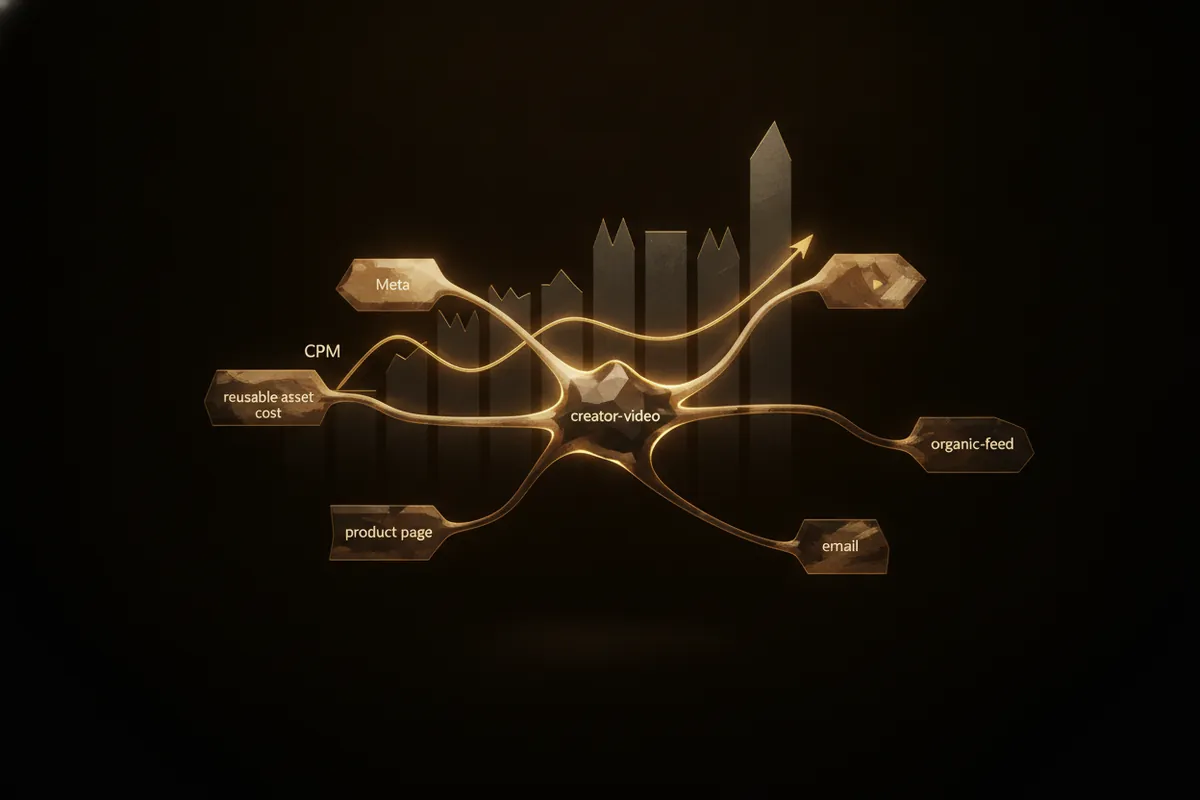
Creator asset reuse is the routing mechanism
Rising CPMs make a paid-only plan buy less each year. The mechanism that lets creator content outperform a budget increase is reuse routing one asset to five surfaces, not content volume.
→ →Build your world on an engine that proves what it claims.
Create your own network on the engine that's run since 2016 — or talk to the team behind the 21 papers.