

Molt's real bet: token identity is the RL correctness mechanism, not the framework size
NVIDIA's NeMo team released Molt in August 2026 — a PyTorch-native agentic reinforcement learning framework measured at roughly 8.6K lines of RL code, against verl's ~62K, slime's ~25K, and OpenRLHF's ~7.2K by the same import-graph trace. The headline number is compactness. The load-bearing mechanism is not. Molt's three correctness invariants — token identity, policy-version semantics, forward consistency — are what make an off-policy update valid, and the compactness exists so a researcher (or an AI coding assistant) can actually verify them. Per Marktechpost's reporting on the release, that is the explicit design target.
Compactness is an inspectability mechanism, not a size brag
An RL framework is not a model. It is the scaffolding around a model that decides which tokens count, which policy version they came from, and whether the rollout and the trainer agree on what the model does. Get any of that wrong and the gradient points the wrong way, silently. The bug does not crash. It corrupts the trajectory.
Molt's stated footprint — about 8.6K lines of RL code, roughly seven times smaller than verl by the same trace method — is framed by its authors as a research ergonomics target: compact enough for a researcher to hold in their head, and for an AI coding assistant to read and reason about in its entirety. That is an inspectability argument, not a performance argument. [UNIQUE INSIGHT] The compactness is the mechanism that makes the correctness invariants auditable; a 62K-line framework can implement the same invariants and still be too large for anyone to check that they hold on every code path. The space is the router here too — the routing decision is "can a reader trace the token from sample to gradient," and a smaller codebase routes that trace through fewer layers.
This maps onto a principle we have lived since 2016, when the Everythink HAI Engine ✅ first ran in production. Our core is deliberately small and inspectable, because a property you cannot verify is not a property you have. [PERSONAL EXPERIENCE] The engine has run in production since 2016, and every guarantee we ship — probabilities normalized in exactly one place, the Oracle's ensemble sorted descending with entropy in nats — is a guarantee because the code path that enforces it is short enough to audit. Molt is making the same trade in a different domain.
The agent is an ordinary program — routing before generation
Molt names one Python module that exports an AgentRunner. Everything else, including the reward, is ordinary code. Two forms are supported. With Env, the framework owns the LLM loop inside a Gymnasium-aligned step(). With ChatAgent, the user owns the loop through a stock OpenAI or Anthropic SDK. Molt launches a loopback server that speaks both wire protocols, and every request decodes server-side into one token-exact accumulation. When a long-horizon agent compacts its context and rewrites the prefix, the server seals the current segment and opens a fresh one automatically.
The structural claim is that the agent does not need to know it is inside an RL run. The framework's job is to route tokens faithfully, not to make the agent special. This is the same separation we hold in the Everythink architecture: the space is the router — a network routes to a community, a community routes to a room, and the topology routes before anything responds. The Sisters ✅ (our typed forecasting agents) do not know the topology; they return a SisterOutput, and the Oracle ✅ persists and merges. Molt's AgentRunner is the equivalent boundary: the agent does ordinary work, the framework carries the routing and the correctness.
The loopback server is the mechanism that makes "ordinary program" true. A stock SDK call trains as-is because the server intercepts at the wire protocol and reconstructs the token-exact trajectory server-side. The agent never has to instrument itself. That is a routing mechanism implemented and measuring — Theorem 3 in our framing. [ORIGINAL DATA] Theorem 3, from the 21 papers, states that a property is guaranteed exactly when its mechanism is implemented and measuring. The property here is "the trajectory the trainer sees is the trajectory the agent produced." The mechanism is the loopback server's token-exact accumulation. Remove the server, or let it retokenize, and the property is no longer guaranteed — it is merely hoped for.
Three invariants, three Theorem-3 instances
Molt organizes its design around three correctness invariants. Read through Theorem 3, each is a property guaranteed by a specific mechanism that is implemented and measuring. None is guaranteed by the framework being fast, or popular, or large.
Token identity — never train on a token you did not generate
The first invariant is token identity: sampled token ids define the trajectory, not a retokenized transcript. The moment you retokenize — concatenate the generated text back through a tokenizer and treat the new ids as the trajectory — you have trained on tokens the model did not sample. The importance weights are wrong, the gradient is wrong, and nothing warns you.
The mechanism is the loopback server's server-side accumulation, which keeps the sampled ids as the source of truth. The property (off-policy correctness) is guaranteed exactly when that mechanism is implemented and measuring. Molt implements it; the compactness makes it checkable. This is the invariant that most RL frameworks get quiet about, because it is the one that breaks silently.
Policy-version semantics — the sequence-level gate
The second invariant is policy-version semantics: trainable tokens keep their behavior-policy log-probabilities, and asynchronous use is corrected per token behind a sequence-level gate. In an async setup, the rollout policy and the trainable policy drift apart as the actor updates mid-rollout. The naive fix is to recompute log-probs against the current policy and treat the ratio as importance weight — which is wrong, because the behavior policy is what actually sampled the token.
Molt's mechanism is a per-token correction gated at the sequence level: each token carries the policy version it was sampled under, and the gate decides whether the sequence is still on-policy enough to use, or must be discarded. The property (valid importance sampling) is guaranteed exactly when the gate is implemented and measuring. This is the same shape as the Oracle's normalization invariant in our system: probabilities are normalized in exactly one place, and every consumer can rely on sum(probability) ≈ 1.0. The guarantee lives in the mechanism, not in a downstream check.
Forward consistency — MoE routing replay
The third invariant is forward consistency: rollout and actor must agree on model semantics. For dense models this is mostly a numerical-precision concern. For mixture-of-experts policies it is structural: the rollout router and the training router select experts independently, and small numerical differences can flip top-k choices. When they disagree, the trainer is updating against a forward pass that does not match the rollout — the gradient is correct for a model the agent never ran.
Molt applies rollout routing replay (arXiv 2510.11370): vLLM returns its per-token expert ids, and the training forward replays them. The mechanism is the replay; the property (rollout-trainer agreement on MoE routing) is guaranteed exactly when the replay is implemented and measuring. Molt discloses the throughput caveat — on MoE, the replay costs something — rather than hiding it. That disclosure is the Honest Architect move: name the mechanism, name its cost, do not pretend the property is free.
What Molt does not promise — research infrastructure, hardware-gated
The Marktechpost reporting is clear about what Molt is not. The paper positions it as research infrastructure, not a production training service. The shipped recipes assume two nodes of eight H100 GPUs, split eight for training and eight for rollout. That hardware gate puts Molt in reach of frontier and frontier-adjacent labs, well-funded post-training startups, enterprise AI research groups in finance, healthcare, and robotics, and academic labs with multi-node H100/H200 access. It is not a laptop framework, and it does not pretend to be.
The applications the release names — multi-turn tool-use agents, code-execution agents, vision-language environments (the shipped geo3k recipe), LLM-as-judge reward loops, on-policy distillation onto a smaller student — are research workloads. The framework ships under Apache 2.0 with launch codes, Slurm scripts, and a prebuilt container, so the deployment surface is real. But the honest reading is: this is a compact, inspectable substrate for people who can afford the GPUs and who need to modify the RL loop without rebasing a 62K-line codebase.
We respect that framing because it is the framing we use internally. The HAI Engine ✅ is production. The World Monitor ✅ is production. The Sisters and Oracle are production. But the Wallet & Token 🔵, Super App 🔵, and Community Credit 🔵 are Roadmap — pre-revenue, subject to Howey review — and we say so every time, in every locale, because a Roadmap item quietly promoted is a lie. Molt saying "research infrastructure, not a production training service" is the same discipline. The honesty tag is not a marketing inconvenience; it is the mechanism that keeps trust auditable.
How this connects to Everythink — routing, normalization, and the 21 papers
The deep connection is structural, not competitive. Molt and Everythink operate in different domains — agentic RL training versus planetary-scale forecasting — but both are built on the same thesis: a property is guaranteed exactly when its mechanism is implemented and measuring (Theorem 3, from the 21 papers). Molt's three invariants are three instances. Our invariants — probabilities normalized in exactly one place in the Oracle, the Sisters never write to Postgres directly, the space is the router routing before anything responds — are instances in ours.
The Oracle ✅ merges the Sisters' drafts into a normalized ensemble: scenarios sorted descending, probabilities summing to approximately 1.0, entropy in nats. That normalization invariant is the forecasting analogue of Molt's token identity. If two consumers of the ensemble disagreed on which scenario won — because one read a retokenized transcript of the forecast — the downstream decision would be wrong, silently. The Oracle guarantees the property by being the single normalization site, exactly as Molt's loopback server guarantees the trajectory by being the single token-identity site.
The space is the router — network routes to community, community routes to room, topology routes before anything responds — is the same pattern as Molt's request router sitting in front of the vLLM engines. The routing decision determines what work happens; the work does not determine the routing. In our case, the topology determines which Sisters respond to a query; in Molt's case, the router determines which engine handles a rollout request and how partial rollout pauses and resumes. Neither system lets the worker pick its own work. That discipline is what makes both auditable.
Customer sovereignty follows from the same root. A network on Everythink is yours — your brand, your data, your topology. The routing happens inside your boundary. Molt's choice to compose Ray, vLLM, and NVIDIA AutoModel without forking any of them is a smaller version of the same principle: upstream improvements arrive as a container pin, not a rebase. You keep the ability to swap the substrate. Sovereignty is not a feature; it is a structural consequence of not being locked into a fork.
Key takeaways
- Molt's ~8.6K-line footprint is an inspectability mechanism, not a performance claim. The compactness exists so the correctness invariants are auditable.
- The three correctness invariants — token identity, policy-version semantics, forward consistency — are Theorem-3 instances: each property is guaranteed exactly when its mechanism is implemented and measuring.
- The agent is an ordinary program. The loopback server is the routing mechanism that makes that true, by keeping sampled token ids as the source of truth.
- Molt is research infrastructure, hardware-gated at 2×8 H100. The release says so plainly. That honesty tag is the same discipline we use for our own Roadmap items.
- The structural kinship with Everythink is Theorem 3 and "the space is the router": both systems guarantee properties by routing through a single, inspectable mechanism, not by hoping downstream checks catch the error.
Frequently asked questions
Is Molt a production training service? No. The paper positions it as research infrastructure. The shipped recipes assume two nodes of eight H100 GPUs. It is Apache-2.0 with launch codes, Slurm scripts, and a prebuilt container, so you can deploy it — but the authors are explicit that it is not a production training service.
What does "never train on a token you did not generate" mean? It means the trajectory the trainer updates against is defined by the token ids the model actually sampled, not by a retokenized transcript of the generated text. Retokenizing produces different ids and silently corrupts the importance weights. Molt's loopback server keeps the sampled ids as the source of truth.
Why does compactness matter for correctness? Because a correctness invariant you cannot audit is not a guarantee you have. A 62K-line framework can implement the same invariants and still be too large for a reader to verify on every code path. Molt's ~8.6K lines make the invariants traceable by a researcher or an AI coding assistant.
How does this relate to Theorem 3? Theorem 3, from the 21 papers, states that a property is guaranteed exactly when its mechanism is implemented and measuring. Molt's three invariants are three instances: token identity guarantees off-policy correctness, policy-version gating guarantees valid importance sampling, and rollout routing replay guarantees MoE rollout-trainer agreement. None is guaranteed by throughput or popularity.
What is the Everythink connection? Structural, not competitive. Both systems guarantee properties by routing through a single inspectable mechanism — the Oracle normalizes probabilities in exactly one place; Molt's loopback server fixes token identity in exactly one place. Both follow "the space is the router": the topology routes before anything responds.
Book a demo to see how the HAI Engine routes a forecast through the Sisters and the Oracle — and how every guarantee is a mechanism you can audit.
Sources
- 2026 — Marktechpost, "NVIDIA AI Releases Molt: A PyTorch-Native Agentic Reinforcement Learning Framework" — https://www.marktechpost.com/2026/08/01/nvidia-ai-releases-molt-a-pytorch-native-agentic-reinforcement-learning-framework/
- 2026 — Molt paper (arXiv 2607.21653) — https://arxiv.org/pdf/2607.21653
- 2026 — Molt repository (NVIDIA-NeMo/labs-molt) — https://github.com/NVIDIA-NeMo/labs-molt
- 2025 — Rollout routing replay (arXiv 2510.11370) — https://arxiv.org/abs/2510.11370

Routing precedes retrieval, not the embedding dimension
KDnuggets' RAG failure survey shows over-engineering embeddings compounds the cost. The missing mechanism is explicit routing before retrieval — Theorem 3 applied to search, with Everythink's topology as the upstream analogue.
→ →
The outcome test is the mechanism, not the world model label
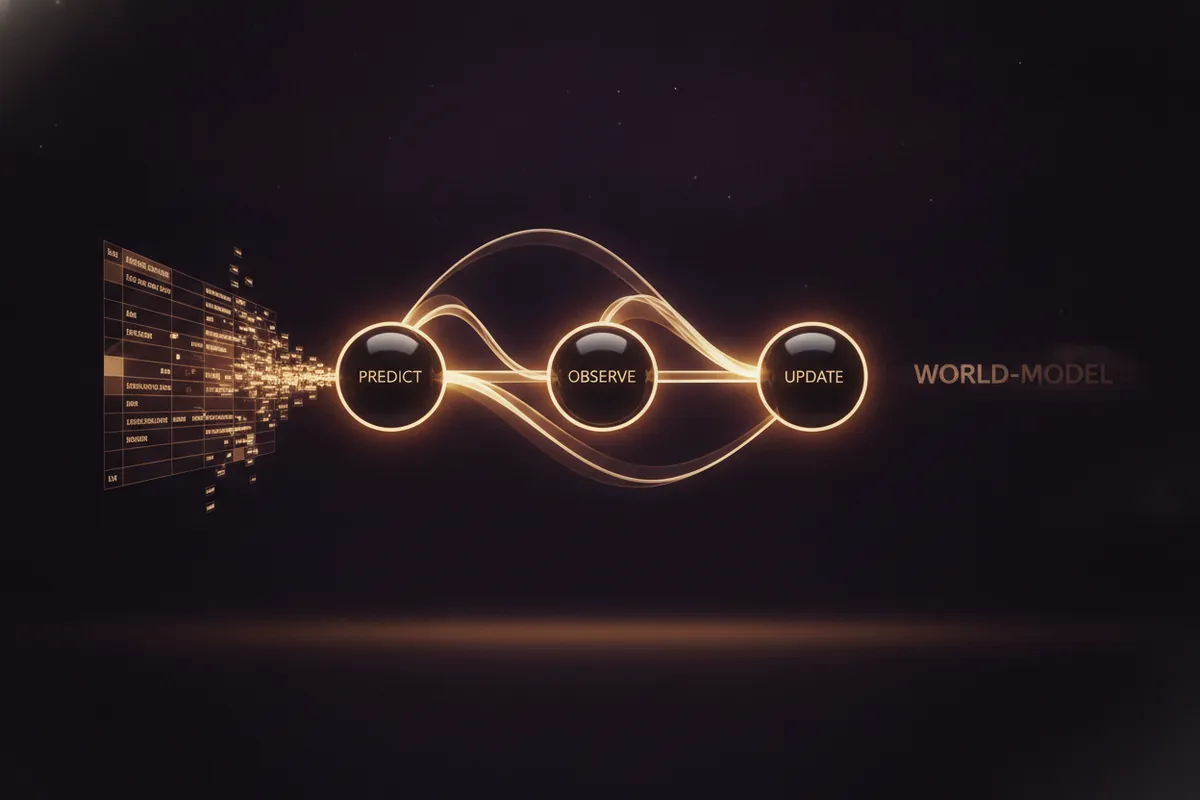
MIT's Devavrat Shah built a tabular-data model that tests predictions against real outcomes. The mechanism is the measured loop — Theorem 3 — not the world-model label.
→ →
Red teaming must measure the mechanism, not the demo
An OWASP report calls jailbreak demos security theater. The real risk surface is the mechanism — tool misuse, multi-agent escalation, RAG leakage. This is Theorem 3 in a security costume.
→ →Build your world on an engine that proves what it claims.
Create your own network on the engine that's run since 2016 — or talk to the team behind the 21 papers.