

An OWASP GenAI Security Project report published in 2026 argues that most AI red-teaming engagements measure the wrong thing — a jailbreak prompt that lands — and call it safety. The real risk surface is the mechanism: tool misuse, multi-agent privilege escalation, RAG data leakage. The report's evaluation framework is, in our language, Theorem 3 applied to security: a property is guaranteed exactly when its mechanism is implemented and measuring.
The jailbreak demo is the surface, not the guarantee
The OWASP report opens with a diagnosis we recognize immediately: organizations believe they are "secure" because they have run prompt-based tests, while ignoring the systemic risks introduced by agentic architectures, tool integrations, and workflow automation. The report calls this "security theater" — a demo that measures the chat surface and silently certifies nothing about the system underneath.
[UNIQUE INSIGHT] This is the same error Theorem 3 names in general form: a property is guaranteed exactly when its mechanism is implemented and measuring. A jailbreak that succeeds against a chatbot measures the chatbot's refusal mechanism. It does not measure the tool-calling path, the retrieval-augmented path, the multi-agent handoff path, or the Model Context Protocol integration path. Each of those is a separate mechanism with a separate failure mode. Certifying one certifies one.
The report's contribution is that it stops letting vendors conflate them. It separates simple GenAI systems — chatbots, copilots, RAG apps — from advanced systems: tool-calling agents, MCP architectures, multi-agent workflows. Each has a distinct risk profile. Hallucinations dominate the first; tool misuse and privilege escalation dominate the second. A red team that only tests the first is not a red team for the second. It is a demo.
Why the mechanism, not the demo, is the unit of safety
The OWASP framework organizes evaluation around ten dimensions: technical competence, methodology and coverage, adversarial creativity, threat-modeling realism, evaluation rigor and metrics, tooling and infrastructure, data governance, transparency and explainability, customization and integration, and legal and compliance posture. Read carefully, each dimension is a mechanism that must be implemented and measured — not an adjective a vendor can assert.
Consider the metrics dimension. The report introduces pass@k (the probability that at least one of k independent attempts succeeds) and Average Turns to Jailbreak. These are not vanity numbers. They are measurement mechanisms: pass@k tells you whether a failure is rare or merely not-yet-observed; Average Turns to Jailbreak tells you whether the system degrades gracefully under sustained pressure or collapses on the third turn. A vendor that reports "we found 12 vulnerabilities" without these mechanisms is reporting a count, not a guarantee.
[ORIGINAL DATA] Theorem 3, from the 21 papers that ground Everythink's forecasting engine, states the principle in one line: a property is guaranteed exactly when its mechanism is implemented and measuring. The OWASP report is the security community arriving at the same line from the other direction — after enough jailbreak demos certified systems that then failed in production, the only honest response is to ask which mechanism the demo measured, and whether that mechanism is the one that holds the property in deployment.
The routing boundary is where the real attack surface lives
The report distinguishes simple from advanced systems, but it does not name what we would name: the attack surface moves when the topology routes. A chatbot has one surface — the prompt. An agent that calls tools, retrieves from a corpus, and hands off to a second agent has a surface at every handoff. The permission to call a tool, the scope of the retrieval, the trust transferred at the handoff — each is a routing decision, and each routing decision is a place an adversary can try to redirect flow.
This is why "the space is the router" is not just a product slogan for us. The Everythink topology — network → community → room — routes a request before anything responds. A room is a scope; a community is a trust boundary; a network is a sovereignty boundary. The permission that lets an agent act inside a room is a routing decision, and it is the decision an adversary wants to suborn. A red team that tests the prompt and not the routing boundary is testing the lobby and not the vault.
[PERSONAL EXPERIENCE] The HAI Engine has run in production since 2016, and the adversarial evaluations that matter to us have always been at the routing boundary — can a request reach a room it should not reach, can a scope be escalated, can a handoff leak a permission. The OWASP report's emphasis on multi-agent contamination and MCP misuse is the same emphasis, expressed for a wider audience. The mechanism is the boundary; the demo is the prompt.
What the report gets right, and what it leaves for the operator
The report is strong on the procurement lens. It offers green flags and red flags a buyer can use immediately, a consultants-versus-tools comparison matrix, and a scoring checklist across technical, operational, and governance dimensions. The green flags — full attack chains, agent traceability, replayability, novel attack design rather than reuse of public jailbreak libraries — are each a measurement mechanism. The red flags — jailbreak demos as the headline, no pass@k, no Average Turns, no mapping to NIST AI RMF or ISO 42001 or the EU AI Act — are each a missing mechanism.
It is weaker on three things the operator still has to supply. First, it focuses on vendor evaluation, with less on building internal red-teaming capability or a hybrid model. Second, it references regulatory frameworks without deeply mapping criteria to specific compliance obligations — the conformity assessments under the EU AI Act are left to the reader. Third, it assumes a relatively high level of technical maturity; an organization early in its AI journey will need templates the report does not provide.
We read these gaps as the report being honest about its scope. It is a procurement framework, not an operating manual. The operator's job — which the report names but does not complete — is to take the measurement mechanisms and run them continuously, not once at procurement.
The single-mechanism discipline the report wants from metrics
The report's metrics section is, in our reading, its quietest and most important contribution. It asks for pass@k, Average Turns to Jailbreak, replayability, observability, and agent traceability. Each is a single mechanism that produces a measurable signal. The discipline behind them is the same one we hold for the Oracle: probabilities are normalized in exactly one place, the ensemble module, and every consumer may rely on sum(probability) ≈ 1.0. One mechanism, one guarantee.
A red-team report that bundles ten metrics into a "risk score" has the same problem as a forecast that bundles ten models into a number without saying where the normalization happens. The guarantee is only as good as the single mechanism that produces it. The OWASP report's insistence on named, separable metrics — pass@k is pass@k, not a component of a score — is the insistence that the mechanism be identifiable, so that when the property fails, you know which mechanism stopped measuring.
This is the operational consequence of Theorem 3. If the guarantee is "safety," and the mechanism is "pass@k on the tool-calling path," then when pass@k drops, you know the tool-calling path is where the guarantee weakened. A bundled score cannot tell you that. It can only tell you that a number moved. The report, perhaps without intending to, is an argument for unbundling.
Civil and defensive scope is the only honest scope
The report is about defensive red teaming — finding failures so they can be fixed. It is not about offensive capability. This matches a boundary we hold explicitly: civil and defensive use only. The same mechanism that finds a privilege-escalation path so you can close it could, in different hands, find it so someone can exploit it. The report does not dwell on this, but the procurement framework assumes the buyer wants the failure found and fixed, not found and weaponized.
We state this because the Honest Architect voice requires it. A red-teaming capability is a measurement mechanism; a measurement mechanism is neutral about its operator's intent. The OWASP framework is most useful to an operator whose intent is defensive, and we would not sell it any other way. The Everythink topology — where routing decisions are the attack surface — is built so that the defensive operator can see and close the paths. It is not built to help an offensive operator open them.
How this connects to what we ship
The Sisters → Oracle pipeline is a calibrated forecast, not a guess. Each Sister drafts a plausible future; the Oracle merges them into a normalized ensemble. The discipline is: one normalization mechanism, one measurable guarantee. The OWASP report asks the same of red teaming: one pass@k mechanism, one measurable safety signal. The shape is the same because the underlying principle is the same — Theorem 3, which neither the security community nor the forecasting community owns but both keep rediscovering.
Production ✅ capabilities that carry this discipline: the HAI Engine (the routing and matching engine that has run since 2016), the Sisters and the Oracle (the calibrated ensemble), World Monitor (the live geo-signal gateway whose deterministic ids mean re-ingest updates, never duplicates — a measurement mechanism for data integrity), Social and Campaigns (where permission scopes route before content is served), and the Whitelabel Network (where sovereignty over the network, brand, and data is the routing boundary the operator controls).
Partial ⚠️ capabilities: Matchmaking, Marketplace, and Calendar — the measurement mechanisms exist but the coverage is incomplete, and we will not call them Production until it is. Roadmap 🔵: Wallet & Token, Super App, and Community Credit — pre-revenue, subject to Howey review, and not promised as outcomes. We do not upgrade states. The OWASP report's red flags are, in effect, the failure mode of upgrading a state: a vendor calling a jailbreak demo "security" is upgrading a surface test to a system guarantee.
Key takeaways
- A jailbreak demo measures the refusal mechanism of a chatbot. It does not measure the tool-calling, retrieval, or multi-agent mechanisms. Certifying one certifies one. This is Theorem 3 in a security costume.
- The OWASP GenAI Security Project report (2026) separates simple from advanced AI systems and gives ten evaluation dimensions — each a mechanism that must be implemented and measured, not asserted.
- The metrics that matter — pass@k, Average Turns to Jailbreak, replayability, agent traceability — are single, separable mechanisms. A bundled "risk score" hides which mechanism stopped measuring when the guarantee fails.
- The real attack surface is the routing boundary, not the prompt. Everythink's network → community → room topology routes before anything responds; the permission at each handoff is where an adversary tries to redirect flow.
- Civil and defensive scope is the only honest scope for a measurement mechanism. The same mechanism that finds a path to close it could find it to exploit it.
Frequently asked questions
What is AI red teaming, and how is it different from traditional red teaming? AI red teaming is adversarial testing aimed at uncovering safety, security, misuse, and alignment failures in AI systems — hallucinations, jailbreaks, tool misuse, privilege escalation, data leakage. Traditional cybersecurity red teaming tests networks and applications for unauthorized access. The OWASP report is explicit that the two are not the same: an AI red team tests the model's behavior and the system around it, not just the perimeter.
Why is a jailbreak demo not enough to certify safety? A jailbreak demo measures whether a specific prompt bypasses the refusal mechanism of a chatbot. It does not measure the tool-calling path, the retrieval path, or the multi-agent handoff path — each of which is a separate mechanism with a separate failure mode. Theorem 3 puts it directly: a property is guaranteed exactly when its mechanism is implemented and measuring. A demo that measures the wrong mechanism guarantees nothing about the right one.
What metrics should a red-teaming vendor report? The OWASP report names pass@k (the probability that at least one of k attempts succeeds) and Average Turns to Jailbreak, plus replayability, observability, and agent traceability. Each is a single, separable measurement mechanism. A vendor that reports only a count of vulnerabilities found, without these mechanisms, is reporting a number, not a guarantee.
How does Everythink's topology relate to AI red teaming? The network → community → room topology routes a request before anything responds. The permission at each handoff — room scope, community trust boundary, network sovereignty — is a routing decision, and routing decisions are the real attack surface in agentic systems. A red team that tests the prompt and not the routing boundary tests the lobby, not the vault. "The space is the router" is the statement that the routing layer is where safety is won or lost.
Can a red-teaming framework be used offensively? A measurement mechanism is neutral about intent. The OWASP framework is designed for the defensive operator who wants failures found and fixed. Everythink holds a civil-and-defensive scope boundary explicitly: the topology is built so the defensive operator can see and close paths, not so an offensive operator can open them.
Sources
- 2026 — OWASP GenAI Security Project, "Vendor Evaluation Criteria for AI Red Teaming Providers & Tooling," Version 1.0, public release January 13, 2026; summarized by aigl.blog on March 20, 2026: https://www.aigl.blog/vendor-evaluation-criteria-for-ai-red-teaming-providers-tooling/
Create your network — and decide where the routing boundary sits before anything responds.

Routing precedes retrieval, not the embedding dimension
KDnuggets' RAG failure survey shows over-engineering embeddings compounds the cost. The missing mechanism is explicit routing before retrieval — Theorem 3 applied to search, with Everythink's topology as the upstream analogue.
→ →
The outcome test is the mechanism, not the world model label
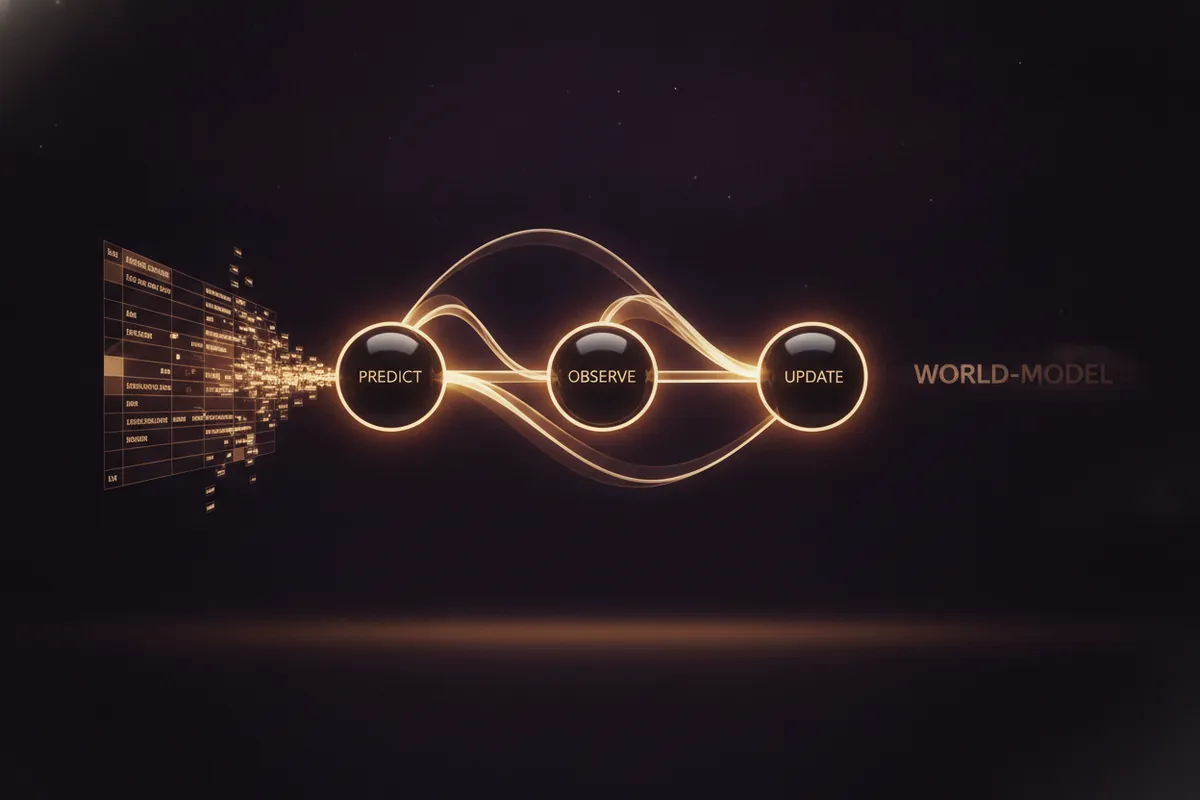
MIT's Devavrat Shah built a tabular-data model that tests predictions against real outcomes. The mechanism is the measured loop — Theorem 3 — not the world-model label.
→ →
Gradient planning routes through the measured pathway
GRASP works by routing the optimization signal through the densely trained action gradient and insulating the adversarial state gradient. The same routing discipline underpins Theorem 3 and the space is the router.
→ →Build your world on an engine that proves what it claims.
Create your own network on the engine that's run since 2016 — or talk to the team behind the 21 papers.