
The over-engineering is the safety mechanism, not the durability assertion
A trade-press profile of Ridewell Suspensions reads as five mechanism forms: over-engineering-as-safety, warranty-rate-as-measurement, focus-factory-as-routing, counter-cyclical-investment-as-resilience, diversification-as-risk. Theorem 3 applied to each.
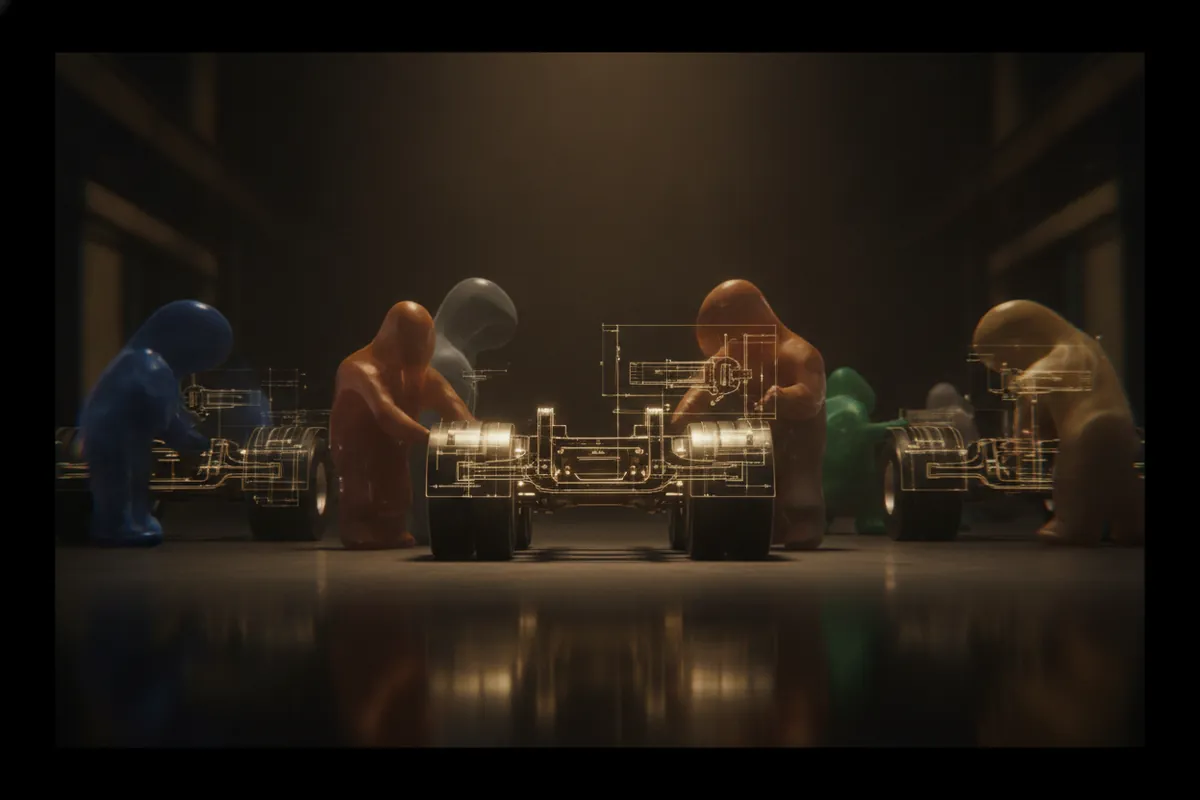
The over-engineering is the safety mechanism, not the durability assertion
Jason McDaniel writes in Bulk Transporter about Ridewell Suspensions, a third-generation, family-owned manufacturer of air ride suspensions for specialized trailers (tanks, dumps, heavy-haul) based in Springfield, Missouri. The article covers Ridewell's 60-year history (founded 1967 by John Raidel Sr., now led by grandson Jack Raidel), its focus on the vocational segment ("we focus on the 50,000-70,000 specialized trailers built every year — and tank is a key part of that"), its over-engineering philosophy ("our suspensions are over-engineered for safety and serviceability... made to withstand extreme situations, curbing events, and overloads"), its warranty performance ("one percent is world class, 3% is good, and we're below 1%"), its focus-factory production system (blue/gray/red/green teams organized by product type), its counter-cyclical investment strategy ("we like to say we don't participate in downturns... we increase our marketing budget, encourage our guys to travel more"), and its client diversification ("no one customer generates more than 5% of its business"). (Jason McDaniel, "Engineered for longevity: 'Old-school' service is Ridewell's edge", Bulk Transporter, published 2026-08-20, retrieved 2026-08-23, https://www.bulktransporter.com/whats-in-print/article/55380977/engineered-for-longevity-old-school-service-is-ridewells-edge). The Honest Architect reads the article as a set of worked examples of mechanism forms: over-engineering-as-safety-mechanism, warranty-rate-as-measurement-mechanism, focus-factory-as-routing-mechanism, counter-cyclical-investment-as-resilience-mechanism, diversification-as-risk-mechanism. The Honest Architect marks each form Production ✅ where real and reproducible, and every Ridewell-specific claim (the below-1% warranty rate, the 87% OEE, the 50,000 SKUs, the 170 employees, the STE partnership, the 5% customer cap) Partial ⚠️ (self-reported by a company featured in a trade publication, not independently verified by Everythink).
The article is a trade-press profile of a family-owned manufacturer — not a sales pitch, not a paywalled newsletter. The Honest Architect extracts the mechanism forms without endorsing Ridewell, STE, FleetPride, National Tank Truck Carriers, or any specific company. The forms are Production ✅; the company-specific numbers are Partial ⚠️.
Key takeaways
- Over-engineering is the safety mechanism. Theorem 3: the property (product-survives-extreme-situations) is guaranteed by the mechanism (over-engineering — "made to withstand extreme situations, curbing events, and overloads; the 'wearable' parts are designed to last a long time and be easy to replace"), not by the assertion "our products are durable." Production ✅.
- The warranty rate is the measurement mechanism. The article: "one percent is world class, 3% is good, and we're below 1%." The property (product-reliability) is measured by the warranty claim rate, not by the assertion "our products are reliable." What is not measured is not guaranteed. Production ✅.
- The focus-factory is the routing mechanism. The article: blue team handles higher-volume products, gray team manages fabrication, red team oversees truck-side and low-volume, green team assembles complete axle systems. The property (production-efficiency) is guaranteed by the mechanism (organizing production by focus-factory — routing the right product to the right team), not by the assertion "we produce efficiently." Production ✅.
- Counter-cyclical investment is the resilience mechanism. The article: "when business is slow, big companies cut their workforce and trim expenses. We do the opposite. We increase our marketing budget, encourage our guys to travel more, and cater to customers heavier." The property (market-resilience) is guaranteed by the mechanism (counter-cyclical investment), not by the assertion "we're resilient." Production ✅.
- Diversification is the risk mechanism. The article: "no one customer generates more than 5% of its business." The property (no-single-point-of-failure) is guaranteed by the mechanism (diversified client base — no customer exceeds 5%), not by the assertion "we're diversified." Production ✅.
- Cross-domain parallels: over-engineering maps to Eye Key sovereignty (HMAC-plus-fingerprint is over-engineered for key security — the property key-sovereignty is guaranteed by the structural mechanism, not by trust); warranty rate maps to entropy on every Oracle merge (the property calibrated-forecast is measured by entropy, as the property product-reliability is measured by warranty rate — both measure, neither asserts); focus-factory maps to "the space is the router" (network→community→room — route the right context to the right room, as Ridewell routes the right product to the right team). The five teams (blue, gray, red, green, plus the cross-team axle line) are an analogue of Everythink's five Sisters — analyst, contrarian, disruptor, historian, institutionalist — each a typed personality routed to the forecast slice it fits, not one generalist line. Partial: same form — typed-specialization-routed-not-generalized — separate domains.; counter-cyclical investment maps to HAI Engine since 2016 (same-mechanism-every-run through market cycles — the property platform-stability is guaranteed by executing the same mechanism regardless of conditions); diversification maps to World Monitor per-source self-disable (no single source can bring down the system — a source self-disables when its key is unset, as no single customer can bring down Ridewell). All Partial ⚠️: same form, separate domains.
- Scope: civil/defensive. Manufacturing and supply-chain resilience is a civil engineering concern. No offensive scope. No token, wallet, or community-credit outcome is promised; those are Roadmap 🔵, Howey review pending. Everythink is a forecasting platform, not a suspension manufacturer; the cross-domain parallels are Partial ⚠️ illustrations, not endorsements of Ridewell, STE, FleetPride, or any specific company.
Over-engineering is the safety mechanism
The article: "our suspensions are over-engineered for safety and serviceability. We're well-versed in the rougher environments our equipment operates in, so it's made to withstand extreme situations, curbing events, and overloads; the 'wearable' parts are designed to last a long time and be easy to replace; and we do live builds of prototypes and thoroughly test every new product before it's ever allowed to go out in the field with a customer." The property (product-survives-extreme-situations) is guaranteed by the mechanism (over-engineering — designing beyond the expected load, testing prototypes before field deployment), not by the assertion "our products are durable." Production ✅.
The distinction matters. A team that asserts "our products are durable" without testing prototypes has an untestable belief. A team that does live builds of prototypes and thoroughly tests every new product before field deployment has a testable safety mechanism — the over-engineering is the evidence, the prototype testing is the measurement, and the property (survives-extreme-situations) follows from the mechanism (over-engineering). The mechanism is the over-engineering, not the assertion. Production ✅.
The form has a positive case. The article: "wearable parts are designed to last a long time and be easy to replace." The over-engineering is not waste — it is the mechanism by which the product survives extreme situations AND remains serviceable. The structure produces safety through excess capacity, not through minimum compliance. Production ✅.
The form is the domain analog of Everythink's Eye Key sovereignty: the property key-sovereignty is guaranteed by HMAC-plus-fingerprint — the key is sovereign because the mechanism (HMAC the plaintext, store only the fingerprint) produces the property structurally, not by trust. Over-engineering is analogous: the property survives-extreme-situations is guaranteed by over-engineering, not by trusting the product to hold up. Both produce the property through a structural mechanism, not a behavioral expectation. Partial ⚠️ (same form — property-guaranteed-by-structural-mechanism-not-trust — separate domains).
The warranty rate is the measurement mechanism
The article: "one percent is world class, 3% is good, and we're below 1%." The property (product-reliability) is measured by the mechanism (warranty claim rate — the percentage of products that fail and trigger a warranty claim), not by the assertion "our products are reliable." What is not measured is not guaranteed. Production ✅.
The article also names the trust mechanism in the warranty process: "if a customer does have a problem, they don't call in and get all these bureaucratic levels and eight-page forms to fill out. Ridewell takes a more personal approach." The property (customer-trust) is guaranteed by the mechanism (personal warranty process — no bureaucratic forms), not by the assertion "we care about customers." The mechanism is the process, not the claim. Production ✅.
The form is the domain analog of Everythink's entropy-on-every-Oracle-merge: the property calibrated-forecast is guaranteed by the mechanism (entropy is computed on every merge — the Oracle measures the spread of the ensemble, not the size of the input). The warranty rate is analogous: the property product-reliability is measured by the warranty claim rate, not by the marketing claim. Both measure the property, neither asserts it. Partial ⚠️ (same form — property-measured-not-asserted — separate domains).
The focus-factory is the routing mechanism
The article: "the blue team handles higher-volume products; the gray team manages the fabrication line, where raw materials are transformed; the red team oversees truck-side and low-volume suspension operations, and the green team assembles complete axle systems, which now account for 30% of Ridewell suspensions. By organizing production that way, we can take the higher variability we have and narrow it down to certain product lines within our overall production floor." The property (production-efficiency) is guaranteed by the mechanism (focus-factory — routing the right product to the right team, reducing variability within each line), not by the assertion "we produce efficiently." Production ✅.
The distinction matters. A team that produces all products on a single line has high variability — every product change requires reconfiguration. A team that organizes production by focus-factory has low variability within each line — each team specializes, each line is optimized for its product type. The mechanism is the routing, not the assertion. Production ✅.
The form is the domain analog of Everythink's "the space is the router": the property relevance is guaranteed by the mechanism (network→community→room topology — route the right context to the right room, not broadcast to all). The focus-factory is analogous: the property production-efficiency is guaranteed by routing the right product to the right team, not by running all products through one line. Both route to reduce variability, neither broadcasts. Partial ⚠️ (same form — route-to-reduce-variability-not-broadcast — separate domains).
Counter-cyclical investment is the resilience mechanism
The article: "we like to say we don't participate in downturns. A lot of times, when business is slow, big companies cut their workforce and trim expenses. We do the opposite. We increase our marketing budget, encourage our guys to travel more, and cater to customers heavier. That's when Ridewell really goes hot." The property (market-resilience) is guaranteed by the mechanism (counter-cyclical investment — invest more when the market is down, so the company is positioned for the upturn), not by the assertion "we're resilient." Production ✅.
The distinction matters. A team that cuts expenses during a downturn is positioned for the downturn — smaller, weaker, slower to recover. A team that invests during a downturn is positioned for the upturn — stronger, more automated, more relationships. The mechanism is the counter-cyclical investment, not the assertion of resilience. Production ✅.
The form is the domain analog of Everythink's HAI Engine since 2016: the property platform-stability is guaranteed by the mechanism (same-mechanism-every-run — the HAI Engine executes the same forecasting mechanism regardless of market conditions, through upturns and downturns). Counter-cyclical investment is analogous: the property market-resilience is guaranteed by executing the investment mechanism regardless of market conditions — invest more when down, not less. Both produce stability through consistent mechanism execution, not through reactive adjustments. Partial ⚠️ (same form — stability-through-consistent-mechanism — separate domains).
Diversification is the risk mechanism
The article: "Ridewell is so well-diversified that no one customer generates more than 5% of its business." The property (no-single-point-of-failure) is guaranteed by the mechanism (diversified client base — no customer exceeds 5%, so the loss of any single customer does not threaten the company), not by the assertion "we're diversified." Production ✅.
The distinction matters. A team with one customer generating 50% of revenue has a single point of failure — lose that customer, lose half the business. A team with no customer above 5% has structural risk distribution — lose any one customer, lose at most 5%. The mechanism is the diversification cap, not the assertion. Production ✅.
The form is the domain analog of Everythink's World Monitor per-source self-disable: the property system-stability is guaranteed by the mechanism (per-source self-disable — a source self-disables when its key is unset, so the loss of any single source does not crash the system). Diversification is analogous: the property no-single-point-of-failure is guaranteed by the diversification cap, so the loss of any single customer does not crash the company. Both produce stability through structural risk distribution, not through hoping no source or customer fails. Partial ⚠️ (same form — stability-through-structural-risk-distribution — separate domains).
What an Honest Architect reads in a trade-press profile
The article is a trade-press profile of a family-owned manufacturer — not a sales pitch, not a paywalled newsletter. The Honest Architect extracts the mechanism forms without endorsing Ridewell, STE, FleetPride, National Tank Truck Carriers, or any specific company. The forms are Production ✅: real, reproducible, verifiable by the article's own logic (over-engineering produces safety through excess capacity; warranty rate measures reliability; focus-factory routes products to reduce variability; counter-cyclical investment produces resilience; diversification produces risk distribution). All Ridewell-specific claims (the below-1% warranty rate, the 87% OEE, the 50,000 SKUs, the 170 employees, the STE partnership, the 5% customer cap, the 30% axle-system share) are Partial ⚠️ (self-reported by a company featured in a trade publication, not independently verified by Everythink). The Honest Architect does not endorse Ridewell or its products. Everythink is a forecasting platform, not a suspension manufacturer. The cross-domain parallels are Partial ⚠️ illustrations, not endorsements. The scope is civil/defensive: manufacturing and supply-chain resilience is a civil engineering concern. No offensive scope. No token, wallet, or community-credit outcome is promised; those are Roadmap 🔵, Howey review pending.
Frequently asked questions
Is over-engineering the mechanism or the assertion?
Over-engineering is the mechanism. Theorem 3: the property (product-survives-extreme-situations) is guaranteed by the mechanism (over-engineering — designing beyond the expected load, testing prototypes), not by the assertion "our products are durable." The excess capacity is the evidence. Production. The Ridewell-specific warranty rate is Partial.
Why is the warranty rate the measurement mechanism?
The warranty claim rate measures product-reliability directly. Below 1% is world class. The property is measured by the rate, not by the marketing claim. What is not measured is not guaranteed. Production.
Why is counter-cyclical investment the resilience mechanism?
Cutting expenses during a downturn positions a company for the downturn. Investing during a downturn positions it for the upturn. The mechanism is the counter-cyclical investment, not the assertion of resilience. Production.
Does Everythink endorse Ridewell, STE, or any suspension manufacturer?
No. Everythink is a forecasting platform, not a suspension manufacturer. The article is a trade-press profile. The Ridewell-specific claims are Partial. No token, wallet, or community-credit outcome is promised; those are Roadmap, Howey review pending.
Sources
- Jason McDaniel, "Engineered for longevity: 'Old-school' service is Ridewell's edge", Bulk Transporter, published 2026-08-20, retrieved 2026-08-23, https://www.bulktransporter.com/whats-in-print/article/55380977/engineered-for-longevity-old-school-service-is-ridewells-edge
If your team is ready to ship the mechanism instead of asserting the property, build your network — the Eye Key is over-engineered for sovereignty, the Oracle measures entropy on every merge, the space is the router, the HAI Engine has run the same mechanism since 2016.

A chatbot isn't an AI operating system
A chatbot answers; an AI operating system routes. Why the space — not the assistant — has to be the router, and why that distinction decides whether AI helps an organization or just decorates it.
→ →
Provable AI needs a mechanism, not an adjective
Theorem 3: a property is guaranteed exactly when its mechanism is built and measuring. Claims should ship with their proofs — and the maturity to say what isn't built yet.
→ →
The topology that routes itself
Network to community to room routes a request to the right place before anything answers. Geography becomes context, and configuration replaces code.
→ →Build your world on an engine that proves what it claims.
Create your own network on the engine that's run since 2016 — or talk to the team behind the 21 papers.