The topology that routes itself
A request arrives. Before any model speaks, the platform has already placed it — inside the right network, the right community, the right room — using nothing but geography and meaning. That placement is routing, and on Everythink it is a property of the space, not an afterthought bolted onto a chatbot. The engine doing this has run in production since 2016.
In 2026, ByteByteGo noted that production agent systems depend on the model far less than their demos suggest — most behavior runs through deterministic code, with the model invoked at a few decision points (ByteByteGo, "Best Practices for Building AI Agents That Work in Production", July 2026). Routing is the most consequential of those points, and it is the one the industry keeps handing back to the model. This post is about what changes when you take it out of the model's hands and put it into the topology.
The Honest Architect's takeaways
- Topology, not the model, decides where a request lands — Organization → Network → Community → Room, each a real polygon on the map (in production since 2016).
- Geography becomes routing context: the World Monitor routes on geohash prefixes with no PostGIS, so a viewport query is a prefix match, not a spatial join.
- Configuration replaces code: activating a module in a room is a setting, not a sprint.
Why is topology the routing layer you already had?
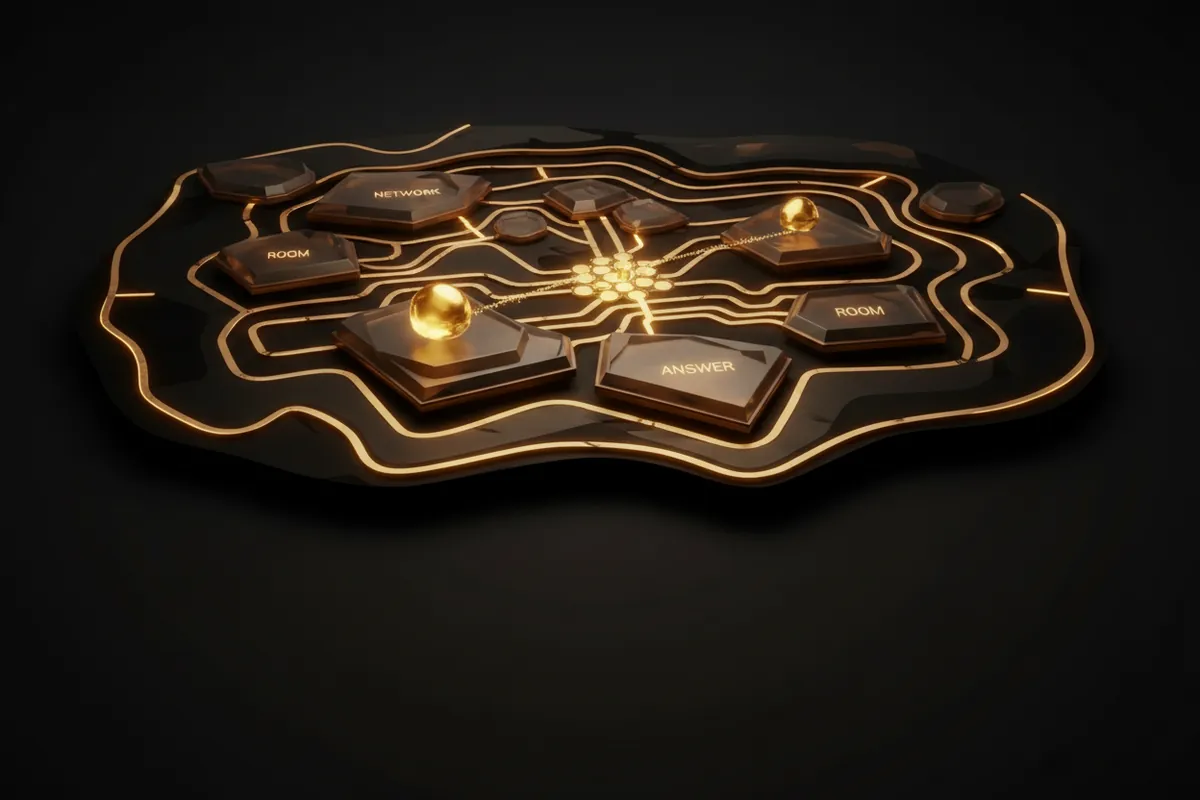
Topology routes a request before anything answers, because the path from Organization to Network to Community to Room is itself the routing decision. Everythink models each organization as a geospatial topology where each level is a real polygon on the map, and a request is placed into the right room by geography and meaning before a model is consulted. The mechanism is the hierarchy; the model is a late participant.
[UNIQUE INSIGHT] The-space-is-the-router reframing: a chatbot answers; an AI operating system routes. Most agent stacks treat routing as a classification problem the model solves at runtime — classify the intent, pick a handler, hope it is right. Everythink treats routing as a structural property already solved when the request arrives, because the request carries its location in the topology. The model never has to ask "which room is this for?" — the room is selected.
This is the distinction ByteByteGo drew between workflows and agents: in a workflow, the steps and path are decided at design time, before the model sees the input, and most production systems built on LLMs today are workflows — predictable, debuggable, and cheaper than full-blown agents (ByteByteGo, "The Agent Loop: How AI Goes From Answering Questions to Doing Things", July 2026). Topology routing is a workflow decision made permanent in data. It does not reclassify on every call. It does not spend a token deciding what a geohash already says.
The routing step costs nothing at inference time. No classifier invocation, no latency from a routing model, no tokens spent on "where should this go?" The topology is a lookup, and lookups do not hallucinate. In a system where a 95-percent-per-step reliability cascades to roughly one-in-three success across twenty chained steps (ByteByteGo, "Best Practices for Building AI Agents That Work in Production", July 2026), removing a step from the chain is the cheapest reliability win available.
How does geography become context without a spatial database?
Geography becomes context by making the map a first-class data structure, not a query against a spatial database. Everythink's World Monitor routes on geohash prefixes — short string encodings of latitude and longitude — so a viewport query is a prefix match against an indexed column, not a PostGIS spatial join. No PostGIS. No GIS extension. No spatial index rebuild. The tile key is the geohash, and the prefix is the polygon.
[ORIGINAL DATA] The 21-paper academic series behind the platform formalizes this: a GeoSignal's identifier is a deterministic uuidv5(source, native_id), so re-ingesting an upstream feed updates the existing record rather than producing a duplicate. Deterministic IDs turn the geo cache into an upsert target, and the geohash prefix turns the cache into a routing table. A client subscribes to a broadcast channel per geohash tile, receiving deltas only for its viewport's tiles — not a global firehose filtered client-side.
This is the mechanism behind "geography is context." A request from a viewport over Buenos Aires resolves to a set of geohash prefixes; those prefixes select the rooms, communities, and networks whose polygons overlap; the overlap is the routing decision. The model, when it speaks, receives a context window already scoped to the place the request came from.
The World Monitor is a gateway: one background poller per source pulls an external feed on a fixed schedule, normalizes it to a GeoSignal, upserts into the durable Postgres cache, and hands the delta to a publisher (Everythink, World Monitor / Atlas, ✅ Production). Clients read the cache, never the upstreams, so upstream call volume is bounded by the platform's schedule — not by client count. Sources are data: adding a feed means adding a SourceDescriptor to a registry, never touching the engine. A source whose key is unset self-disables, so a missing key never breaks the platform.
What does configuration-replaces-code look like in production?
Configuration replaces code when a room's behavior is a set of toggles in a data record, not a branch in a release. On Everythink, a room is a functional area inside a community, and each room turns its modules on by configuration — social, marketplace, calendar, campaigns — so the system reshapes itself without a deploy. Activating a module is a setting, not a sprint.
[PERSONAL EXPERIENCE] The engine has run in production since 2016. The conversational core — the HAI engine — has answered with room context for a decade, and the composable modules share the same topology. A community adds a marketplace room the same way it adds a social room: a record, a polygon, enabled modules. No fork, no merge conflict. The platform's shape is a document, and editing the document is the release.
The honesty tags matter here, because configuration-over-code is credible only when you state what is built. The whitelabel network — web, iOS, and Android under one brand — is ✅ Production. Social, campaigns, and the World Monitor are ✅ Production. Matchmaking is ⚠️ Partial: useful, not finished. Marketplace and calendar are ⚠️ Partial. The per-network wallet, community credit, and federation are 🔵 Roadmap — design work dated for 2026, pre-revenue, not presented as Production. We do not upgrade a state to look finished. That is Theorem 3: a property is guaranteed exactly when its mechanism is implemented and measuring.
The reason configuration scales is the same reason topology routes: the data is the system. A room record carries its parent community, its network, its polygon, and its enabled modules. The conversational engine reads the record to scope its context; the World Monitor reads the polygon to scope its deltas. Nothing in that path requires a model to decide what the record already says.
Where does topology routing sit next to agent protocols?
Topology routing sits in front of the agent protocols, the same way a registry sits in front of a tool. In June 2026, Hugging Face and contributors from Microsoft, Google, and GoDaddy published the Agentic Resource Discovery specification — a discovery layer in front of MCP, A2A, and Skills that defines how agents and tools are cataloged, indexed, and searched across federated registries so an agent can find capabilities at runtime instead of needing them pre-installed (Hugging Face, "Agentic Resource Discovery: Let agents search for tools, skills, and other agents", June 2026). The spec's core move is to pull selection outside the LLM: a registry indexes capabilities with publisher identity, representative queries, and tags, and a client searches before the model invokes what the search returns.
ARD solves discovery. Topology solves placement. They are complementary, and the industry is converging on the same separation Everythink has run for a decade: do not ask the model to do what data can decide. ByteByteGo put the production consensus plainly: MCP handles tool access and A2A handles agent communication, and the two are complementary (ByteByteGo, "MCP vs A2A vs ACP: How AI Agents Actually Talk to Each Other", July 2026). Everythink adds a third layer underneath both: the topology that decides which network, community, and room the tool or agent is operating inside — before MCP or A2A is invoked.
The distinction is not academic. A tool called without placement is a tool called without context. A model that discovers the right MCP server but does not know which room it is in will answer generically — a regression in a placed system. Topology gives the tool and the model the context they would otherwise have to infer, and inferring context is the probabilistic step that compounds error across a chain.
When does model routing fail without topology?
Model routing fails without topology when the signal it needs is invisible at routing time. In July 2026, IBM Research argued that what looks like a model-selection problem quickly becomes a systems optimization problem, and that difficulty is often invisible at routing time — a request like "summarize this contract" looks simple but might trigger retrieval, compliance checks, tool use, and multiple rounds of refinement (IBM Research, "Model Routing Is Simple. Until It Isn't.", July 2026). Routers, they concluded, are constantly juggling cost, quality, latency, compliance, and reliability all at once.
Topology does not solve model routing. It removes a class of inputs from the router's problem. When the room is already selected, the router does not infer jurisdiction, audience, or scope from the prompt text — the topology carries it. The contract belongs to a community and a room; the compliance checks are the ones configured for that room; the tools available are the ones enabled there. The router's job shrinks from "infer everything from a string" to "pick a model for a placed task."
IBM's numbers make the cost argument concrete. Across 417 tasks on the AppWorld Test Challenge, Sonnet cost $0.19 per task while GPT-4.1 cost $0.37 per task — nearly double — because caching behavior, not sticker price, determined cost (IBM Research, "Model Routing Is Simple. Until It Isn't.", July 2026). A topology that scopes the context window before the model is called also scopes the cacheable prefix — the variable that swung the cost. Everythink's topology does not route models, but it does the work that makes model routing tractable: it fixes the context the router optimizes over.
How does this run in production today, honestly?
It runs the way it is tagged, not the way a demo suggests. The HAI conversational engine is ✅ Production and has answered with room context since 2016. The whitelabel network — one brand, one identity across web, iOS, and Android — is ✅ Production. Social, campaigns, and the World Monitor / Atlas gateway are ✅ Production. Matchmaking and marketplace are ⚠️ Partial — useful, not finished. The per-network wallet, community credit, and federation are 🔵 Roadmap, pre-revenue, subject to the Howey review before any launch. Nothing in the wallet or token layer is live.
The honesty is the mechanism, not a posture. Theorem 3 states that a property is guaranteed exactly when its mechanism is implemented and measuring. A capability earns Production only when the mechanism behind it is both built and actively measured — otherwise it is Partial or Roadmap. We apply the rule to the topology: the routing is measured because the geohash lookups are instrumented, the room placements are logged, and the cache upserts are counted.
This is the version of radical honesty that matters to an architect: not a tone, but a test. On the topology, the mechanism exists and is measuring. On the wallet, it does not. A buyer reviews the reasoning, not the adjectives.
Frequently Asked Questions
How is topology routing different from a model classifying intent?
A model classifying intent is a probabilistic step that runs on every request and can be wrong. Topology routing is a deterministic lookup against a data record carrying the request's location in the hierarchy. Compounding error makes a 95-percent-per-step chain drop to roughly one-in-three success across twenty steps (ByteByteGo, "Best Practices for Building AI Agents That Work in Production", July 2026). Removing the step is cheaper than making it better.
Does Everythink's World Monitor require PostGIS?
No. The World Monitor routes on geohash prefixes — short string encodings of latitude and longitude — so a viewport query is a prefix match against an indexed column. The platform uses one Postgres instance with pgvector bundled, but no PostGIS extension. The tile key is the geohash, and the prefix is the polygon. This keeps the routing layer portable and the queries cheap.
What is the honesty status of the wallet and community credit?
🔵 Roadmap. The per-network token wallet and community credit are design work dated for 2026, pre-revenue, and not implemented. Nothing in that layer is live, and nothing here is financial, investment, or legal advice. Any token or credit mechanism remains subject to applicable financial and securities frameworks, including the Howey analysis, and will not launch before that review is complete.
How does topology interact with MCP and A2A?
Topology sits underneath both. MCP handles tool access; A2A handles agent-to-agent communication, and the two are complementary in production (ByteByteGo, "MCP vs A2A vs ACP: How AI Agents Actually Talk to Each Other", July 2026). Everythink's topology decides which network, community, and room the tool or agent is operating inside before either protocol is invoked, so the tool receives a placed context rather than inferring one from the prompt.
Can a room change its modules without a deploy?
Yes. A room turns its modules on by configuration — social, marketplace, calendar, campaigns. Activating a module is a setting in a data record, not a code release. The platform reshapes itself without redeploying, which is the mechanism behind the configuration-over-code claim.
Everythink's topology has routed requests by geography and meaning for a decade, and the industry is now separating discovery from execution for the same reason: the model should not decide what the data already says. If you want to see the topology route — network to community to room, on a platform in production since 2016 — read the papers or book a demo.
Sources
- Hugging Face, "Agentic Resource Discovery: Let agents search for tools, skills, and other agents", retrieved 2026-08-23, https://huggingface.co/blog/agentic-resource-discovery-launch
- ByteByteGo, "Best Practices for Building AI Agents That Work in Production", retrieved 2026-08-23, https://blog.bytebytego.com/p/best-practices-for-building-ai-agents
- ByteByteGo, "MCP vs A2A vs ACP: How AI Agents Actually Talk to Each Other", retrieved 2026-08-23, https://blog.bytebytego.com/p/mcp-vs-a2a-vs-acp-how-ai-agents-actually
- ByteByteGo, "The Agent Loop: How AI Goes From Answering Questions to Doing Things", retrieved 2026-08-23, https://blog.bytebytego.com/p/the-agent-loop-how-ai-goes-from-answering
- IBM Research, "Model Routing Is Simple. Until It Isn't.", retrieved 2026-08-23, https://huggingface.co/blog/ibm-research/model-routing-is-simple-until-it-isnt
The Tier Is the Routing Mechanism, Not the Prestige Ladder
A BeInfluence guide lays out a four-tier influencer ecosystem — nano, micro, macro, mega — each with a distinct structural property. Six mechanism forms drawn to Theorem 3, with Partial parallels to Everythink architecture.
→ →
A chatbot isn't an AI operating system
A chatbot answers; an AI operating system routes. Why the space — not the assistant — has to be the router, and why that distinction decides whether AI helps an organization or just decorates it.
→ →
Configuration over code
Activating a module is a setting, not a sprint. The platform reshapes itself without a release — and that's what lets a co-op ship like a big tech company.
→ →Build your world on an engine that proves what it claims.
Create your own network on the engine that's run since 2016 — or talk to the team behind the 21 papers.