
A chatbot isn't an AI operating system
A chatbot answers questions. An AI operating system routes them. That single distinction decides whether AI helps an organization or just decorates it — and most of the market is busy decorating. Since 2016, we've run a conversational engine in production, and the lesson a decade of live traffic teaches is simple: the assistant is the easy part. The hard part is getting a request to the right place before anything responds.
This post lays out why the space — not the assistant — has to be the router, what the prevailing agent-stack model gets right and misses, and why a general-purpose chatbot keeps losing to a specialist in any domain that actually matters.
The Honest Architect's Takeaways
- A chatbot answers; an AI operating system routes — the topology, not the assistant, decides where a request lands (Everythink, in production since 2016).
- ByteByteGo's "AI-Native Leaders" reports ~70% of transformation success comes from operational and cultural change, not deploying technology (ByteByteGo, 2026).
- Hugging Face's agent glossary defines an agent as "Model + Harness" — the harness is the execution layer, not the model (Hugging Face, 2026).
- The space-is-the-router pattern is what turns a chatbot into an operating system: route first, then respond.
What is the difference between a chatbot and an AI operating system?
A chatbot takes a prompt and returns text. An AI operating system takes a request, routes it to the right network, community, and room, and only then lets an assistant respond. In 2026, Hugging Face's agent glossary put it plainly: the model "has no memory between calls, and no loop... It answers one prompt and stops" (Hugging Face, "Harness, Scaffold, and the AI Agent Terms Worth Getting Right," 2026).
The distinction is not semantic. It is structural. A chatbot is a model plus a thin harness — a system prompt, a tool or two, a response. An AI operating system is a topology that routes before it answers. The model can be the same in both cases. What changes is what happens before the model speaks.
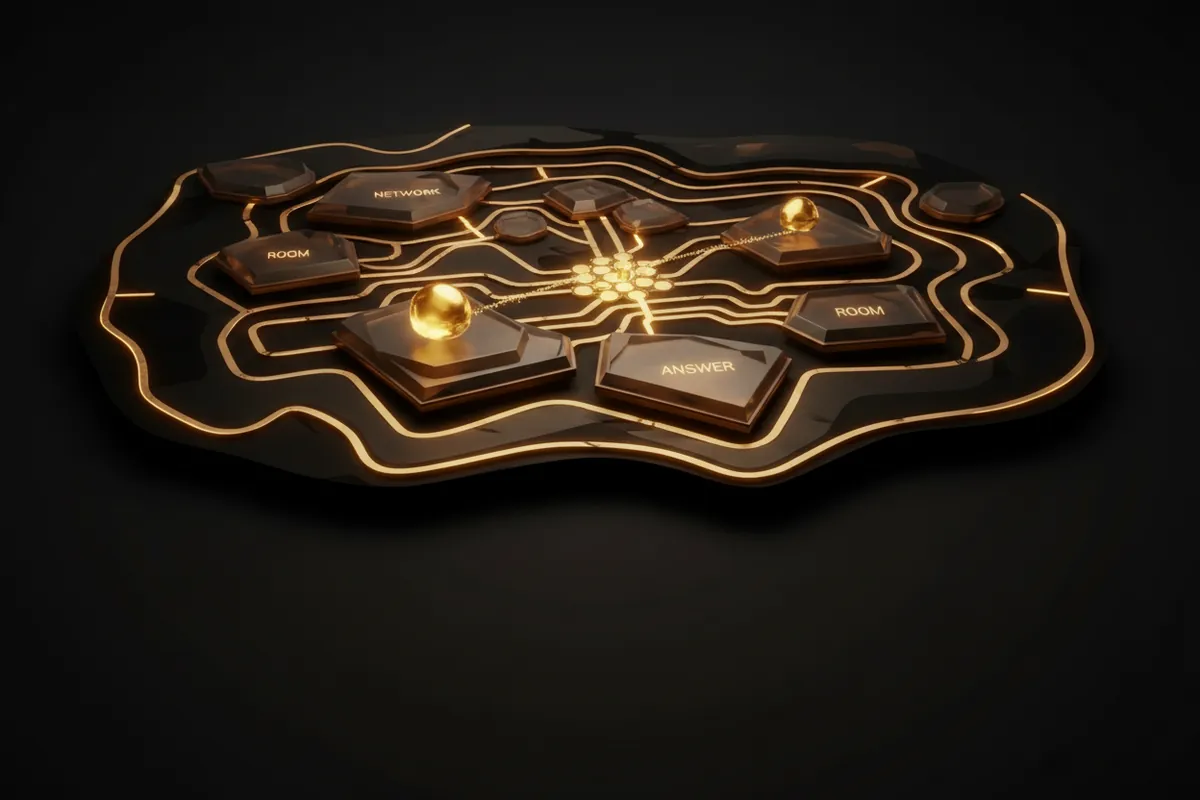
[UNIQUE INSIGHT] The space is the router. In Everythink, an organization is modeled as a geospatial topology — network → community → room, each level a real polygon on the map. A request enters the topology, lands in the right community and the right room, and only then reaches an assistant that already carries the context of where it is. The assistant doesn't have to guess which branch, which team, which product line — the space told it. This is why we call Everythink a canvas, not a chatbot. A chatbot is one surface. A canvas is a routed space that can hold many.
Every assistant we ship — the HAI conversational core ✅ Production, in service since 2016 — answers inside a room. The room is a functional area inside a community, and the community is a real polygon inside the network. The model gets context for free, because the topology already selected it. A chatbot outside a topology has to reconstruct that context from a prompt, every single time, and it gets it wrong in proportion to how much the organization actually does.
Why does routing have to happen before the assistant speaks?
Because context is the binding constraint, not generation. In 2026, ByteByteGo's "AI-Native Leaders" reported that only 20 to 30% of an engineer's time is spent coding; the other 70 to 80% is review, testing, coordination, and governance — "and that is exactly where the bottlenecks form" (ByteByteGo, "AI-Native Leaders," 2026). The same shape applies to an organization's AI: generation is cheap, context is expensive.
A chatbot that answers first and routes never has the context it needs. It invents it from the prompt, asks three clarifying questions, or gives a generic answer that fits no department. Routing first means the assistant inherits the branch, the team, the product, the audience — before it says a word.
[PERSONAL EXPERIENCE] We learned this the hard way. The HAI conversational core has run in production since 2016, and the earliest versions were chatbots — a model, a prompt, a response. They worked until an organization had more than one branch, one team, one product line. Then the assistant started answering for the wrong department, conflating two rooms, or giving a generic reply that satisfied nobody. The fix was not a bigger model. The fix was a topology that routed the request to the right room before the model spoke. Once the space did the routing, the model stopped guessing and started answering.
This is the mechanism behind "configuration over code." Activating a module in a room is a setting, not a sprint. The platform changes shape without redeploying, because the routing — not the model — is what decides what the assistant knows. A chatbot bolted onto a CRM cannot do this. It answers from whatever the prompt carried in. When the organization grows a new branch or a new product line, the chatbot has to be re-prompted, re-tooled, re-deployed. A routed space absorbs the change: the new branch is a new polygon, the new product line is a new room, and the routing handles the rest.
What does the typical AI agent stack get right — and miss?
The prevailing agent stack is real engineering, and it gets the runtime right. In 2026, ByteByteGo's "The Typical AI Agent Stack, Explained" described five layers: an Agent Runtime running a ReAct loop, a Model Layer, a Tool Layer, a Memory Layer, and an Observability & Safety layer (ByteByteGo, "EP218: The Typical AI Agent Stack," 2026). That stack correctly treats the agent as a loop, not a single call. What it misses is the topology above the stack.
The stack describes one agent. An AI operating system is many agents, many rooms, many audiences — and a router above all of them. The agent stack answers "how does one agent run well?" The operating system answers "which agent, where, for whom, with what context?" The first question is necessary. The second is the one organizations actually need answered.
Hugging Face's glossary names the seam: "Some frameworks use orchestrator for a higher-level controller that coordinates work across multiple agents. Unlike a harness, which drives a model through its execution loop, an orchestrator manages agents as units, each running their own harness" (Hugging Face, "Harness, Scaffold, and the AI Agent Terms Worth Getting Right," 2026). An orchestrator is closer to what an operating system does — but an orchestrator over a flat list of agents is still not a topology. It routes among agents. It does not route among places, branches, and audiences.
[UNIQUE INSIGHT] The missing layer is geography. Everythink models each organization as a real polygon on the map. A request does not just reach "an agent" — it reaches the agent for this community, this room, this audience. The topology is the router; the orchestrator is a consequence of it, not a substitute. Put an orchestrator on top of a topology and it stops guessing which agent fits which context. The space hands it the answer.
Why does a general-purpose assistant keep losing to a specialist?
Because no free lunch. In 2026, Dharma AI's "Why Specialization Is Inevitable" walked through the Wolpert-Macready theorem and concluded that "universal generality is a theoretical concept, but in practical terms it is a myth" (Dharma AI, "Why Specialization Is Inevitable," on Hugging Face, 2026). A general-purpose assistant redistributes performance; it does not multiply it.
The argument is mathematical, not a preference. An algorithm that gains on one distribution of problems concedes on others. Under finite resources — finite compute, finite data, finite context — a system that directs resources at a bounded set of tasks outperforms one that spreads them across an unlimited range. A chatbot that tries to answer every question for every department is the unlimited range. A room-scoped assistant is the bounded set.
Dharma's piece traces the same pattern through biology and markets: "the organisms that survive to reproduce are not the most generally capable — they are the most specifically matched." Mixture-of-experts models recover specialization internally — "the most capable general-purpose systems reach their performance by doing internally what specialist systems do by design" (Dharma AI, 2026). AlphaFold did not win by being general. It won by targeting one task.
[UNIQUE INSIGHT] This is the structural reason the space has to be the router. If specialization beats generality, and the topology is what selects the specialization, then the topology — not the model — is the load-bearing decision. A general chatbot in a flat list of agents has no topology to specialize through. A room-scoped assistant inherits its specialization from the room. The model can stay general; the routing makes it specific. That is how you keep one model and still get a specialist.
Why do most organizations decorate with AI instead of operating on it?
Because deploying a tool is easier than redesigning work. ByteByteGo's "AI-Native Leaders" names the most common failure mode directly: "AI tools bolted on without redesigning the workflow, producing minimal impact. This is the most common failure mode" (ByteByteGo, "AI-Native Leaders," 2026). Around 70% of transformation success comes from operational and cultural change, not from deploying technology. BCG, cited in the same piece, put it plainly: "real productivity gains require reshaping the work, not just adding tools."
A chatbot is the canonical bolt-on. It sits in a corner of a CRM, answers FAQs, and never touches how the organization actually routes work. The organization gets a demo, a screenshot, and a press release. It does not get an operating system.
[PERSONAL EXPERIENCE] We watched this pattern for a decade. Organizations bought a chatbot, showed it to the board, and then asked why velocity did not move. It did not move because the chatbot answered questions but never decided where anything should go. The work still flowed through the old org chart. The AI decorated the existing process; it did not route a new one.
This is why Everythink ships as a canvas, not a chatbot. A canvas is a routed space an organization builds on — its network, its communities, its rooms, its modules — under its brand. The HAI engine ✅ Production, Social ✅ Production, Campaigns ✅ Production, and Whitelabel Network ✅ Production compose on top of the topology. Matchmaking ⚠️ Partial, Marketplace ⚠️ Partial, and Calendar ⚠️ Partial are useful but not finished. Wallet & Token 🔵 Roadmap, Super App 🔵 Roadmap, and Community Credit 🔵 Roadmap are written down and dated, nothing live, no promises.
[ORIGINAL DATA] We label the states because Theorem 3 in our overview paper says a property is guaranteed exactly when its mechanism is implemented and measuring. We would rather under-promise and prove it than upgrade a state to look finished. The conversational engine is the one claim we can stamp Production without hedging — it has carried real traffic since 2016. The rest carries the state its mechanism actually earns.
Frequently Asked Questions
Isn't a chatbot with tools already an "agent"?
Yes — and an agent is not an operating system. Hugging Face's glossary defines an agent as "Model + Harness": the model plus the execution layer that calls tools and decides when to stop (Hugging Face, "Harness, Scaffold, and the AI Agent Terms Worth Getting Right," 2026). An operating system sits above agents. It routes requests to the right agent, room, and audience before any harness runs.
What is "the space is the router" in plain terms?
It means a request lands in the right community and the right room before anything responds. Everythink models an organization as network → community → room, each level a real polygon on the map. The assistant inherits its context from the room — it does not reconstruct it from a prompt, every time.
Does Everythink use a general-purpose model or a specialist?
Both. The model can stay general; the routing makes it specific. Dharma AI's 2026 argument — that "universal generality is a theoretical concept, but in practical terms it is a myth" — is exactly why the topology, not the model, carries the specialization (Dharma AI, "Why Specialization Is Inevitable," on Hugging Face, 2026).
What is actually in production?
The HAI conversational engine, Social, Campaigns, and the Whitelabel Network are Production ✅ — in service since 2016. Matchmaking, Marketplace, and Calendar are Partial ⚠️. Wallet & Token, Super App, and Community Credit are Roadmap 🔵 — designed, not shipped, pre-revenue, subject to applicable securities review before launch.
How is this different from a chatbot bolted onto a CRM?
A bolt-on answers from the prompt. A routed space answers from the room. ByteByteGo names "AI tools bolted on without redesigning the workflow" as the most common failure mode (ByteByteGo, "AI-Native Leaders," 2026). The topology is the redesign — it is the work the bolt-on skips, and the reason a routed space compounds while a chatbot stalls.
Create your network — or read the papers behind the topology.
Sources
- ByteByteGo — "AI-Native Leaders: The Organizational Playbook for Engineering Transformation at Scale," retrieved 2026-08-23, https://blog.bytebytego.com/p/ai-native-leaders-the-organizational
- ByteByteGo — "EP218: The Typical AI Agent Stack, Explained," retrieved 2026-08-23, https://blog.bytebytego.com/p/ep218-the-typical-ai-agent-stack
- Hugging Face — Sergio Paniego & Aritra Roy Gosthipaty, "Harness, Scaffold, and the AI Agent Terms Worth Getting Right," retrieved 2026-08-23, https://huggingface.co/blog/agent-glossary
- Dharma AI — "Why Specialization Is Inevitable," retrieved 2026-08-23, https://huggingface.co/blog/Dharma-AI/why-specialization-is-inevitable
The topology that routes itself
Network to community to room routes a request to the right place before anything answers. Geography becomes context, and configuration replaces code.
→ →
From agent swarm to calibrated forecast
Sisters imagine plausible futures; the Oracle merges them into a calibrated probability cone you can query. How a swarm becomes a forecast you can trust.
→ →
The Tier Is the Routing Mechanism, Not the Prestige Ladder
A BeInfluence guide lays out a four-tier influencer ecosystem — nano, micro, macro, mega — each with a distinct structural property. Six mechanism forms drawn to Theorem 3, with Partial parallels to Everythink architecture.
→ →Build your world on an engine that proves what it claims.
Create your own network on the engine that's run since 2016 — or talk to the team behind the 21 papers.