

The hosted proxy is the access mechanism, not the model you serve
Hugging Face's hf jobs run one-liner stands up a private, OpenAI-compatible vLLM endpoint in a single command, and the load-bearing part is not the model — it is the hosted proxy that scopes every request to your namespace. Per the 2026 Hugging Face post "Run a vLLM Server on HF Jobs in One Command," an a10g-large flavor runs at $1.50/hour billed per second, and the exposed URL is reachable only with an HF token carrying read access to the job. The gate is provisioned, not built.
This is the same form we keep arriving at: the routing layer decides who gets a response before the model ever speaks. Name the mechanism, then judge whether the mechanism is actually present and measuring — that is Theorem 3 from the 21 papers (a property is guaranteed exactly when its mechanism is implemented and measuring). Here the property is access-is-scoped-to-me, and the mechanism is a hosted proxy that demands a bearer token bound to my namespace. The model is downstream of that decision.
What HF Jobs actually provisions
The post is candid about what the command gives you: "hf jobs run is docker run for HF infrastructure." You pick an image (vllm/vllm-openai:latest), a GPU flavor, a port to expose, and a timeout. The platform pulls the image onto a rented GPU, boots vLLM, and routes the container's port through a public jobs proxy. That proxy is the single mechanism doing three jobs at once: it gives you a stable URL, it terminates the request, and it enforces the bearer-token gate.
The honesty in the post is worth pausing on. The authors distinguish this from a production service in the same sentence they introduce it: "If you're after a managed, production-ready service instead, that's what Inference Endpoints are for." They do not call Jobs production. They call it "the quickest way to stand up a model for tests, evals, or batch generation." That is a vendor naming the mechanism's real scope instead of overselling it — the posture we try to hold on our own roadmap, where Wallet & Token 🔵, Super App 🔵, and Community Credit 🔵 stay Roadmap until their mechanisms ship and measure.
The expose-a-port pattern is the routing decision
The --expose 8000 flag is where the routing happens. It tells the platform to route the container's port through the public jobs proxy and hand back a URL of the form https://<job_id>--8000.hf.jobs. Everything else — the model choice, the tensor-parallel size, the chat template — is configuration of what runs behind that route. The route is the boundary. This is the same shape as our rule that persistence is always reached through a port (a trait), never a concrete PgPool: the caller depends on the boundary, not the thing behind it.
The bearer-token gate is the access scope
The post is explicit and blunt about what the proxy enforces: "Every request must carry an HF token with read access to the job's namespace. A plain browser visit will be rejected. In effect, the jobs proxy is your API gate: access is scoped to you (and your org)." That is the whole access-control story. There is no second auth layer inside vLLM. The proxy is the gate.
[UNIQUE INSIGHT] The load-bearing insight is that the access boundary is a property of the routing layer, not of the model or the application behind it. A model server with no proxy is an open port. The same model server behind a namespace-scoped proxy is a private endpoint. The model did not change; the routing did. This is "the space is the router" in miniature: the topology (who can reach what) is decided before anything responds. At Everythink, the network→community→room topology routes a request before a Sister or the Oracle sees it — the room is the gate, not the model behind the room.
Pay-per-second is the cost-control mechanism
The billing model is not a footnote. Jobs bills per second of hardware usage, and the post tells you to stop the server when you are done: hf jobs cancel <job_id>. The --timeout flag is a safety net that auto-stops the job, but "cancelling explicitly is cheaper." The mechanism that controls cost is the cancel command plus the per-second meter — not a promise about efficiency.
This is Theorem 3 again, applied to cost. The property I do not pay for idle is guaranteed by the mechanism scale-to-zero, and scale-to-zero is present in Inference Endpoints, not in Jobs. In Jobs, the property I do not pay for idle is guaranteed only by the mechanism I explicitly cancel, which means it is guaranteed only if a human or a script fires cancel. If nobody cancels, you pay until the timeout. The post honors this by naming the two products side by side instead of pretending one does both.
The timeout is a safety net, not a budget
A --timeout 2h does not mean "this costs at most two hours of GPU." It means "if I forget to cancel, the platform will stop the job at two hours." The difference matters. A safety net catches you when the primary mechanism (cancelling) fails; it does not replace the primary mechanism. We treat our own rollback path the same way: a deploy-and-pray workflow needs a rollback mechanism, and the safety net (a timeout, a health probe) is not the mechanism — the explicit rollback is.
Jobs vs Inference Endpoints is a mechanism-match
The post's closing comparison is the cleanest part, because it refuses to rank the two products and instead matches each to a job. Reach for HF Jobs when you want "maximum flexibility and control" — you pick the image, the exact vllm serve flags, and the hardware, and pay per second for as long as the job runs. Reach for Inference Endpoints when you want "something more production-ready" — finer-grained access control (public, protected, or private) and scale-to-zero so you are not billed during inactivity.
This is a mechanism-match, not a feature comparison. The question is not "which is better." The question is "which mechanism guarantees the property I need." If the property is experiment, then tear down, Jobs matches: per-second billing plus explicit cancel is the mechanism, and flexibility over the serve flags is the mechanism for trying a model before committing. If the property is durable endpoint with no idle spend, Inference Endpoints matches: scale-to-zero is the mechanism that guarantees no-idle-billing, and finer-grained access control is the mechanism that guarantees the scope you want without a custom gateway.
[ORIGINAL DATA] The 21-paper series calls this the mechanism-property correspondence: a property is guaranteed exactly when its mechanism is implemented and measuring. Applied here, the decision between Jobs and Endpoints is not a taste call — it is a lookup. List the property you need (idle-cost-zero, public-access, exact-flag-control, per-second-experiment), then pick the product whose mechanism implements and measures that property. If neither does, neither is the right tool, and no amount of configuration will make it so.
The sharding mechanism must match the flavor
The post's section on bigger models hides a mechanism rule worth pulling out. To serve a 122B Qwen3.5 mixture-of-experts on 2× H200, you set --tensor-parallel-size 2, and the rule is stated plainly: "--tensor-parallel-size should match the number of GPUs in the flavor (h200x2 → 2, h200x8 → 8)." Mismatch the two and the mechanism does not work — the model will not shard correctly across the GPUs you actually have.
The same section names the memory mechanism: for the hybrid Mamba/attention architecture with a 256K-token default context, "Capping the context length and concurrent-sequence count keeps it within the GPUs' memory. If a model fails to start with an out-of-memory or cache-block error, dialing these two down is the first thing to try." The mechanism for fitting a model in memory is cap --max-model-len and --max-num-seqs to the budget the GPUs actually have. That is a measured constraint, not a vibes assertion about capability.
The harness is the agent mechanism, not the model
The post's Pi coding-agent section is a quiet illustration of a rule we hold hard: the harness is the mechanism, not the model. To back a terminal coding agent, you relaunch vLLM with --enable-auto-tool-choice and --tool-call-parser hermes, because "agents drive the model through tool calls, and vLLM only accepts those if the server is launched with tool calling enabled." The model did not gain a capability. The harness (tool-call parsing, the Pi agent loop) was wired to the server, and that wiring is the mechanism that makes tool calls work. We have written this elsewhere: you do not hire an agent, you wire a mechanism. The agent is the wiring; the model is the engine behind it.
Cross-domain: the space is the router
Every mechanism in the HF Jobs post has a parallel in our own stack, and naming them is how we keep the architecture honest rather than aspirational.
- The proxy-as-gate ↔ the room-as-gate. The HF jobs proxy scopes access to a namespace. At Everythink, the network→community→room topology scopes access to a room. "The space is the router" means the room routes a request before a Sister or the Oracle responds — the room is the gate, the model is behind the gate. The mechanism form is identical; the domain is different.
- The bearer token ↔ the Eye Key. The HF token with read access to the job's namespace is the credential that gets you through the proxy. Our Eye Key (with a space) is the credential that gets you through our API gate, and the Eye Key plaintext never touches disk — only the HMAC and fingerprint persist. The property credential-sovereignty is guaranteed by the mechanism HMAC-before-persist, the same way access-scoped-to-me is guaranteed by bearer-token-bound-to-namespace. Both are routing-layer guarantees, not model guarantees.
- Tensor-parallel ↔ Oracle normalization. The sharding rule (parallel size matches GPU count) is a constraint-matching mechanism. Our Oracle ✅ normalizes probabilities in exactly one place — consumers rely on
sum(probability) ≈ 1.0, scenarios sorted descending, entropy in nats. Both are "the mechanism must match the constraint": shard size to GPU count, normalization to one location. Get the match wrong and the guarantee breaks.
[PERSONAL EXPERIENCE] The HAI Engine has run in production since 2016, and the lesson we keep relearning is the one the HF Jobs post states without fanfare: the gate is the thing you provision first, and the model is the thing you configure second. A model behind the wrong gate is an open port. A model behind the right gate is a product.
What this means for building on Everythink
The Everythink stack is shaped by the same rule the HF Jobs post follows. Sisters ✅ never write to Postgres — they return a SisterOutput and the Loom persists through a port (LoomStore), the way vLLM serves through a proxy. The Oracle ✅ merges the Sisters' drafts into a normalized Ensemble in exactly one place, the way the proxy is the one place access is enforced. The World Monitor ✅ is a gateway that reads from a cache, never from upstreams, bounded by our poll schedule rather than by client count — the way the jobs proxy bounds access by namespace rather than by model.
The modules that are not yet Production carry their own honesty tags and stay tagged. Matchmaking ⚠️, Marketplace ⚠️, and Calendar ⚠️ are Partial — the mechanism exists but does not yet measure at full scale. Wallet & Token 🔵, Super App 🔵, and Community Credit 🔵 are Roadmap, pre-revenue, subject to Howey review, and we will not quietly promote them. That is the same posture the HF Jobs post takes when it separates Jobs from Endpoints: name the mechanism, name its scope, do not upgrade a state.
Civil and defensive scope only. We do not build targeting or offensive tooling. A routing layer that scopes access is a defensive mechanism — it decides who reaches what — and that is the only direction we point it.
Key takeaways
- The proxy is the gate, not the model. The HF jobs proxy scopes every request to your namespace via a bearer token. Access is a property of the routing layer, not of the model behind it.
- Pay-per-second is a mechanism, not a price. The property no idle spend is guaranteed by scale-to-zero (Inference Endpoints) or by explicit cancel (Jobs). The timeout is a safety net, not the primary mechanism.
- Jobs vs Endpoints is a mechanism-match. List the property you need, then pick the product whose mechanism implements and measures it. It is a lookup, not a taste call.
- Shard size must match GPU count; memory caps must match the GPU budget. Both are constraint-matching mechanisms. Get the match wrong and the guarantee breaks.
- The harness is the agent mechanism. Tool calls work because the server was launched with tool-call parsing enabled, not because the model got smarter. You wire a mechanism; you do not hire an agent.
- The space is the router. The room routes before the model responds, the way the proxy routes before vLLM responds. The gate is provisioned first; the model is configured second.
Frequently asked questions
What is the single mechanism that makes an HF Jobs endpoint private? The hosted jobs proxy. Every request must carry an HF token with read access to the job's namespace, and a plain browser visit is rejected. The model behind the proxy does no access control of its own — the proxy is the gate.
Why does the post distinguish HF Jobs from Inference Endpoints instead of calling Jobs production? Because the mechanisms differ. Jobs bills per second and stops only on explicit cancel or timeout; Inference Endpoints add scale-to-zero and finer-grained access control. Calling Jobs production would upgrade a state the mechanism does not support — the same thing we refuse to do with our Roadmap modules.
How does tensor-parallel sizing work, and why does it matter? --tensor-parallel-size must equal the number of GPUs in the flavor (h200x2 → 2). It is a constraint-matching mechanism: the sharding must match the hardware. Mismatch it and the model will not shard correctly across the GPUs you have.
What does this have to do with Everythink's "the space is the router"? The HF proxy scopes access to a namespace before the model responds. Everythink's network→community→room topology scopes access to a room before a Sister or the Oracle responds. Both are routing-layer guarantees — the gate is provisioned first, the model is configured second.
Is the Everythink HAI Engine the same kind of mechanism? The same form, different domain. The HAI Engine has run in production since 2016, and its rule is the same: the gate (the room, the port, the proxy) routes before the engine responds. Sisters return output and the Loom persists through a port; the Oracle normalizes in one place. The mechanism is named, not adjectived.
If you want a platform where the routing layer is provisioned before the model speaks, where every capability carries an honesty tag, and where the gate is the first thing you build — create your network.

Native audio is the sync mechanism, not the resolution tier
Veo 3.1's real mechanism is native audio-visual sync in one generation pass — a structural guarantee, not a 1080p/4K resolution knob. Theorem 3 reads it externally.
→ →
The Graduation Route Is the Mechanism, Not the Thesis
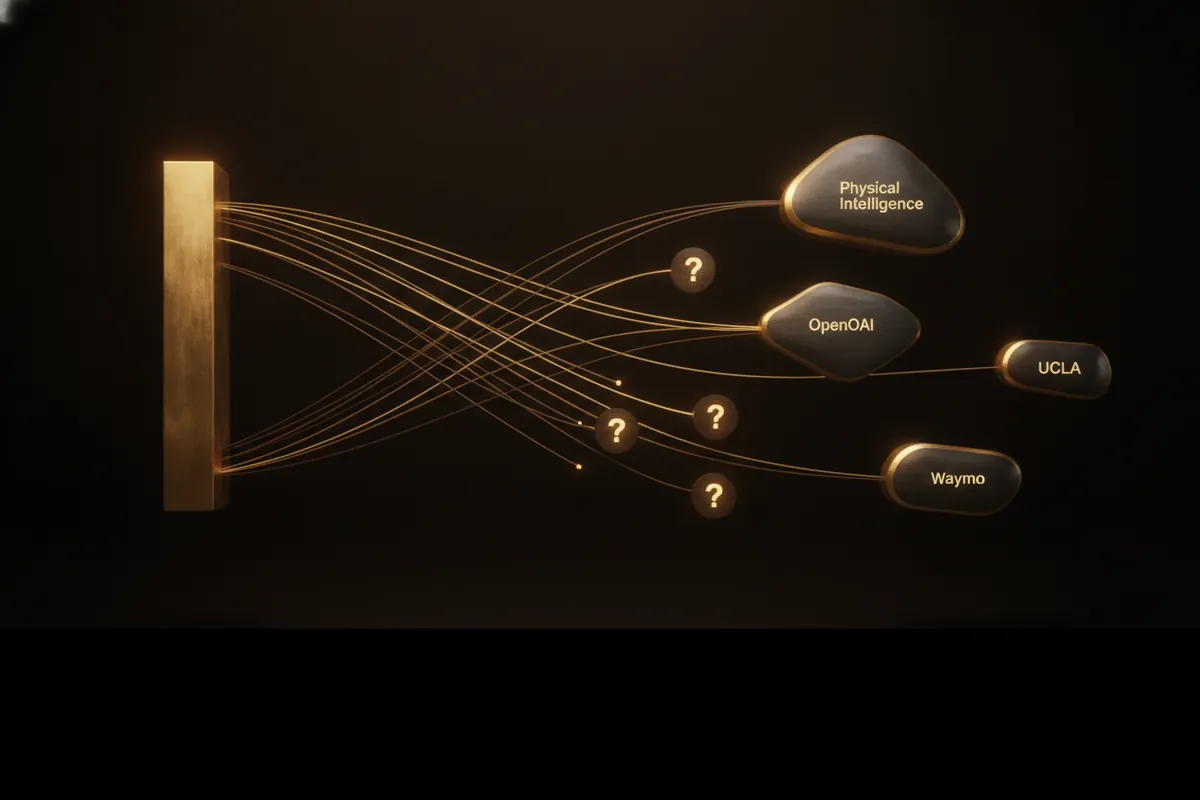
The 2026 BAIR Graduate Showcase is a routing table: the next-destination line, not the thesis title, predicts which mechanisms reach production. A third of the class is still looking for a route.
→ →
Self-forcing is the latency mechanism, not the FPS claim
Waypoint-1 hits 30 FPS, but the load-bearing mechanism is self-forcing: post-training aligning the training regime with inference, stopping error accumulation.
→ →Build your world on an engine that proves what it claims.
Create your own network on the engine that's run since 2016 — or talk to the team behind the 21 papers.