
The Correlation Is the Mechanism, Not the Narrative Output
An AI trading agent on a Raspberry Pi, a paper account, a net loss. The Honest Architect reads the correlation engine as the signal-vs-noise mechanism, instruction files as personality bounds, bracket-at-entry as risk control, tradeability-first as useful output, explicit schema as boundary parsing, measured loss as honest status.

The Correlation Is the Mechanism, Not the Narrative Output
An Honest Architect reading of Offensive OSINT s06e01 - How not to trade with Openclaw, published 2026-04-02 by Peter Seal on Offensive OSINT.
The surface claim of the article is a trading experiment: a solo operator gave an AI agent trading authority on a $10k Alpaca paper account, backed by PREDI (a real-time alternative-data platform of 80+ sources) and OpenClaw (a persistent agent daemon), both on a Raspberry Pi 4. The Honest Architect reads it for the mechanism under the experiment and finds six. The load-bearing one is the correlation engine: one source mentioning a ticker is noise; the same ticker across unusual options flow and realtime search and an SEC 8-K is potentially tradeable. Theorem 3 in Everythink's HAI Engine asserts the same form: a property is guaranteed exactly when its mechanism is implemented and measuring. Here the property is "a signal is real"; the mechanism is "the correlation engine flags the same keyword across multiple sources at the same time."
A scope note before the mechanisms: the source is a paper-trading experiment, openly shared, with a net loss of $74 (-0.74%) over roughly twelve days. This post extracts mechanism forms for agent architecture, not investment advice. Everythink makes no financial prediction claims; the commercial trading or finance go-to-market is 🔵 Roadmap (pre-revenue, subject to Howey review). The six mechanism forms are ✅ — extractible from the article's own evidence. Cross-domain parallels to Everythink are ⚠️ — structural, not a claim that our systems serve the same market.
Mechanism 1 — The correlation engine is the mechanism of signal-vs-noise
The article states that "the most interesting piece is the correlation engine. It's a dedicated endpoint that looks for the same keyword appearing across multiple sources at the same time. One source mentioning a ticker is noise. The same ticker showing up in unusual options flow and realtime search and an SEC 8-K filed that's potentially tradeable." The Honest Architect reads this as a signal-vs-noise claim: a signal is real is guaranteed by multi-source correlation being implemented and measuring, not by a single source being loud. The mechanism that produces "this ticker is potentially tradeable" is "the same keyword appears across multiple sources simultaneously." The correlation is the mechanism; the single loud source is not. ✅ Production — the article names the mechanism (correlation engine, same keyword across multiple sources) and the property (potentially tradeable signal).
The article is honest that most real-time noise detection is noise by itself: "it gets interesting when their correlation engine starts seeing the same keywords popping up across different sources at the same time." The correlation turns noise into a candidate signal.
The cross-domain parallel to Everythink's World Monitor is only structural. World Monitor is a multi-source geo-signal gateway: one background poller per source pulls an external feed on a fixed schedule, normalizes it to a GeoSignal, and upserts into a durable cache. A single source reporting a fire is an event; the same geohash tile showing fire plus vessel diversion plus flight pattern change is a correlated signal. The article's "same keyword across multiple sources is the signal" and World Monitor's "same geohash tile across multiple sources is the correlated delta" share the same form: multi-source correlation is the mechanism that separates signal from noise. ⚠️ Partial — World Monitor serves civil and defensive geo-signal delivery, PREDI's correlation engine serves a personal trading experiment.
Mechanism 2 — The instruction files are the mechanism of personality-bounds
The article states that "at the beginning of using Openclaw you have to give him reason to live that is covered in couple markdown files: SOUL.md defines the personality and trading philosophy... IDENTITY.md is the operational identity... USER.md covers who it's working for." The Honest Architect reads this as a personality-bounds claim: the agent behaves within bounds is guaranteed by the instruction files being declared and loaded, not by the model's defaults being safe. The mechanism that produces "the agent executes immediately" is "IDENTITY.md declares execution bias, and the next session incorporates the file." The instruction files are the mechanism; the model's default behavior is not. ✅ Production — the article names the mechanism (SOUL.md, IDENTITY.md, USER.md, updated on lessons) and the property (bounded agent behavior).
The article is honest that the files are updated when something breaks: "the files get updated, and the next session incorporates the change automatically." The bounds are revised by measured failures.
The cross-domain parallel to Everythink's typed Sisters is only structural. Each Sister is a typed personality loaded at runtime from a TOML file (analyst, contrarian, disruptor, historian, institutionalist) — editing one does not require recompiling. The article's "the instruction files define the personality and the next session loads them" and the Sisters' "the TOML defines the personality and each run loads it" share the same form: a declared personality file is the mechanism of typed behavior. ⚠️ Partial — the Sisters serve civil and defensive prediction, OpenClaw's instruction files serve a personal trading experiment.
Mechanism 3 — The bracket-at-entry is the mechanism of risk-control
The article states that "every entry must use order_class=bracket with take_profit.limit_price and stop_loss.stop_price set at entry, not after. Bracket legs are attached to the parent order and bypass the PDT check entirely with no exceptions." The Honest Architect reads this as a risk-control claim: a position has a stop is guaranteed by the bracket being attached at entry, not by the agent remembering to add one later. The mechanism that produces "every position has a take-profit and a stop-loss" is "the bracket is hardcoded into the order class at entry." The bracket-at-entry is the mechanism; the intention to add a stop later is not. ✅ Production — the article names the mechanism (order_class=bracket, TP and SL at entry, hardcoded) and the property (every position is bracketed).
The article is honest about why this is hardcoded. An early position was "a plain market buy, with the plan to add a stop loss after the fill. Clean enough in theory. In practice, Alpaca flagged the protective stop as a day trade violation." The fix is now "hardcoded into the identity file and every heartbeat file... with no exceptions."
The cross-domain parallel to Everythink's Eye Key sovereignty is only structural. The Eye Key is the user-owned credential — the key is the rate-limit boundary, and the platform does not subsidize the user's compute. The article's "the bracket is the risk boundary, hardcoded with no exceptions" and Eye Key's "the key is the rate-limit boundary, registered not negotiated" share the same form: a hardcoded boundary is the mechanism of control. ⚠️ Partial — Eye Key governs API sovereignty for civil and defensive prediction, the bracket-at-entry governs a personal trading experiment.
Mechanism 4 — The tradeability-first constraint is the mechanism of useful-output
The article states that "during the first few days of the Iran war, the heartbeat reports got very good at explaining Middle East dynamics and very poor at generating actual positions. The agent spent 80k tokens building a picture of Hormuz shipping disruptions and then says 'XLE remains a hold.' Technically correct but useless." The fix: "If geopolitics signal doesn't resolve to a specific ticker with an executable plan (bracket levels, size, entry condition), skip it and look elsewhere." The Honest Architect reads this as a useful-output claim: the output is useful is guaranteed by the tradeability-first constraint being enforced, not by the analysis being thorough. The mechanism that produces "the agent produces an executable plan" is "the constraint requires a specific ticker with bracket levels, or the cycle skips." The tradeability-first constraint is the mechanism; thoroughness is not. ✅ Production — the article names the mechanism (tradeability-first rule in IDENTITY.md, executable plan required or skip) and the property (useful output).
The article is honest about why this was "the biggest tuning problem." Language models "will produce long, well-reasoned, beautifully structured analysis. And then they will not do anything with it." The narrative is the model's default output; the tradeability-first constraint forces a decision.
The cross-domain parallel to Theorem 3 itself is only structural. Theorem 3 asserts that a property is guaranteed exactly when its mechanism is implemented and measuring — the narrative about a property is not the guarantee; the mechanism is. The article's "the narrative is not the output, the executable trade is" and Theorem 3's "the claim is not the guarantee, the mechanism is" share the same form: the mechanism is the output that matters. ⚠️ Partial.
Mechanism 5 — The schema-explicit-in-instructions is the mechanism of boundary-parsing
The article states that "/api/digest/ does not return {results: [...]}. It returns an object with a signals key that's a dict of lists (one per source) plus a stale array. The agent spent several early cycles parsing it as a results array, reporting 'digest: 0 signals' while perfectly good data was there but untouched." The fix: "When building an API that an agent will consume, the schema has to be spelled out explicitly in the instructions." The Honest Architect reads this as a boundary-parsing claim: the agent parses the response correctly is guaranteed by the schema being explicit in the instructions, not by the agent inferring the structure. The mechanism that produces "the agent reads the signals dict" is "the schema is declared in the instructions, and the agent does not infer." The explicit schema is the mechanism; inference is not. ✅ Production — the article names the mechanism (schema spelled out in instructions, documented in long-term memory) and the property (correct parsing).
The article is honest that the failure was silent. The agent did not crash; it reported "digest: 0 signals" while the data was there. A silent misparse is worse than a crash because the agent proceeds with an empty picture and does not know it is wrong. The explicit schema prevents the silent misparse.
The cross-domain parallel to Everythink's Zod-at-runtime-boundary is only structural. Everythink's wire types are defined once in Zod in @everythink/types, and responses are parsed at the network boundary; a bad payload surfaces as a typed ApiError, never a crash. The article's "the schema is explicit in the instructions, and the agent does not infer" and Everythink's "the schema is explicit in Zod, and the parser does not infer" share the same form: an explicit schema at the boundary is the mechanism of correct parsing. ⚠️ Partial.
Mechanism 6 — The measured-loss honesty is the mechanism of status-reporting
The article states the net result plainly: "Net total -$74 (-0.74%)." And the verdict: "It works in the sense that the agent trades, follows the workflow, sends nice reports, and hasn't hallucinated a position or accidentally leveraged the account into oblivion." But: "What it hasn't done, at least not consistently, is what the whole thing is actually built for: catching high-conviction movers before they're obvious. The infrastructure is there... The calibration between 'interesting signal' and 'executable trade' is still being tuned. That's the honest status." The Honest Architect reads this as a status-reporting claim: the status is honest is guaranteed by the measured loss being reported and the gap being named, not by the experiment being declared a success. The mechanism that produces "the reader knows the real status" is "the net loss is published and the unmet goal is named." The measured honesty is the mechanism; the success framing is not. ✅ Production — the article names the mechanism (net -$74 published, unmet goal named) and the property (honest status).
The article is honest that the infrastructure works and the calibration does not. Theorem 3 draws the distinction: the infrastructure is implemented, but the property "catches high-conviction movers before they're obvious" is not yet guaranteed because its mechanism (the calibration between interesting signal and executable trade) is not yet measuring. The article names the gap.
The cross-domain parallel to Everythink's Oracle entropy is only structural. The Oracle normalizes probabilities in exactly one place and stamps entropy in nats on every merge — the entropy is the calibration signal that comes for free from the normalization, not a separate assertion of confidence. The article's "the measured loss is the status, and the unmet goal is named" and the Oracle's "the entropy is the calibration, and it is stamped not asserted" share the same form: a measured signal is the mechanism of honest status. ⚠️ Partial.
What this implies for scope and limits
The Offensive OSINT article is about a personal paper-trading experiment, an AI agent on a Raspberry Pi, and alternative-data signal processing. Everythink's platform is about civil and defensive prediction. The cross-domain parallels are structural — they share mechanism forms, not markets. The Honest Architect marks them ⚠️.
Everythink's own go-to-market for trading, finance, or investment applications is 🔵 Roadmap — pre-revenue, subject to Howey review. The architectural parallels hold independently; the commercial claims do not. This post is not investment advice; the source experiment netted a loss, and the article itself says so.
What the article does not claim deserves a mark too. It does not claim the agent is profitable — it claims the agent is "still standing but hasn't made me rich." It does not claim the infrastructure is the bottleneck — it claims the calibration is. It does not claim the models are brilliant — it claims "the agent's knowledge of finance is only as good as the instructions you give it." These scope limits are the article's honesty, and this post preserves them.
Key points
- A signal is real is guaranteed by multi-source correlation being implemented and measuring, not by a single source being loud. The correlation engine is the mechanism. ✅ Production.
- The agent behaves within bounds is guaranteed by the instruction files being declared and loaded, not by the model's defaults. The instruction files are the mechanism. ✅ Production.
- A position has a stop is guaranteed by the bracket being attached at entry, not by the agent remembering to add one later. The bracket-at-entry is the mechanism. ✅ Production.
- The output is useful is guaranteed by the tradeability-first constraint being enforced, not by the analysis being thorough. The tradeability-first constraint is the mechanism. ✅ Production.
- The agent parses the response correctly is guaranteed by the schema being explicit in the instructions, not by the agent inferring the structure. The explicit schema is the mechanism. ✅ Production.
- The status is honest is guaranteed by the measured loss being reported and the gap being named, not by the experiment being declared a success. The measured honesty is the mechanism. ✅ Production.
- The cross-domain parallels to World Monitor (multi-source correlation is signal-vs-noise), typed Sisters (declared personality file is typed behavior), Eye Key (hardcoded boundary is control), Theorem 3 (the mechanism is the output that matters), Zod-at-runtime-boundary (explicit schema at boundary is correct parsing), and Oracle entropy (measured signal is honest status) are only structural — different markets, same mechanism forms. ⚠️ Partial.
- Everythink's go-to-market for trading, finance, or investment applications is 🔵 Roadmap — pre-revenue, subject to Howey review; this post is not investment advice; the architectural parallels hold, the commercial claims do not.
Sources
- Offensive OSINT s06e01 - How not to trade with Openclaw, Offensive OSINT, published 2026-04-02. https://www.offensiveosint.io/offensive-osint-s06e01-how-not-to-trade-with-openclaw/ (retrieved 2026-08-23).
- Everythink platform architecture: HAI Engine in production since 2016; Theorem 3 (a property is guaranteed exactly when its mechanism is implemented and measuring); "the space is the router" topology (network → community → room); World Monitor (geo-signals routed by geohash prefix, multi-source gateway with per-source self-disable, clients read the cache not the upstreams); Oracle ensemble normalization with entropy in nats stamped on every merge; typed Sisters (analyst, contrarian, disruptor, historian, institutionalist) loaded at runtime from TOML files; trait-based hexagonal ports with interchangeable adapters; Zod wire types defined once in
@everythink/types, parsed at the network boundary, bad payload → typed ApiError; Eye Key sovereignty (HMAC and fingerprint registered, plaintext never touches disk, the user's key is the rate-limit boundary).
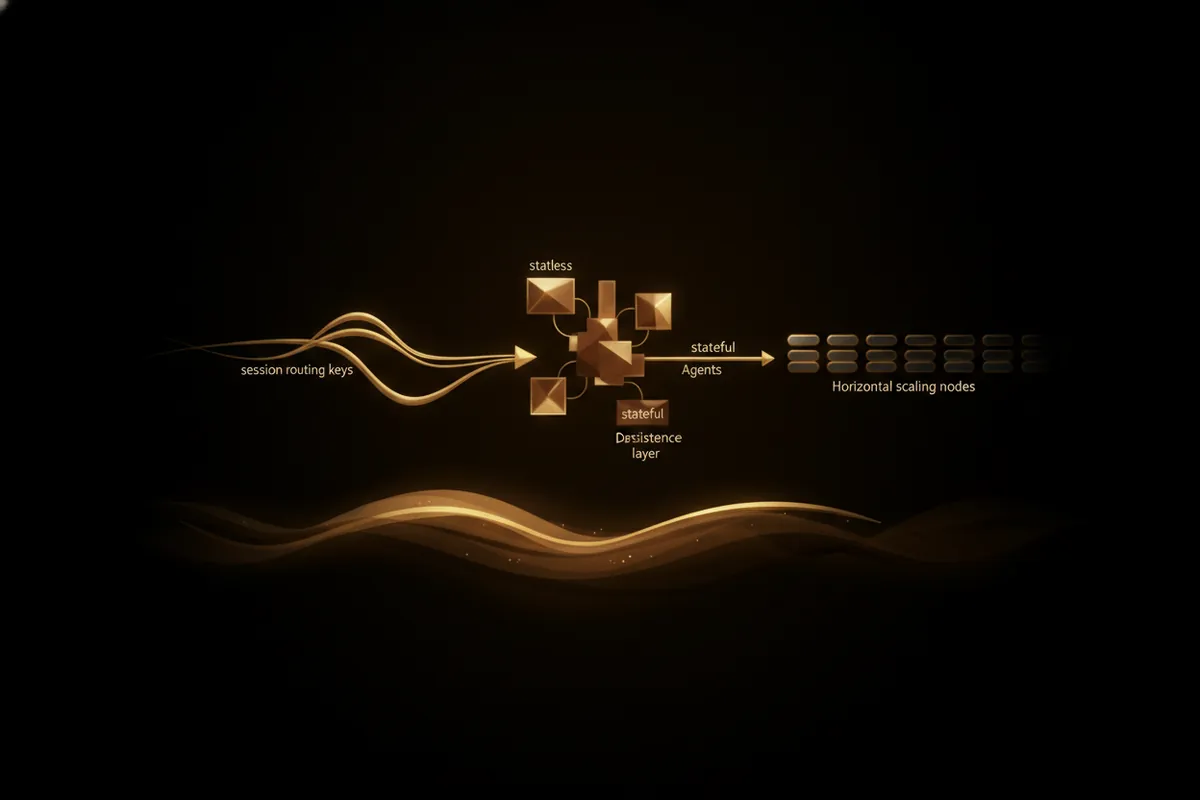
The state location is the mechanism, not the agent label
An Honest Architect's reading of MachineLearningMastery's stateful-vs-stateless agent design article: six mechanism forms, Theorem 3, and cross-domain parallels to Everythink's stateless Sisters and stateful Loom.
→ →
The hook is the guarantee mechanism, not the prompt
A Claude Code hook is deterministic code at a fixed point in the agent loop — Theorem 3: a property is guaranteed by an implemented, measuring mechanism.
→ →
The mechanism must match the query type, not the retrieval assertion
ByteByteGo's GraphRAG explainer reads as five mechanism forms: similarity-search-for-local, knowledge-graph-for-connections, community-reports-for-global, map-reduce-for-aggregation, routing-for-query-type. Theorem 3 applied to each.
→ →Build your world on an engine that proves what it claims.
Create your own network on the engine that's run since 2016 — or talk to the team behind the 21 papers.