
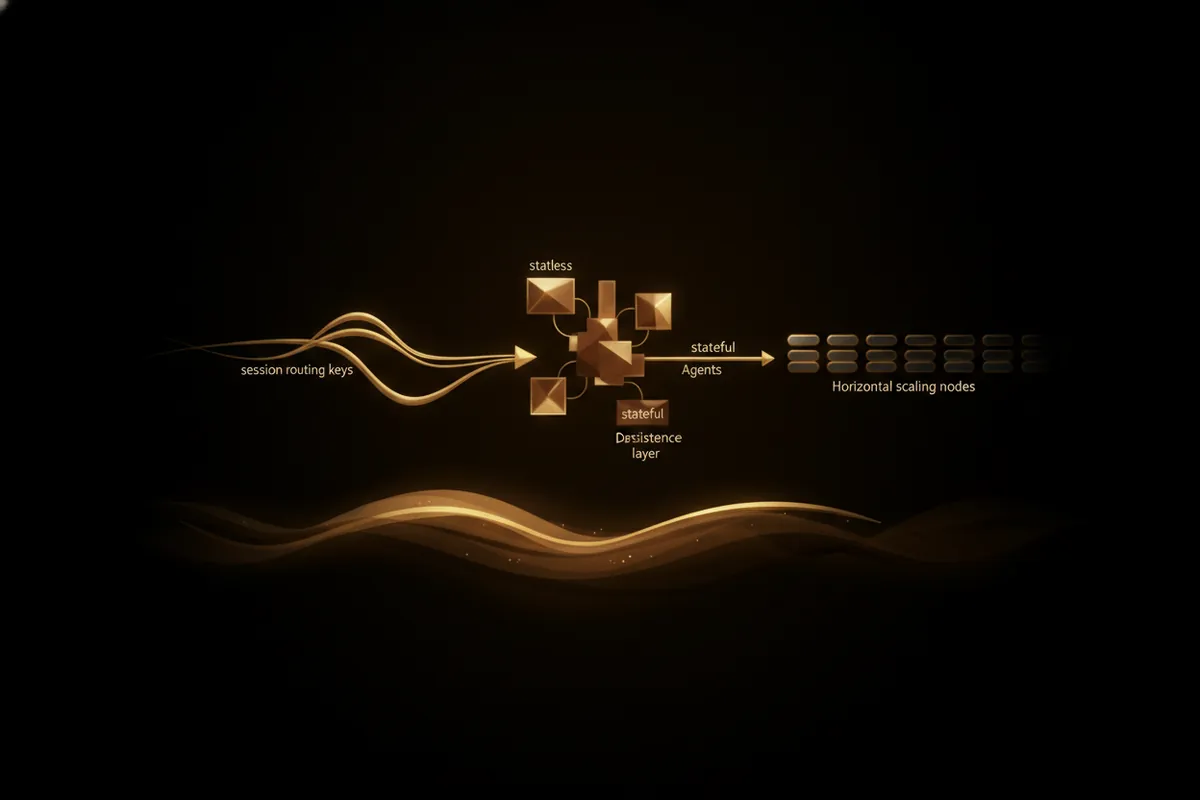
The state location is the mechanism, not the agent label
An Honest Architect's reading of Stateful vs. Stateless Agent Design: Tradeoffs for Scalable Agentic Systems, published 2026-07-24 by Iván Palomares Carrascosa on MachineLearningMastery.com.
The surface claim of the article is a taxonomy: stateless agents versus stateful agents, with code examples for each. The Honest Architect reads it for the mechanism under the taxonomy, and finds six. The load-bearing one is the state location: the article's own framing is that "where does the agent's memory reside?" is the question that "has to be answered before any load balancer is configured." The agent label (stateless or stateful) is the marketing layer; the state location is the mechanism layer. Theorem 3 in Everythink's HAI Engine asserts the same form: a property is guaranteed exactly when its mechanism is implemented and measuring. Here the property is "scales horizontally to any instance"; the mechanism is "no server-side state exists."
This post extracts six mechanism forms from the MachineLearningMastery article, applies Theorem 3 to each, and draws cross-domain parallels to the Everythink platform. Each parallel from our platform is marked ⚠️ — Everythink operates in civil and defensive forecasting, the MachineLearningMastery article operates in developer education and agent architecture, so the parallel is structural, not a claim that our systems serve the same market. The six mechanism forms themselves are ✅ — they are extractable from the article's own evidence.
Mechanism 1 — Statelessness is the horizontal-scaling mechanism
The article states that "architectures based on stateless agents can be scaled horizontally with remarkable ease. Since no user memory is stored on a backend server, incoming requests can be forwarded to any available instance." The Honest Architect reads this as a mechanism claim: horizontal scaling to any instance is guaranteed by the absence of server-side state, not by a smarter load balancer. The mechanism that produces "any instance can serve any request" is "no instance holds state that another instance lacks." If the state is zero, the routing is trivial; if the state is non-zero, the routing must respect it. ✅ Production — the article names the mechanism (no user memory on the backend) and the property (any instance can serve).
The article is honest that this is a tradeoff, not a victory. The same absence of server-side state that makes horizontal scaling easy also makes multi-turn continuity hard, which is the next mechanism. Statelessness buys scaling; it costs continuity. The HAI Engine runs Sisters that return SisterOutput and never write to Postgres themselves — the Loom persists. The Sisters are stateless compute workers; the Loom is the stateful persistence layer. The MachineLearningMastery article's "stateless agent scales horizontally because no server-side state" and Everythink's "stateless Sisters scale because they return output and do not persist" share the same form: the compute node is stateless, the persistence is elsewhere. ⚠️ Partial — the parallel is structural; Everythink's stateless Sisters serve civil and defensive forecasting, the MachineLearningMastery stateless agent serves developer education. Different domains, same form: the compute node carries no state, so it can be replaced or replicated freely.
Mechanism 2 — Client-supplied history is the stateless continuity mechanism
The article states that in a stateless design "the frontend must re-send the whole conversation history alongside every new request. As a result, the context window grows with a snowballing effect, quickly driving up token usage." The Honest Architect reads this as a continuity claim: multi-turn continuity in a stateless design is guaranteed by the client carrying the history, not by the agent remembering it. The mechanism that produces continuity is the client-supplied payload, not the agent's memory. The cost is named honestly: the payload snowballs, and token usage grows with it. ✅ Production — the article names the mechanism (client re-sends history) and the cost (snowballing context window).
The article is honest that this cost is a ceiling, not a nuisance. A stateless agent that handles arbitrarily long conversations must receive arbitrarily long payloads, so the token cost grows with the conversation length. This is a mechanism with a named ceiling, not a free lunch: it works until the payload exceeds the context window or the budget, and then it stops working. The Eye Key is the user's own credential — the HMAC and fingerprint are recorded, the plaintext never touches disk, and the key is the user's rate-limit boundary. The MachineLearningMastery article's "the client carries the history, the server carries none" and Everythink's "the user carries the key, the server stores only the HMAC" share the same form: the sovereignty-bearing artifact lives with the client, the server stores only a verifier. ⚠️ Partial — the parallel is structural; Eye Key governs API sovereignty for civil and defensive forecasting, the MachineLearningMastery client-history governs multi-turn continuity for developer education. Different domains, same form: the client carries the load-bearing artifact, the server carries a derivative.
Mechanism 3 — Server-side database is the stateful continuity mechanism
The article states that in a stateful design "the agent takes on the memory burden itself. The client, meanwhile, only needs to send the newest user prompt together with a unique identifier. The agent then retrieves the session history or context from a database and appends the new message to it." The Honest Architect reads this as a continuity claim: multi-turn continuity in a stateful design is guaranteed by a server-side database keyed by session identifier, not by the client resending history. The mechanism that produces continuity is the database lookup, not the payload size. The client payload stays small; the server stores the growing history. ✅ Production — the article names the mechanism (database keyed by session identifier) and the property (continuity with small client payload).
The article is honest that this moves the cost, it does not eliminate it. The stateful design trades payload cost for database cost: "scaling this solution becomes much harder, starting with the need for a persistent database layer in the architecture." Statefulness buys small payloads and server-side trimming; it costs a database layer and harder scaling. The Loom persists simulations and foresight through its slice-owned LoomStore port, and the Sisters return SisterOutput without persisting — the Loom is the stateful layer, the Sisters are the stateless workers. The MachineLearningMastery article's "the agent retrieves history from a database and appends the new message" and Everythink's "the Loom retrieves prior state, fans out to Sisters, persists the merged result" share the same form: the orchestrator owns the state, the workers own the compute. ⚠️ Partial — the parallel is structural; the Loom serves civil and defensive forecasting, the MachineLearningMastery stateful agent serves developer education. Different domains, same form: the persistence layer is the continuity bearer, the compute layer is the stateless producer.
Mechanism 4 — The session identifier is the routing key
The article states that "the session identifier is used to query the relevant information from past interactions in the conversation at hand." The Honest Architect reads this as a routing claim: stateful memory retrieval is guaranteed by the session identifier as the routing key, not by the agent's recall. The mechanism that makes history retrievable is the session_id key, not the agent's internal memory. Without the key, the database is an unindexed pile; with the key, the database is a retrievable history. ✅ Production — the article names the mechanism (session identifier as the query key) and the property (retrievable history).
The article is honest that the session identifier is a routing concern, not a memory concern. A stateful agent that loses the session identifier loses the history, even if the history is still in the database. The stateful design depends on the routing key being present and consistent, not on the database existing. Everythink's topology is network → community → room: a request is routed to a room before anything responds, and the room key is the routing key that makes the right state reachable. The MachineLearningMastery article's "the session identifier routes the request to the right history" and Everythink's "the topology routes the request to the right room" share the same form: the routing key precedes the response, and the routing key decides which state is reachable. Everythink's World Monitor embodies the same form at planetary scale: geo-signals routed by geohash tile prefix, clients read the cache not upstreams, so the routing key (the geohash) decides which tile's state is reachable before any viewport response. ⚠️ Partial — the parallel is structural; Everythink's router is a topology of public rooms and geohash tiles, the MachineLearningMastery router is a session identifier. Different domains, same form: the routing key is the retrievability bearer, and the routing decision precedes the response.
Mechanism 5 — Localized amnesia is the stateful scaling failure mode
The article states that "in infrastructures that scale horizontally, strategies such as centralized memory caching with Redis may also become necessary to avoid 'localized amnesia', where a session's history is stranded on the single instance that happened to serve the earlier turns." The Honest Architect reads this as a failure-mode claim: the stateful scaling failure is guaranteed by instance-local state in a horizontally-scaled fleet, not by the database being slow. The mechanism that produces localized amnesia is "the state lives on the instance that wrote it, and the load balancer does not route by session_id." The fix is named honestly: centralized memory caching with Redis, so the state is shared across instances. ✅ Production — the article names the failure mode (localized amnesia), the mechanism (instance-local state in a scaled fleet), and the fix (centralized caching).
The article is honest that this is a specific failure mode with a specific mechanism, not a vague "scaling is hard." Localized amnesia happens when the state is instance-local and the routing is state-blind; it does not happen when the state is shared or the routing is session-aware. The Honest Architect marks this as the article's honesty about the precision of the failure: the failure has a mechanism, and the mechanism has a fix. Everythink's AppState repositories are Arc
Mechanism 6 — Workflow match is the selection mechanism
The article states that "the choice between a stateful and a stateless architectural design boils down to properly matching the infrastructure to the workflow," and gives the match criteria: stateless for "simple pipelines oriented to very specific tasks, like text extraction, summarization, or single-turn classification chatbots"; stateful for "long-running assistants, coding assistants, or multi-turn bots in applications like customer service." The Honest Architect reads this as a selection claim: the right state model is guaranteed by matching the state location to the workflow's continuity demand, not by picking the more sophisticated design. The mechanism that produces the right choice is the workflow match, not the technology preference. ✅ Production — the article names the mechanism (match infrastructure to workflow) and the criteria (single-turn vs multi-turn).
The article is honest that neither design is universally superior. A stateless agent forced into a multi-turn workflow snowballs payloads; a stateful agent forced into a single-turn workflow pays a database cost it does not need. There is no global winner: the right mechanism depends on the workflow, and the workflow is the selection criterion. Everythink's architecture is a set of ports where each port answers a different question, and the use-case crates depend on the trait, never the concrete adapter — the right port is selected by the question, not by the implementation preference. The MachineLearningMastery article's "match the state model to the workflow" and Everythink's "match the port to the question" share the same form: the selection is by the demand, not by the supply. ⚠️ Partial — the parallel is structural; Everythink's port selection serves civil and defensive forecasting, the MachineLearningMastery state-model selection serves developer education. Different domains, same form: the selection mechanism is the demand match, not the supply preference.
What this implies for scope and limits
The MachineLearningMastery article is about developer education and agent architecture. Everythink's platform is about civil and defensive forecasting. The cross-domain parallels in this post are structural — they share mechanism forms, not markets. The Honest Architect marks the parallels ⚠️ for this reason.
Everythink's own go-to-market for commercial agent-tooling is 🔵 Roadmap — the platform is pre-revenue, and any commercial application of the parallels drawn here is subject to that Roadmap state and to Howey review before it could be offered. The architectural parallels hold independently; the commercial claims do not.
What the article does not claim deserves a mark too. It does not claim that stateless is superior — it names the snowballing-payload cost. It does not claim that stateful is superior — it names the database-layer cost and the localized-amnesia failure. It does not claim that the tradeoff is solvable — it names the matching criterion. These scope limits are the article's honesty, and this post preserves them.
Key takeaways
- Horizontal scaling to any instance is guaranteed by the absence of server-side state, not by a smarter load balancer. The state location is the scaling mechanism. ✅ Production.
- Multi-turn continuity in a stateless design is guaranteed by the client carrying the history, with a snowballing-payload cost. The client payload is the continuity bearer. ✅ Production.
- Multi-turn continuity in a stateful design is guaranteed by a server-side database keyed by session identifier, with a database-layer cost. The database is the continuity bearer. ✅ Production.
- Stateful memory retrieval is guaranteed by the session identifier as the routing key. The routing key is the retrievability bearer. ✅ Production.
- The stateful scaling failure is guaranteed by instance-local state in a horizontally-scaled fleet; the fix is shared state or session-aware routing. The failure has a mechanism, and the mechanism has a fix. ✅ Production.
- The right state model is guaranteed by matching the state location to the workflow's continuity demand. The workflow is the selection mechanism. ✅ Production.
- Cross-domain parallels to Everythink's HAI Engine (stateless Sisters, stateful Loom), "the space is the router" (routing key precedes response), World Monitor (cache as stateful layer, pollers as stateless feeders), Eye Key (client carries the load-bearing artifact), and hexagonal ports (shared trait, demand-match selection) are only structural — different markets, same mechanism forms. ⚠️ Partial.
- Everythink's go-to-market for commercial agent-tooling is 🔵 Roadmap — pre-revenue, subject to Howey review; the architectural parallels hold, the commercial claims do not.
Sources
- Iván Palomares Carrascosa, Stateful vs. Stateless Agent Design: Tradeoffs for Scalable Agentic Systems, MachineLearningMastery.com, published 2026-07-24. https://machinelearningmastery.com/stateful-vs-stateless-agent-design-tradeoffs-for-scalable-agentic-systems (retrieved 2026-08-23).
- Everythink platform architecture: HAI Engine in production since 2016; Theorem 3 (a property is guaranteed exactly when its mechanism is implemented and measuring); topology "the space is the router" (network → community → room); World Monitor (geo-signals routed by geohash tile prefix, clients read the cache not upstreams); Oracle ensemble normalization with entropy in nats stamped on every merge; typed Sisters (analyst, contrarian, disruptor, historian, institutionalist) returning SisterOutput without persisting, Loom as stateful persistence layer; hexagonal trait-based ports with swappable adapters; Eye Key sovereignty (HMAC and fingerprint recorded, plaintext never touches disk, the user's key is the rate-limit boundary).
The mechanism must match the query type, not the retrieval assertion
ByteByteGo's GraphRAG explainer reads as five mechanism forms: similarity-search-for-local, knowledge-graph-for-connections, community-reports-for-global, map-reduce-for-aggregation, routing-for-query-type. Theorem 3 applied to each.
→ →
The four-layer verification is the mechanism, not the reliability assertion
Ciberpatrulla's pre-contractual company verification guide reads as five mechanism forms: four-layer-verification, public-source-as-measurement, layered-architecture-as-routing, absence-as-signal, temporal-consistency. Theorem 3 applied to each.
→ →
The windowing is the mechanism, not the model assertion
An Honest Architect's reading of Marktechpost's GeoAI tutorial: six mechanism forms from a building-footprint extraction pipeline, Theorem 3, and cross-domain parallels to Everythink's World Monitor and Oracle.
→ →Build your world on an engine that proves what it claims.
Create your own network on the engine that's run since 2016 — or talk to the team behind the 21 papers.