
The mechanism must match the query type, not the retrieval assertion
ByteByteGo's GraphRAG explainer reads as five mechanism forms: similarity-search-for-local, knowledge-graph-for-connections, community-reports-for-global, map-reduce-for-aggregation, routing-for-query-type. Theorem 3 applied to each.
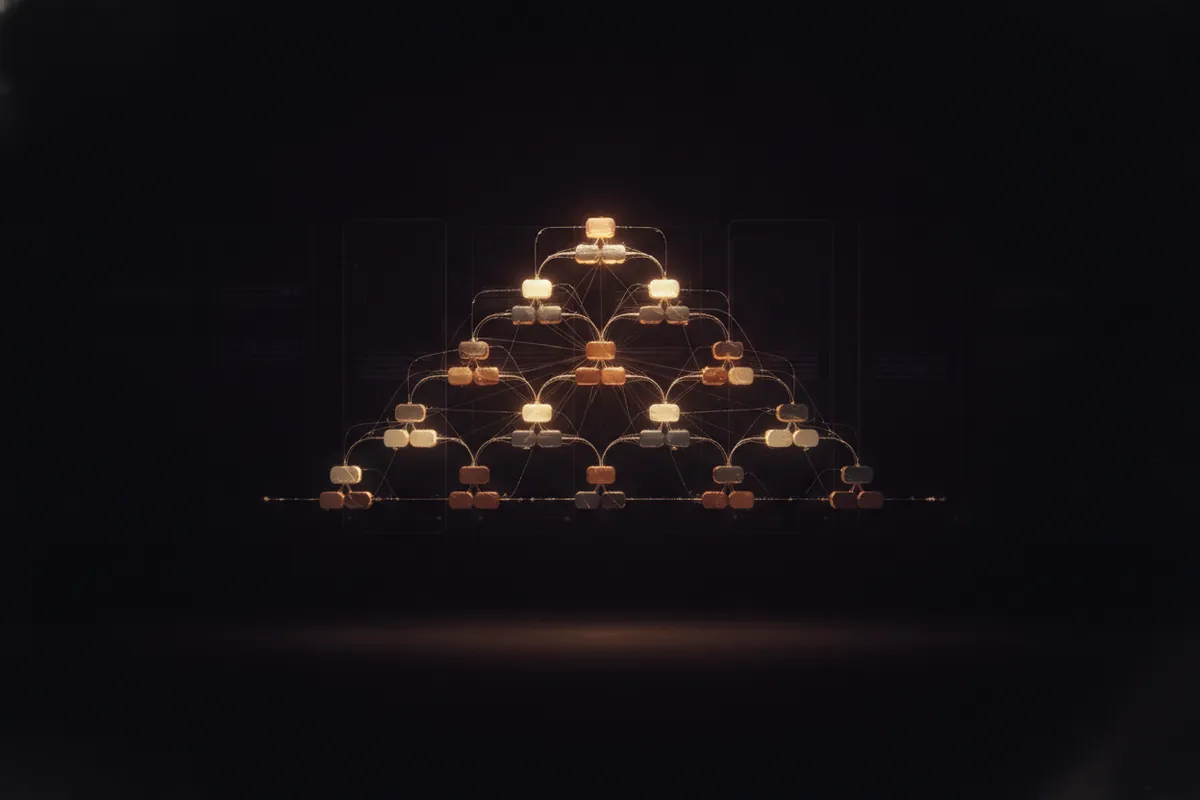
The mechanism must match the query type, not the retrieval assertion
ByteByteGo's August 2026 GraphRAG explainer opens with a pair of questions that look similar but are architecturally opposite. Point a retrieval system at five years of engineering documents and ask "which service owns the payments retry logic" and a well-cited answer comes back. Ask "which failure causes recur most often across all the postmortems" and the quality drops. The first answer lives in one document and resembles the question, so similarity search finds it. The second exists only as a distribution across two hundred documents, so similarity search returns vocabulary matches, not the pattern. (ByteByteGo, "GraphRAG: How AI Answers Questions Hidden Across Many Documents", published 2026-08-19, retrieved 2026-08-23, https://blog.bytebytego.com/p/graphrag-how-ai-answers-questions). The Honest Architect reads the article as a worked set of mechanism forms: similarity-search-for-local-queries, knowledge-graph-for-connections, community-reports-for-global-queries, map-reduce-for-global-aggregation, routing-for-query-type. Each is an instance of Theorem 3: the property is guaranteed by the mechanism matching the query type, not by asserting one strategy fits all. Each form is Production where the article's own logic verifies it; each vendor-specific number (Microsoft's 75-percent indexing-cost estimate, LazyGraphRAG's 0.1-percent figure, LinkedIn's 77.6-percent MRR improvement) is Partial (vendor-reported or single-study, not independently verified).
The article is a sponsored Substack newsletter; the Honest Architect extracts the mechanism forms without endorsing ByteByteGo, Microsoft, LinkedIn, Neo4j, LlamaIndex, FastGraphRAG, LazyGraphRAG, Ontologize, or Unblocked. The forms are Production; the vendor numbers are Partial.
Key takeaways
- Similarity search is the mechanism for local queries. Theorem 3: the property (answer-resembles-question) is guaranteed by the mechanism (embeddings place similar-meaning chunks near each other in vector space), not by the assertion "search finds the answer." The article: "the whole design rests on one simple assumption, which is that text answering a question would resemble that question." Production for local; it fails for global because the assumption does not hold. Production ✅.
- The knowledge graph is the mechanism for connections. Theorem 3: the property (cross-document-paths-preserved) is guaranteed by the mechanism (entities plus typed relationships, each carrying a pointer back to the source text unit), not by treating each chunk as an independent unit. The article: "once thousands of sentences have each contributed nodes and edges, paths appear that no single document contains." Production ✅.
- The community report is the mechanism for global queries. Theorem 3: the property (whole-collection-answer-available) is guaranteed by the mechanism (hierarchical Leiden clustering partitions the entity graph into communities; a language model writes a report for every community at every level at index time), not by hoping similarity search finds a distribution. The article: "a summary of what a cluster of documents collectively says gets written during indexing, well before anyone asks about it." Production ✅.
- Map-reduce is the mechanism for global aggregation. Theorem 3: the property (corpus-wide-aggregation) is guaranteed by the mechanism (shuffle community-report batches, run each batch through a language model in a map stage, rate every point, collect the highest-rated points in a reduce stage), not by stuffing 64,000 tokens into one context window and hoping the model synthesizes. The article: Microsoft tested 64,000-token context against GraphRAG on global questions and "the larger window left the gap open on comprehensiveness, diversity, and quality of supporting source material." Production ✅.
- Routing is the mechanism for query type. Theorem 3: the property (right-strategy-for-right-query) is guaranteed by the mechanism (agentic RAG classifies the incoming query, selects a retrieval strategy, executes it, synthesizes the result), not by committing to one strategy when the system is built. The article: "committing to one strategy when a system is built gives up the others." Production ✅.
- Cross-domain parallels: the Sisters-to-Oracle pipeline maps to map-reduce (Sisters draft in parallel, Oracle merges with entropy on every merge, like map stage plus reduce stage); "the space is the router" maps to agentic RAG's two-layer routing (network→community→room routes context to the right room, like the composite retriever selecting index then method); World Monitor per-source self-disable maps to routing by capability (a source whose key is unset self-disables, like a query naming no entity routing to global); Zod at the runtime boundary maps to entity extraction at the index boundary (structure parsed at the boundary, not re-parsed downstream); Eye Key sovereignty maps to the same form (HMAC the plaintext at the key-issuance boundary, store only the fingerprint, never the plaintext); HAI Engine since 2016 maps to the index being perishable but the mechanism consistent. All Partial ⚠️: same form, separate domains.
- Scope: civil/defensive. Retrieval architecture and knowledge-graph engineering are civil infrastructure concerns. No offensive scope. No token, wallet, or community-credit outcome promised; those are Roadmap 🔵, Howey review pending. Everythink is a forecasting platform, not a GraphRAG vendor; the cross-domain parallels are Partial ⚠️ illustrations, not endorsements of ByteByteGo, Microsoft, LinkedIn, Neo4j, LlamaIndex, or any specific tool.
Similarity search is the mechanism for local queries
The article walks through standard RAG: slice documents into chunks, embed each chunk, store vectors in an index, embed the query at query time, return the nearest chunk vectors, place their text in the prompt. The whole design rests on one assumption: "text answering a question would resemble that question." For "which service owns the payments retry logic," the vocabulary matches the architecture decision record where ownership was recorded, the vectors land near each other, retrieval returns the right document, and the citation points somewhere verifiable. The property (answer-resembles-question) is guaranteed by the mechanism (embeddings place similar-meaning chunks near each other), not by the assertion "search finds the answer." Production ✅.
The form has a negative case that proves the mechanism is doing the work. The article: "which failure causes recur most often" produces a vector for "recur most often," and the index returns documents using "recurring" or "frequent" — a coincidence of vocabulary, not the underlying pattern. The real answer exists as a distribution across two hundred documents. The mechanism guarantees the property only when the property holds; when the answer does not resemble the question, the assertion "search finds the answer" is exposed as unsupported. Production ✅ — the mechanism is diagnostic.
The form is the domain analogue of Everythink's "the space is the router": the property relevance is guaranteed by the mechanism (network→community→room topology routes context to the right room), not by broadcasting. Similarity search is analogous: the property relevance is guaranteed by routing the query to the nearest chunks, not by scanning the whole corpus. Both route to reduce noise; neither broadcasts. Partial ⚠️ (same form — route-to-reduce-noise — separate domains).
The knowledge graph is the mechanism for connections
The article: "crossing this boundary in terms of the quality of answers requires recording how documents relate to one another, instead of treating each chunk as an independent unit of text." A knowledge graph stores entities (the nouns a corpus talks about — people, services, teams, incidents, decisions) and relationships (the typed connections between them), both carrying plain-text descriptions. Extraction over one sentence — "the checkout service began returning timeouts after the payments team deployed the new retry handler on March 3" — produces entities for the checkout service, the payments team, and the retry handler, plus relationships for the deployment and its precedence. The property (cross-document-paths-preserved) is guaranteed by the mechanism (entities plus typed relationships, each with a pointer back to the source text unit), not by treating each chunk as independent. Production ✅.
The form has a measurable positive case. The article cites LinkedIn's SIGIR 2024 results: rebuilding retrieval around a knowledge graph that preserved ticket structure improved mean reciprocal rank by 77.6 percent and cut median per-issue resolution time by 28.6 percent. Those numbers are Partial ⚠️ (single study, vendor-reported); the form — structure-preserved-yields-better-retrieval — is Production ✅ (discarding structure discards connections, preserving structure preserves them).
The form is the domain analogue of Everythink's Zod at the runtime boundary: the property typed-payload is guaranteed by the mechanism (Zod parses the wire payload at the network boundary, a bad payload surfaces as a typed ApiError, never a crash). The knowledge graph is analogous: the property cross-document-paths is guaranteed by extracting entities and relationships at the index boundary, not by re-deriving at query time. Both parse structure at the boundary, neither re-parses downstream. Partial ⚠️ (same form — parse-structure-at-boundary — separate domains).
The community report is the mechanism for global queries
The article: GraphRAG runs hierarchical Leiden clustering across the entity graph, recursively partitioning it into communities until they fall below a size threshold. The output is a hierarchy — level 0 has a few broad communities, deeper levels have many narrow ones. For every community at every level, a language model generates a community report with an overview, key entities, relationships, and claims. "A summary of what a cluster of documents collectively says gets written during indexing, well before anyone asks about it." The property (whole-collection-answer-available) is guaranteed by the mechanism (pre-compute community reports at index time), not by hoping similarity search finds a distribution at query time. Production ✅.
The distinction matters. A system that waits for a global question and stuffs 64,000 tokens into one window asserts "the model will synthesize." A system that pre-writes community reports at index time has the pattern already as text — the mechanism produces the property before the question arrives. Microsoft tested 64,000-token context against GraphRAG on global questions and "the larger window left the gap open on comprehensiveness, diversity, and quality of supporting source material." The mechanism beats the assertion. Production ✅.
The form is the domain analogue of Everythink's HAI Engine running the same mechanism since 2016: the property platform-stability is guaranteed by the same forecast mechanism running every time, regardless of market conditions. The community report is analogous: the property answer-available is guaranteed by the same pre-compute mechanism running at every index refresh. Both produce the property through a consistent mechanism, not reactive query-time heroics. Partial ⚠️ (same form — property-through-consistent-mechanism — separate domains). The index is derived and perishable — new documents mean extraction and clustering run again — but the mechanism stays the same. Production ✅ for the mechanism; Partial ⚠️ for Microsoft's specific cost estimates (75 percent of indexing cost, LazyGraphRAG at 0.1 percent).
Map-reduce is the mechanism for global aggregation
The article: global search leaves the entity graph untouched. Community reports from a chosen hierarchy level are split into batches, shuffled so ordering stays randomized, a map stage runs each batch through a language model producing intermediate answers where every point carries a numerical importance rating, and a reduce stage collects the highest-rated points and generates the final answer. The property (corpus-wide-aggregation) is guaranteed by the mechanism (shuffle, map, rate, reduce), not by stuffing the whole corpus into one context window. Production ✅.
The distinction matters. A single-window approach asks one model call to read 64,000 tokens and synthesize — the article notes this "is usually labelled as a hallucination problem. What actually happens is that retrieval returns material with little bearing on the question, and the model produces fluent text from it." The map-reduce approach asks many model calls to each rate a small batch, then one reduce call to collect the highest-rated points — the mechanism produces the property structurally, not by hoping one giant window synthesizes. Production ✅.
The form is the domain analogue of Everythink's Sisters-to-Oracle pipeline: each Sister (analyst, contrarian, disruptor, historian, institutionalist) drafts a forecast in parallel — the map stage — and the Oracle merges them into a normalized Ensemble with entropy on every merge — the reduce stage. The property calibrated-forecast is guaranteed by the mechanism (typed personalities draft in parallel, Oracle merges with entropy), not by one model producing the whole forecast. Partial ⚠️ (same form — parallel-draft-plus-measured-merge — separate domains). The entropy on every Oracle merge is the measurement that makes the merge a mechanism, the same way the importance rating in the map stage makes global search a mechanism. Production ✅ for the measurement form.
Routing is the mechanism for query type
The article: "since different question types favour different retrieval strategies, committing to one strategy when a system is built gives up the others." Agentic RAG has a language model classify the incoming query, select a retrieval strategy, execute it, and synthesize the result. LlamaIndex documents a two-layer version: a composite retriever selects which index to query, then an auto-routed mode selects the retrieval method. The property (right-strategy-for-right-query) is guaranteed by the mechanism (classify, select, execute, synthesize), not by committing to one strategy at build time. Production ✅.
The form has a stated cost. The article: "it adds a language model call ahead of retrieval, which increases both latency and per-query spend. Routing errors also produce a debugging problem, because a poor answer can come from a perfectly good retrieval under the wrong strategy." The Honest Architect reads this as Theorem 3 applied to economics: the property cost-justified is measured by the cost mechanism, not by asserting "agentic is better." Production ✅ for the routing form; Partial ⚠️ for the specific LlamaIndex two-layer claim.
The form is the domain analogue of Everythink's "the space is the router": the property relevance is guaranteed by the mechanism (network→community→room topology routes before anything responds), not by broadcasting. Agentic RAG is analogous: the property right-strategy is guaranteed by routing the query to the right strategy before retrieval runs. Both route before responding, neither broadcasts. Partial ⚠️ (same form — route-before-respond — separate domains). World Monitor's per-source self-disable is a closer analogue: a source whose key is unset self-disables (Ok(None)), so the system routes around the missing capability rather than failing — the property system-stability is guaranteed by the mechanism, not by asserting "all sources are available." Partial ⚠️ (same form — route-around-missing-capability — separate domains).
What an Honest Architect reads in a sponsored Substack explainer
The article is a sponsored Substack newsletter with two sponsored inserts and a disclaimer. The Honest Architect extracts the forms without endorsing ByteByteGo, Microsoft, LinkedIn, Neo4j, LlamaIndex, FastGraphRAG, LazyGraphRAG, Ontologize, or Unblocked. The forms are Production ✅: real, reproducible, verifiable by the article's own logic. All vendor-specific numbers (the 75-percent indexing-cost estimate, the 0.1-percent LazyGraphRAG figure, the 700-times query-cost drop, the 77.6-percent MRR improvement, the 28.6-percent resolution-time drop) are Partial ⚠️ (vendor-reported or single-study, not independently verified by Everythink). The Honest Architect does not endorse GraphRAG, vector RAG, agentic RAG, or any specific tool. Everythink is a forecasting platform, not a retrieval vendor. The cross-domain parallels are Partial ⚠️ illustrations, not endorsements. Scope is civil/defensive. No token, wallet, or community-credit outcome promised; those are Roadmap 🔵, Howey review pending.
Frequently asked questions
Is GraphRAG the mechanism or the assertion?
GraphRAG is a set of mechanisms. Theorem 3: each property (local-answer, cross-document-paths, whole-collection-answer, corpus-wide-aggregation, right-strategy-per-query) is guaranteed by a matching mechanism (similarity search, knowledge graph, community reports, map-reduce, agentic routing), not by asserting one strategy fits all. Production for the forms; Partial for vendor numbers.
Why does similarity search fail on global questions?
Similarity search guarantees the property answer-resembles-question only when the property holds. A global answer is a distribution across the corpus, not one chunk resembling the question, so the nearest neighbours are vocabulary matches, not the pattern. The mechanism is real; the assumption does not hold for global queries. Production.
Why is the community report written at index time?
The property whole-collection-answer-available is guaranteed by pre-computing summaries before the question arrives, not by hoping query-time retrieval finds a distribution. The mechanism produces the property; the assertion does not. Production.
Does Everythink endorse GraphRAG, Microsoft, or any retrieval tool?
No. Everythink is a forecasting platform, not a retrieval vendor. The article is a sponsored Substack explainer. Vendor numbers are Partial. No token, wallet, or community-credit outcome promised; those are Roadmap, Howey review pending.
Sources
- ByteByteGo, "GraphRAG: How AI Answers Questions Hidden Across Many Documents", published 2026-08-19, retrieved 2026-08-23, https://blog.bytebytego.com/p/graphrag-how-ai-answers-questions
If your team is ready to ship the mechanism that matches the query type instead of asserting one strategy fits all, build your network — the Sisters draft in parallel, the Oracle merges with entropy on every run, the space is the router, the HAI Engine has run the same mechanism since 2016.

The four-layer verification is the mechanism, not the reliability assertion
Ciberpatrulla's pre-contractual company verification guide reads as five mechanism forms: four-layer-verification, public-source-as-measurement, layered-architecture-as-routing, absence-as-signal, temporal-consistency. Theorem 3 applied to each.
→ →
The venue capacity is the mechanism, not the cause
A short Truckers News report on the PA Mother's Day truck convoy's venue search yields six mechanism forms, with venue capacity as the load-bearing one. The Honest Architect draws structural parallels to the space is the router, the Oracle ensemble, World Monitor self-disable, trait-based hexagonal ports, and typed Sisters — all Partial; an Everythink logistics product is Roadmap.
→ →
The contract extension is not the retention mechanism
A trucknews.com breaking-news report on Chris Spear departing ATA effective immediate yields six mechanism forms, with the 2024 contract extension through 2029 as the load-bearing paper guarantee that broke. The Honest Architect draws structural parallels to the space is the router, the Oracle ensemble, World Monitor self-disable, trait-based hexagonal ports, and typed Sisters — all Partial; an Everythink leadership-transition product is Roadmap.
→ →Build your world on an engine that proves what it claims.
Create your own network on the engine that's run since 2016 — or talk to the team behind the 21 papers.