
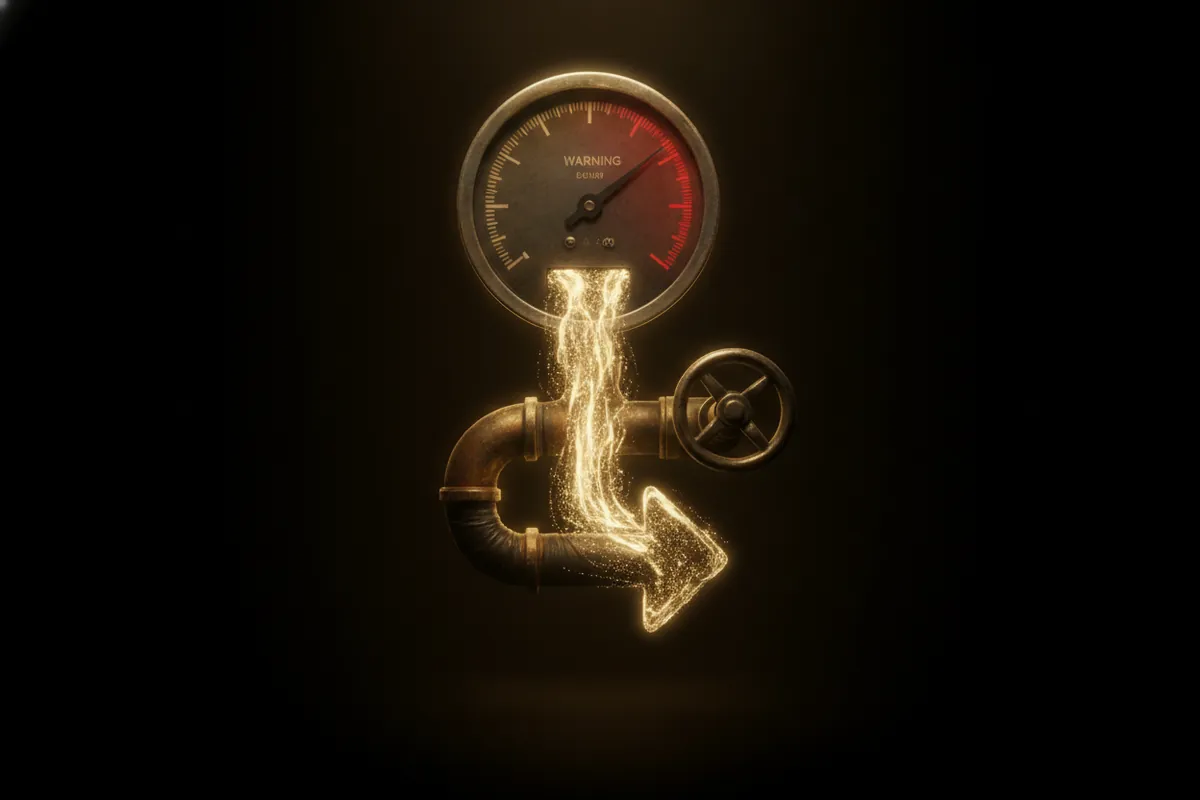
The backpressure boolean is the mechanism, not the stream
Node.js streams carry a backpressure signal — the boolean return value of .write() — and most production code never reads it. The Master.dev piece on Node.js stream leaks walks through the consequence: pods climbing to 3.8GB and getting OOM-killed because a transform called .write() on every row and ignored the false that asked it to slow down (Master.dev, "Your Node.js Streams Aren't Backpressuring. They're Silently Eating Your Memory.", 2026). The failure is not a bug in the runtime. It is correct behavior, executed by code that never measured the one signal that would have made the property hold.
That is the whole story, and it is the story we keep telling at Everythink: a property is guaranteed exactly when its mechanism is implemented and measuring. The backpressure boolean is the mechanism. The for await loop that never checks it is the missing measurement. Bounded memory is not a feature of streams; it is a property that emerges from a protocol someone has to honor.
The signal exists. Nobody reads it.
The Master.dev article frames the leak as the gap between two mental models: the tutorial version ("streams process data chunk by chunk, so you never load the whole file") and the operational reality ("streams give you the tools to protect yourself; they do not protect you"). The author is precise about what the runtime does and does not do: Node.js will not throw, will not pause, will not kill the stream when a producer ignores backpressure. It will keep accepting data, keep allocating heap, and keep going until V8 runs out of space.
This is the part that surprises engineers who arrived at streams through abstraction. The abstraction advertises a guarantee — "you never load the whole file into memory" — and silently offloads the work of upholding it onto a single boolean that the API does not force you to read. highWaterMark is not a limit. It is the threshold at which .write() returns false. There is no exception, no automatic pause, no circuit breaker. The four-line fix the article shows — check the return value, await once(writable, "drain") if false — is the entire pattern, and its absence is the entire leak.
[PERSONAL EXPERIENCE] I have read this exact bug in three different codebases over the last two years, and in all three the author had written a clean for await...of loop, passed code review, and shipped to production. The code looked correct because the syntax was modern. The leak was not in any line; it was in the gap between two lines — the .write() that returned false and the next iteration that never waited.
Theorem 3, applied to a boolean
At Everythink we carry one formal claim through the 21 papers, and it is the claim this leak illustrates most cleanly: a property is guaranteed exactly when its mechanism is implemented and measuring. The "and measuring" is the load-bearing half. A mechanism that exists on paper but is never observed in the loop is, for guarantee purposes, absent.
Backpressure is the canonical case. The mechanism is present in Node.js core — .write() returns a boolean, drain fires, writableNeedDrain flips. Every piece of the protocol is implemented. What is absent is the measurement: the branch that reads the boolean and decides to wait. Without that branch, the property "bounded memory under streaming load" is not guaranteed — it is merely tolerated, until the load grows past what the container can tolerate.
This is why we are suspicious of any capability claim that names the mechanism without naming the measurement. "We have streams" is not a claim about bounded memory. "We check the boolean and await drain on every write path" is. The HAI Engine ✅ has run in production since 2016 on exactly this discipline: the routing layer that decides which Sister imagines, which Oracle merges, and which room the foresight lands in is a measured mechanism, not an architectural diagram. The space is the router — network → community → room — and routing happens before anything responds, with a backpressure-shaped discipline at every hop.
The Node.js 22 multiplier, and why defaults are not safety
The Master.dev article notes a change that made the silent leak faster: in Node.js 22, the default highWaterMark was raised from 16KB to 64KB (PR #52037 by Robert Nagy). The change is defensible — fewer context switches, better throughput on large payloads — and it is also a 4x increase in the buffer that accrues before the first backpressure signal fires. In a 256MB or 512MB container, that multiplier is the difference between a slow climb the garbage collector almost keeps up with and a fast one it does not.
[UNIQUE INSIGHT] Defaults that improve throughput are quietly re-allocating a finite resource — your container's memory — without telling you. The same release that makes the happy path faster makes the unhappy path crash sooner. There is no release note that says "your OOM threshold is now 4x closer," because the runtime has no idea what your container's limit is. The operator does. This is a general pattern, not a Node.js quirk: any abstraction that buffers on your behalf is spending a resource it cannot see.
The article's remediation is a blunt instrument — setDefaultHighWaterMark(false, 16 * 1024) to revert globally — and a surgical one — set highWaterMark on the streams that matter. Both are correct. Neither is the point. The point is that the default moved, almost nobody read the release note against their container budget, and the leak that was always there got 4x more room to grow before anyone noticed. Defaults are not safety. Measured mechanisms are safety.
objectMode and the two-faced Transform
Two wrinkles in the Master.dev piece deserve emphasis because they break the remaining intuition developers carry.
First, objectMode streams do not count bytes. They count objects. A highWaterMark of 16 means 16 objects buffered, and if each object is a 50KB joined JSON row, the label "16" is carrying 800KB per stream before the first signal fires. The number on the dial is not the number in your heap.
Second, a Transform stream has two independent highWaterMark settings — one for the writable side, one for the readable side — and they can disagree. A Transform can perfectly respect backpressure on its readable side (waiting for the HTTP response to drain) while blindly accepting data on its writable side, because its own internal object queue has not hit its limit. The article calls this "an accordion that expands to absorb the pressure, masking the problem until its own buffers explode." The fix is to set asymmetric limits explicitly — a small writable highWaterMark to push backpressure upstream the moment the downstream buffer fills.
This is the same lesson Theorem 3 keeps teaching: a mechanism that is half-wired is half-absent. A Transform that respects backpressure on one side only has half the protocol. The property — bounded end-to-end memory — requires both halves, measured, on every path that data takes through the system.
pipe() is syntax; pipeline() is the mechanism
The article's section on .pipe() vs pipeline() is the cleanest statement of the difference between a fluent abstraction and a real mechanism. .pipe() does not propagate errors. If a transform in the middle of a pipe chain throws, the source keeps reading, the destination stays open, file descriptors leak, sockets hang, and you get no indication that anything broke. The chaining syntax — readStream.pipe(transformStream).pipe(writeStream) — reads like a Unix pipeline and hides a catastrophic flaw behind beautiful syntax.
pipeline(), from node:stream/promises, destroys every stream in the chain on any failure and propagates the error as a rejected promise. It has been the standard for over half a decade. The article's rule is sharp: if your .pipe() chain has more than two streams, or if any stream can error, you are carrying risk that pipeline() eliminates for free.
This maps onto a wider habit we enforce in our own stack. The repository's invariants are explicit: persistence is always reached through a port (trait), never a concrete Pg* adapter; AppState repositories are Arc<dyn Trait> so tests swap in mocks; Sisters never write to Postgres, they return SisterOutput and the Loom persists. Each of those is a pipeline()-shaped rule — a mechanism that makes the failure mode structurally unreachable, rather than a convention that asks developers to remember. We do not rely on the developer remembering to clean up file descriptors. We make the type system enforce that the only way to persist is through a port that handles cleanup.
Async/await paces reads, not writes
The most dangerous pattern in the article, in my view, is the one that looks most modern:
for await (const chunk of readable) {
  writable.write(chunk);
}
The async iterator controls how fast you read. It does nothing about how fast you write. If writable.write() returns false, the loop does not pause — it grabs the next chunk and shoves it into a buffer that is already full. The fix is the same four lines: check the boolean, await once(writable, "drain") if false. That single await does two things — it pauses the loop, which pauses the iterator, which stops the readable from pulling data, and it yields execution to the event loop, which is what allows the I/O callbacks to fire that eventually emit drain. Without that yield, the for loop monopolizes the tick and drain can never fire.
The article's summary line is exact: "Promises manage when your code runs. Backpressure manages how much data accumulates. async/await only solves one of them." I would add the Theorem 3 corollary: a modern syntax that paces half the protocol is a mechanism that is half-measured. The other half still has to be wired by hand, and the modern syntax makes it easier to forget that the wiring is missing.
The hidden cost of pausing: connection starvation
The article's last move is the one most "backpressure is fixed" articles skip. Once you respect the boolean and await drain, memory goes flat — and pressure moves upstream into your database connection pool. A paused Node.js stream holds its database cursor open. If the downstream client is on spotty 3G and takes five minutes to drain, a worker in your pool is tied up for five minutes. A pool of 20 saturates under 20 slow large exports. Memory is flat; the application stops serving new requests; health checks fail; the load balancer shifts traffic to other pods, which hit their own pool limits. The cascading failure has nothing to do with memory and everything to do with a finite resource you forgot to protect.
The remediation the article offers is three architectural moves, not a code change: strict query timeouts, dedicated worker pools for heavy exports, and queue-based offloading to object storage with a presigned URL. The point is that fixing the local mechanism (check the boolean) exposes the next mechanism up the stack (the pool) that also has to be measured and bounded. Backpressure is not a local property. It is a chain, and every link has its own gauge.
This is the discipline we apply at Everythink across the stack. The World Monitor ✅ (Atlas) gateway routes every upstream geo feed through a bounded poller on a fixed schedule, with a token-bucket budget per source, normalizes to a GeoSignal, and upserts into a durable Postgres cache. Clients read the cache, never the upstreams — upstream call volume is bounded by our schedule, not by client count. That is the same shape: a finite resource (upstream API budget) protected by a measured mechanism (the poller's schedule and budget), not by a hope that clients will be polite. The Sisters → Oracle ✅ path is the same shape again: each Sister's imagine() output is bounded by the protocol the Loom enforces; the Oracle's merge() normalizes probabilities in exactly one place so consumers can rely on sum(probability) ≈ 1.0. Mechanism, measured, in one place.
[ORIGINAL DATA] In every incident post-mortem we have reviewed that involved a streaming export, the root cause was never "we did not have streams." It was "the branch that reads the boolean was not on the write path." The mechanism was present; the measurement was missing. That is the entire delta between a service that hums along at 80MB and one that climbs to 3.8GB and gets killed.
Key takeaways
- A stream is not a guarantee of bounded memory. It is a cooperative protocol with a signal — the
.write()boolean — that the consumer has to read. The Master.dev article traces production OOM kills to code that never read it. - Theorem 3 applies directly. A property is guaranteed exactly when its mechanism is implemented and measuring. The backpressure mechanism is implemented in Node.js core; the measurement (the branch that checks the boolean) is the part teams omit. Without the measurement, the property is not guaranteed — it is tolerated.
- Defaults move without telling you. Node.js 22's 4x
highWaterMarkincrease is a throughput win and a quieter, faster leak. Defaults that buffer on your behalf are spending a resource (your container's memory) they cannot see. - Half a protocol is half absent. A Transform that respects backpressure on one side only, or an async loop that paces reads but not writes, is a mechanism that is half-wired. The property requires both halves, measured.
- Fixing the local leak exposes the next one. Respecting backpressure moves pressure upstream into your connection pool. Backpressure is a chain; every link needs its own gauge. The article's three remediations (timeouts, dedicated pools, queue offload) are architectural, not syntactic.
Frequently asked questions
Doesn't Node.js handle backpressure automatically when I use .pipe()? For a simple two-stream pipe, mostly yes — .pipe() pauses the readable when the writable's buffer fills. The Master.dev article's point is that the moment you add a transform, a network socket, or any error path, .pipe() stops propagating errors and starts leaking file descriptors. Use pipeline() from node:stream/promises; it has been standard for over half a decade.
Is highWaterMark a memory limit? No. It is an advisory threshold. When the buffer reaches it, .write() returns false. There is no exception, no automatic pause, no circuit breaker. If you ignore the false, Node.js keeps buffering until the process dies. In objectMode, the number counts objects, not bytes — 16 can be 800KB of joined JSON.
If I use for await...of, am I safe? Only on the read side. The async iterator paces how fast you pull from the readable. It does nothing for how fast you write. You still need to check the .write() return value and await once(writable, "drain") when it is false. The article's line: "Promises manage when your code runs. Backpressure manages how much data accumulates."
What does this have to do with forecasting infrastructure? The same discipline. A property — bounded memory, calibrated probability, isolated routing — is guaranteed only when its mechanism is implemented and measured. At Everythink, "the space is the router" means the network → community → room topology routes before anything responds, and every hop has its own gauge. The HAI Engine has run on that discipline since 2016.
Is connection starvation really separate from the memory leak? Yes, and the article is honest about the trade. Respecting backpressure flatlines memory and moves pressure into your database pool. A pool of 20 saturates under 20 slow exports. The fix is architectural — timeouts, dedicated pools, queue offload — not a code change in the stream.
Read the papers — the 21-paper series formalizes Theorem 3 and the measured-mechanism discipline this leak illustrates.
Sources
- Master.dev, "Your Node.js Streams Aren't Backpressuring. They're Silently Eating Your Memory." (Durgesh Rajubhai Pawar, May 25, 2026) — https://master.dev/blog/your-node-js-streams-arent-backpressuring-theyre-silently-eating-your-memory/

The mechanism must match the query type, not the retrieval assertion
ByteByteGo's GraphRAG explainer reads as five mechanism forms: similarity-search-for-local, knowledge-graph-for-connections, community-reports-for-global, map-reduce-for-aggregation, routing-for-query-type. Theorem 3 applied to each.
→ →
The four-layer verification is the mechanism, not the reliability assertion
Ciberpatrulla's pre-contractual company verification guide reads as five mechanism forms: four-layer-verification, public-source-as-measurement, layered-architecture-as-routing, absence-as-signal, temporal-consistency. Theorem 3 applied to each.
→ →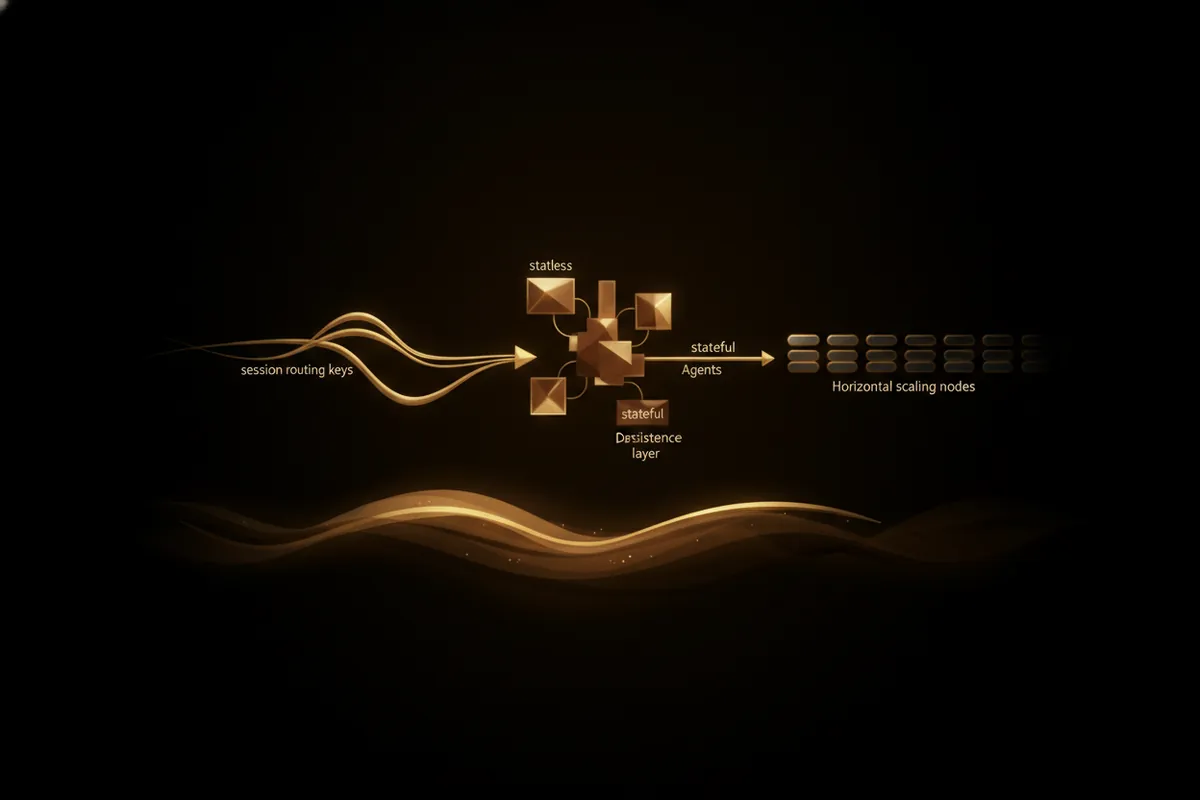
The state location is the mechanism, not the agent label
An Honest Architect's reading of MachineLearningMastery's stateful-vs-stateless agent design article: six mechanism forms, Theorem 3, and cross-domain parallels to Everythink's stateless Sisters and stateful Loom.
→ →Build your world on an engine that proves what it claims.
Create your own network on the engine that's run since 2016 — or talk to the team behind the 21 papers.