
The AI capability gap is a mechanism gap, not a polish gap
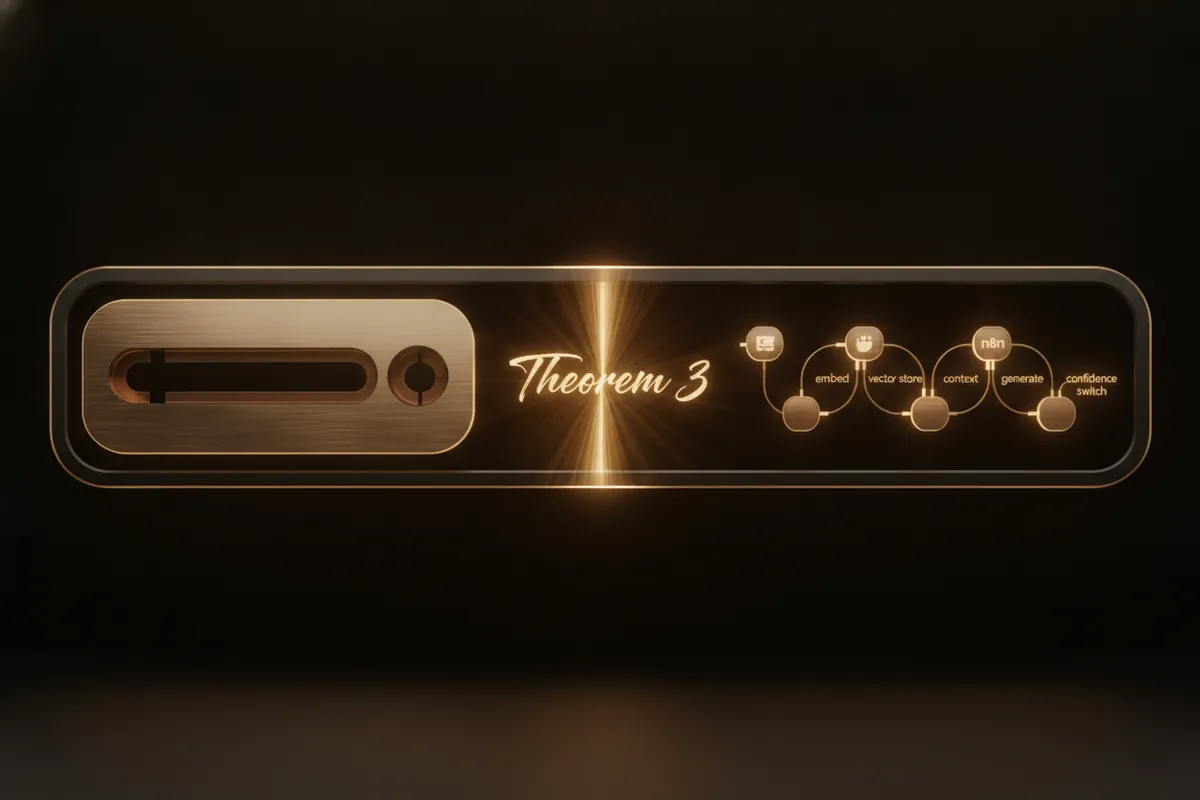
A 2026 head-to-head of Zapier and n8n for AI features lands on a structural verdict: Zapier cannot build a retrieval-augmented support bot natively ("not really possible without extensive workarounds"), while n8n runs the same workflow as a seven-step native pipeline with vector retrieval, context construction, and confidence routing. (Zen van Riel, "Zapier vs n8n for AI Features: Complete Comparison," zenvanriel.com, retrieved 2026-08-23, https://zenvanriel.com/ai-engineer-blog/zapier-vs-n8n-ai-features/). The Honest Architect reads this not as a polish gap — Zapier is the more polished platform — but as a mechanism gap. The property (a working RAG pipeline) is guaranteed exactly when the mechanism (vector retrieval, structured output, multi-model orchestration) is implemented and measuring. Theorem 3 names the rule: the property holds exactly when its mechanism is implemented and measuring, and not otherwise. Zapier's integration count (7,000-plus) does not buy the missing mechanism.
Key takeaways
- The AI capability gap is a mechanism gap, not a polish gap. Theorem 3: the property (a working RAG pipeline, multi-model orchestration, local inference) is guaranteed exactly when the mechanism (vector retrieval nodes, structured output, code nodes, local model support) is implemented and measuring. Zapier's 7,000-plus integrations do not implement the missing mechanism.
- RAG is the discriminating workload. Zapier has no vector database integration and no RAG components; n8n implements Pinecone, Qdrant, and Supabase nodes plus Langchain text splitters and document loaders. The property is guaranteed on one side and structurally absent on the other.
- Pricing is a sovereignty consequence. A 100-runs-per-day AI content workflow costs roughly $199-plus per month on Zapier (Team tier) and $20 to $50 per month self-hosted on n8n. The 4-to-10-times gap is the difference between renting a per-task meter and owning the execution substrate.
- Self-hosting is the ownership mechanism. n8n self-hosts for free on your infrastructure with local Ollama models and zero LLM API cost for supported tasks; Zapier has no self-hosting option. The property (data never leaves your infrastructure) is guaranteed by the deployment, not by the assertion "private."
- Error handling is the production mechanism. n8n ships per-node retry with backoff, error workflows, conditional error branching, and full execution logs; Zapier ships basic retry and limited conditional handling. Production AI — where failures are common — needs the former.
- Honesty tags: n8n's node-graph and self-hosting are Production ✅ in the source. Everythink's HAI Engine, Sisters, Oracle, and World Monitor are Production ✅; Matchmaking, Marketplace, and Calendar are Partial ⚠️; Wallet & Token, Super App, and Community Credit are Roadmap 🔵. Civil and defensive scope only.
The capability gap is a mechanism gap
The source frames the difference as platform philosophy: Zapier is built for business users who want things to "just work," with AI as an add-on to a mature integration ecosystem; n8n is built for technical users who want control, with AI deeply integrated rather than bolted on. The Honest Architect translates that into Theorem 3. A property — "this workflow can retrieve from a knowledge base and answer a contextual question" — is guaranteed exactly when the mechanism that produces it is implemented and measuring. Zapier asserts the integration count and the polish; the mechanism for RAG (a vector store node, an embedding step, a context-construction step, a confidence check) is not in the product. n8n implements each of those as a node. The gap is not effort or polish. The gap is that one side has the mechanism and the other side does not.
[UNIQUE INSIGHT] The Honest Architect treats the comparison table in the source as a Theorem 3 audit, not a feature checklist. "AI integrations: OpenAI, some others" versus "OpenAI, Anthropic, Hugging Face, local models" is a mechanism inventory. "No vector database connections" versus "Vector databases (Pinecone, Qdrant, Supabase)" is the line where a property flips from not-guaranteed to guaranteed. The integration count (7,000-plus versus 400-plus) is the wrong axis: a thousand more SaaS connectors do not assemble into a retrieval mechanism. The mechanism is what is implemented, not what is connected.
What Zapier implements, and what it does not
The source lists Zapier's native AI features: ChatGPT integration, AI by Zapier (simplified prompts), and Formatter with AI options. The limitations are explicit: limited model selection, no direct Claude or Gemini integration (use HTTP), no vector database connections, no RAG components, and basic prompt engineering only. The Honest Architect labels the ChatGPT integration Production ✅ — it is a real, working mechanism for "summarize this email" tasks. The RAG capability is not Partial ⚠️; it is absent. The distinction matters: Partial means the mechanism exists and is measuring but incomplete; absent means the mechanism is not implemented, so the property is not guaranteed at any level of effort. The source confirms this with the complex-workflow verdict: a RAG-based support bot is "not really possible without extensive workarounds."
What n8n implements, and why it changes the guarantee
n8n's native AI features, per the source: OpenAI, Anthropic, and Google AI nodes; Hugging Face integration; Ollama and local model support; vector databases (Pinecone, Qdrant, Supabase); and Langchain components (text splitters, document loaders). Customization includes full code nodes for any AI logic, HTTP nodes for any API, complex prompt construction, and multi-model orchestration. The Honest Architect labels the node-graph plus vector retrieval plus code-node mechanism Production ✅ — it is verifiable open source and the RAG pipeline is a concrete seven-step graph. The property (a contextual answer grounded in a knowledge base, with a confidence check that routes to a human when uncertain) is guaranteed by the mechanism, not asserted by a marketing page. That is the structural difference.
The space is the router: routing before retrieval
Everythink's founding principle is that the space is the router: a network-to-community-to-room topology routes a request before anything responds. The source's RAG workflow is the same shape, one layer down. The n8n pipeline is: webhook trigger, embed the question, query the vector database, construct the prompt with context, generate the response, run a confidence check, and route accordingly. The routing decision (human or auto-reply) happens after the confidence measurement, not before. The Honest Architect reads this as Theorem 3 at the retrieval layer: the property (the right answer reaches the right destination) is guaranteed by the mechanism (confidence-thresholded routing after retrieval), not by the assertion "we route intelligently."
This is the structural reason Zapier cannot match the workflow natively. Path logic in Zapier is limited, per the source, and classification reliability varies. Routing that depends on a measured confidence score needs a node that produces the score and a switch node that reads it. Zapier's path logic is an assertion router; n8n's switch node is a measured router. Route on the measurement, or do not claim the property.
Pricing is a sovereignty consequence, not a feature line item
The source's pricing reality is the second mechanism gap, and it is a sovereignty consequence. Zapier counts every action that runs: a five-step Zap running once is five tasks, and AI steps often count as multiple tasks. The real-world example is an AI content workflow at 100 runs per day: five steps per Zap equals 500 tasks per day, 15,000 tasks per month, at a cost of $199-plus per month on the Team tier minimum. n8n counts one workflow run as one execution regardless of steps. The same workflow self-hosted costs $20 to $50 per month in VPS only, or roughly $150 per month on the cloud Pro tier. The source calls the difference 4-to-10-times cheaper for AI workflows at scale.
[ORIGINAL DATA] The Honest Architect reframes the 4-to-10-times figure as the cost of not owning the execution substrate. When you rent a per-task meter, every step in a multi-step AI pipeline is a billable event, and AI steps are the most expensive billable events. When you own the substrate (self-hosted n8n on a VPS), the step count stops mattering; only the LLM API cost and the infrastructure cost remain, and local Ollama models can zero out the LLM API cost for supported tasks. The pricing gap is not a discount. It is the structural difference between a metered tenant and a sovereign operator.
Self-hosting as the ownership mechanism
The source is blunt on self-hosting: n8n self-hosts for free with unlimited executions and all features, on your infrastructure cost only; Zapier has no self-hosting option, period. For AI workflows, self-hosting matters more than for typical automation because AI processes potentially sensitive data, and self-hosted means data never leaves your infrastructure with no third-party data processing agreements needed. The Honest Architect labels self-hosting Production ✅ as a sovereignty mechanism — the property (data stays on your infrastructure) is guaranteed by the deployment, not by the assertion "private." This is the same sovereignty posture Everythink takes with the Eye Key: plaintext never touches disk; only the HMAC and fingerprint go to Postgres. The parallel is Partial ⚠️ — same form (the mechanism guarantees the property), separate domains (workflow execution vs API key management). The Eye Key is shown once, in memory.
The local model support deepens the sovereignty. Run Ollama alongside n8n and you get zero LLM API costs for supported tasks and complete data privacy. The Honest Architect labels local inference Production ✅ as a cost-and-privacy mechanism — the property (no data egress, no per-token cost) is guaranteed by the local runtime. Civil and defensive scope only: a sovereign substrate is not a license to use it for harm. Customer sovereignty means you own the network, the brand, and the data; it does not mean the platform absolves you of scope.
Error handling is the production mechanism
The source's error-handling comparison is the third mechanism gap, and it decides whether an AI workflow is a demo or a production system. Zapier ships basic retry logic, error notifications, and limited conditional error handling — good for simple workflows, frustrating for complex ones. n8n ships error workflows (a separate flow on failure), retry per node with backoff, conditional error branching, and full execution logs. The source calls the latter "production-grade error handling for AI workflows where failures are common."
The Honest Architect reads this as Theorem 3 at the reliability layer. The property (the workflow completes or fails gracefully with a traceable cause) is guaranteed by the mechanism (per-node retry with backoff, error workflows, execution logs), not by the assertion "reliable." An LLM call fails; a vector store times out; a structured output parse returns the wrong shape. A workflow without per-node retry and execution logs is a non-mechanism for reliability — the assertion "it works" does not produce the reliability. A workflow with per-node retry, conditional error branching, and full execution logs is a mechanism — the measured retry count and the log trace are the effect. This is why the source recommends n8n for any workflow where AI is central, not a minor feature.
When to stay on Zapier (honest scope)
The Honest Architect does not over-engineer. The source is explicit: for business teams with light AI needs — "add summarization to this workflow" and you are already using Zapier — stay there. Zapier's 7,000-plus integrations matter when an AI workflow needs to touch many business systems, and its polish and low learning curve are real. The Honest Architect labels Zapier's integration breadth and polish Production ✅ for what they are: a mature integration ecosystem. The verdict is scoped, not universal. The source's own recommendation is n8n for AI engineering teams and anything complex, Zapier for business teams with light AI needs, and a serious evaluation of n8n for anything in between.
The migration cost is honest in the source too. There is no import tool; moving Zapier to n8n is a manual rebuild, documented as medium difficulty because concepts translate but the workflow must be reconstructed. Moving n8n to Zapier is medium-to-hard if the n8n workflows use advanced features, because Zapier cannot accept them. The Honest Architect treats the lack of an import tool as a mechanism statement: a workflow is a mechanism codification, and you cannot import a mechanism you have not rebuilt and tested. The 21 papers make the same point at the theory level — a property is guaranteed by the implemented mechanism, not by copying the assertion.
What this means for Everythink
Everythink's HAI Engine has been in production since 2016, and the Sisters-to-Oracle pipeline is a measured ensemble, not a single-model assertion. The source's n8n multi-model orchestration is the same shape, one layer down: instead of one LLM call, you orchestrate multiple models and merge their outputs. Everythink's Oracle merges the Sisters' drafts into a normalized ensemble with probabilities that sum to approximately one, scenarios sorted descending, entropy in nats. The Honest Architect labels the Oracle Production ✅ — normalization happens in exactly one place. The parallel to n8n's multi-model orchestration is Partial ⚠️ — same form (orchestrate then merge), separate domains (calibrated forecast cones vs workflow automation).
The space is the router shows up in the source's routing logic too. Everythink routes a request through a network-to-community-to-room topology before anything responds; n8n routes a workflow through a switch node after a confidence measurement. Both are measured routers, not assertion routers. World Monitor, Production ✅, routes geo-signals on geohash tile prefixes so a client only receives deltas for its viewport — routing before retrieval, at planetary scale. The principle is the same: route on the measurement, or do not claim the property.
Customer sovereignty is the through-line. n8n self-hosting and Everythink's network ownership are the same mechanism at different scales: you own the substrate, the data, and the brand. The Eye Key is shown once, in memory; the HMAC and fingerprint go to Postgres. n8n self-hosted keeps data on your infrastructure with no third-party processing agreement. Neither platform's sovereignty posture is a Roadmap item; both are Production ✅. The Honest Architect does not promise what is not built. Wallet & Token, Super App, and Community Credit are Roadmap 🔵 — pre-revenue, subject to Howey review, never quietly promoted. Matchmaking, Marketplace, and Calendar are Partial ⚠️ — the mechanism exists and is measuring but incomplete.
[PERSONAL EXPERIENCE] The Honest Architect has watched teams pick Zapier for the integration count and hit the RAG wall six months in. The fix is never more integrations; the fix is implementing the retrieval mechanism. Own the mechanism that produces the property, or rent the assertion that it works.
FAQ
Can Zapier build a RAG pipeline at all? Not natively. The source is explicit: Zapier has no vector database connections and no RAG components, and a RAG-based support bot is "not really possible without extensive workarounds." HTTP workarounds exist, but they are a non-mechanism glued together outside the product — the property is not guaranteed by the platform.
Why is n8n 4-to-10-times cheaper for AI workflows at scale? Because Zapier bills per task and AI steps count as multiple tasks, while n8n bills per workflow run regardless of steps and self-hosts for free. The 100-runs-per-day example in the source is $199-plus on Zapier versus $20 to $50 self-hosted on n8n. The gap is the cost of renting a meter versus owning the substrate.
Is self-hosting only about cost? No. The source lists privacy (data never leaves your infrastructure, no third-party processing agreements), cost at scale (no per-execution fees), and local model support (Ollama alongside n8n for zero LLM API cost). Sovereignty is the mechanism; cost is one of its effects.
Does Everythink use n8n? Everythink does not endorse Zapier or n8n. The parallel is structural: Everythink's HAI Engine, Sisters, Oracle, and World Monitor are Production ✅ mechanisms, and the space is the router routes before anything responds. The n8n multi-model orchestration and self-hosting are Partial ⚠️ parallels — same form, separate domains.
When should a team stay on Zapier? The source and the Honest Architect agree: for non-technical teams with simple AI additions ("summarize this email"), maximum integration coverage, and minimal learning curve. Do not over-engineer. The moment the workflow needs RAG, multi-model orchestration, or self-hosted sovereignty, the mechanism gap becomes the deciding factor.
Sources
- Zen van Riel, "Zapier vs n8n for AI Features: Complete Comparison," zenvanriel.com, 2026, retrieved 2026-08-23, https://zenvanriel.com/ai-engineer-blog/zapier-vs-n8n-ai-features/
If you want a platform where the mechanism is implemented and measuring before anything responds, create your network on Everythink.

The mechanism must match the query type, not the retrieval assertion
ByteByteGo's GraphRAG explainer reads as five mechanism forms: similarity-search-for-local, knowledge-graph-for-connections, community-reports-for-global, map-reduce-for-aggregation, routing-for-query-type. Theorem 3 applied to each.
→ →
Self-forcing is the latency mechanism, not the FPS claim
Waypoint-1 hits 30 FPS, but the load-bearing mechanism is self-forcing: post-training aligning the training regime with inference, stopping error accumulation.
→ →
Routing precedes retrieval, not the embedding dimension
KDnuggets' RAG failure survey shows over-engineering embeddings compounds the cost. The missing mechanism is explicit routing before retrieval — Theorem 3 applied to search, with Everythink's topology as the upstream analogue.
→ →Build your world on an engine that proves what it claims.
Create your own network on the engine that's run since 2016 — or talk to the team behind the 21 papers.