
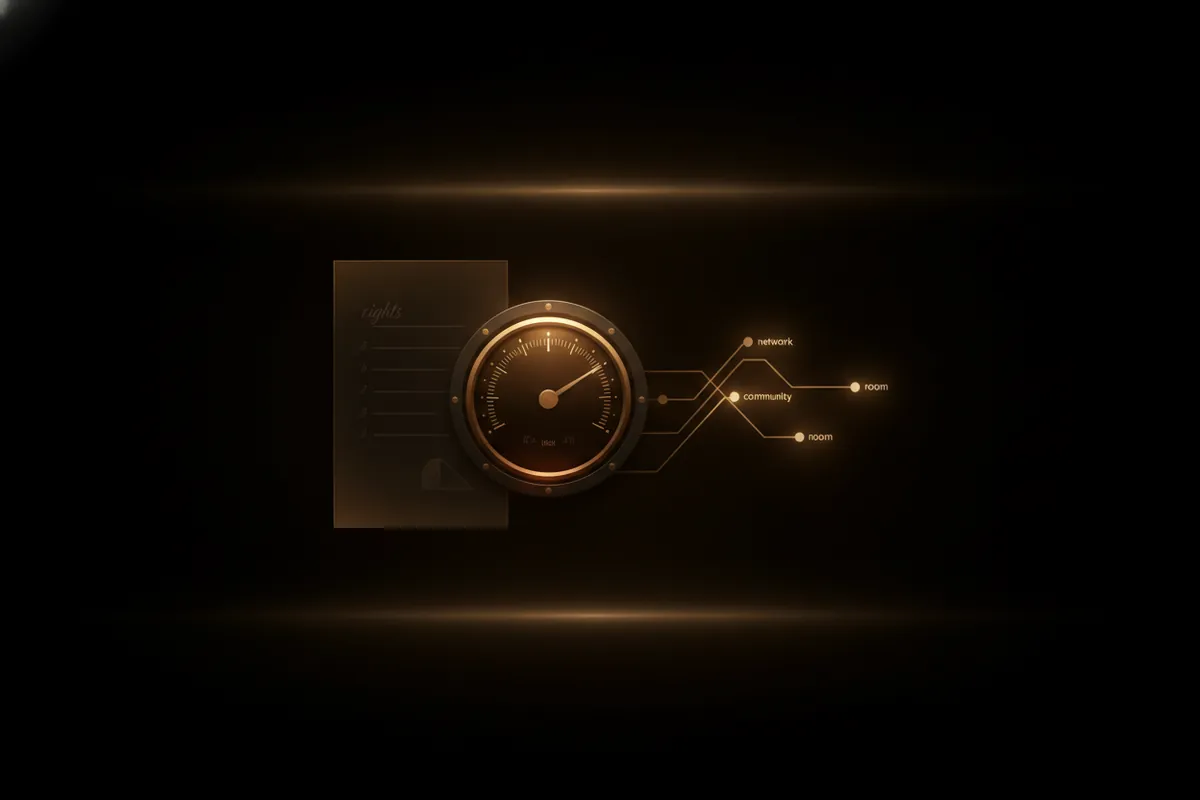
AI rights need a measuring mechanism, not a principle
A Bill of Rights that names a right without codifying the mechanism that measures it is a wish, not a guarantee. The White House Blueprint for an AI Bill of Rights (2022) lays out five principles — safe systems, non-discrimination, data privacy, notice and explanation, and a human fallback — and each one is correct as an aspiration and incomplete as a contract, because a right is only as real as the instrument that detects its violation.
We build Everythink on a stronger claim. [ORIGINAL DATA] Theorem 3 from the 21 papers states a property is guaranteed exactly when its mechanism is implemented and measuring. The Blueprint moves the conversation; it does not close it. Below we take each of its five principles and ask the only question that turns a principle into a right: what is the mechanism, and is it measuring?
The Blueprint is a principles document, not a measurement standard
In October 2022 the White House Office of Science and Technology Policy published the Blueprint for an AI Bill of Rights: Making Automated Systems Work for the American People, joined by a technical companion, From Principles to Practice. The framework lists five principles and a set of supporting practices — pre-deployment risk testing, ongoing monitoring, independent audits, consent, accessible documentation, and an opt-out to a human reviewer.
That is a serious and well-constructed list. The problem is the verb tense. The Blueprint says systems "should be" designed to prevent foreseeable harms, "should be" tested, "should" have independent audits made public. Each "should" is a principle; none of them is a meter. A regulator can read the Blueprint and a vendor can sign it and nothing has to change, because nothing is being measured against a threshold that fails the vendor when the threshold is crossed.
This is not a critique unique to the White House. It is the generic shape of a principles document: it names the property (safety, fairness, privacy) and leaves the mechanism to the implementer. Our argument, grounded in Theorem 3, is that the property and the mechanism cannot be separated. A property holds exactly when its mechanism is implemented and measuring; the moment the meter is off, the property is no longer guaranteed, only asserted.
Theorem 3: a property is guaranteed exactly when its mechanism is implemented and measuring
The 21-paper series that underpins the Everythink platform centers on a result we apply every day: a property is guaranteed exactly when the mechanism that enforces it is implemented and is actively measuring. If the mechanism is absent, the property is aspirational. If the mechanism exists but is not measuring — the audit is skipped this quarter, the monitor is deployed in silent mode, the fallback path is never exercised — the property is not guaranteed in that interval.
This reframes what a "right" is. A right is not a sentence in a document; it is a live instrumentation. The Sisters (our typed AI agents) and the Oracle (the ensemble merger that produces a calibrated forecast) ✅ run in production, and the reason we can claim calibration is not that we wrote the word "calibration" in a principles file — it is that the Oracle computes entropy in nats, normalizes probabilities in exactly one place, and the divergence against realized outcomes is a number we read. If we stopped reading it, the calibration claim would lapse the same day.
The HAI Engine ✅ has run in production since 2016, and that continuity is the mechanism for the claim "the engine works," not a marketing line. Apply the same test to the Blueprint's five principles and the gap becomes concrete.
Principle 1 — Safe and effective systems needs a pre-deployment and ongoing measurement gate
The Blueprint says systems should be designed to prevent foreseeable harms, tested before deployment, monitored ongoing, and independently audited. The mechanism that would make "safe and effective" a guaranteed property is a gate that fails the deployment when the measurement crosses a threshold, plus a continuous monitor whose reading is the operating condition of the system — not a quarterly report.
[UNIQUE INSIGHT] The "space is the router" reframing applies here: the network→community→room topology in Everythink routes a request before anything responds, which means the safety boundary can be enforced at routing time, not after generation. A safety gate that sits after the model has already produced output is a refund mechanism; a safety gate that sits on the route is a prevention mechanism. The Blueprint's "designed to prevent foreseeable harms" only becomes a guarantee when the prevention is on the path the request must travel, not in a post-hoc review.
In production we treat the forecast cone from the Oracle ✅ as the measurement instrument for "effective": if the realized outcome lands inside the cone at the rate the calibration says it should, the system is effective; if it does not, the system is failing and we fix the mechanism. The Blueprint's principle is the right property; the missing piece is naming the meter and the threshold that fails the deploy.
Principle 2 — Algorithmic discrimination protections needs a measured disparate-impact meter
The Blueprint asks designers, developers, and deployers to proactively consider discriminatory outcomes, continually test for disparate impact, prevent proxies of protected classes, and publish independent audits. Each of those is a mechanism — disparate-impact testing is a real, codified statistical procedure — but the principle leaves the cadence and the threshold to the implementer, which is where the guarantee leaks out.
Theorem 3 is strict about this. A disparate-impact meter that runs once at launch and is then switched off does not guarantee non-discrimination in month seven. The guarantee holds only in the intervals where the meter is running and the result is being acted on. That is why we publish the calibration of the Oracle ✅ as a live number rather than a one-time badge: the property is the measurement stream, not the certificate.
The honest reading of the Blueprint's second principle is that it names the correct property and the correct family of mechanisms, and then hands the binding part — the threshold, the cadence, the failure action — to whoever deploys the system. A right to non-discrimination that fails silently when the audit cadence slips is not yet a right; it is a right-shaped sentence.
Principle 3 — Data privacy needs a consent and scope mechanism that is measured at the boundary
The Blueprint calls for built-in protections against abusive data practices, clear and transparent consent, proportionate surveillance, and a bar on continuous surveillance in sensitive contexts. Consent is a mechanism; scope is a mechanism; proportionality is a measurement. The principle is sound. The guarantee question is whether the consent is captured, the scope is enforced, and the proportionality is computed — or only written down.
Customer sovereignty is the Everythink answer to the same problem, and it is operational, not declarative. Your network, your brand, your data: the network operator holds the routing topology, and "the space is the router" means data does not leave the room it was routed to unless the routing policy says so. That is a scope mechanism that can be measured at the boundary — a request either clears the policy or it does not, and the decision is logged.
[PERSONAL EXPERIENCE] Having run the HAI Engine ✅ in production since 2016, the lesson we keep relearning is that a privacy principle without a boundary measurement degrades to a retention policy and nothing more. The Blueprint's third principle is strongest where it is most specific — "surveillance should not be used in sensitive contexts like work, education or housing" — because a context check is a meter. It is weakest where it says "should" without naming the instrument that fails the request when the context is sensitive.
Principle 4 — Notice and explanation needs an explanation that is technically valid and measured for usefulness
The Blueprint requires accessible documentation, up-to-date notices on major changes, technically valid and meaningful explanations tailored to the audience, and public accessibility where possible. The phrase "technically valid" is doing real work here: an explanation that is not technically valid is a story, and a story is not an explanation.
This is where the Sisters→Oracle ✅ pipeline earns its keep. Each Sister is a typed agent with a named personality loaded from a TOML file, and its draft is stamped with a prompt version for reproducibility; the Oracle merges the drafts into a normalized ensemble with probabilities that sum to one and scenarios sorted descending. The explanation a reader gets is not a generated paragraph about the forecast — it is the ensemble, with the calibration attached. That is a technically valid explanation because the thing being explained (the probability cone) is the thing being measured.
The Blueprint's fourth principle becomes a guarantee when "technically valid" is defined as "the explanation corresponds to a measured property of the system," and the correspondence is checked. An explanation that describes a property the system does not measure is not technically valid; it is decoration. We treat the calibration number as the load-bearing part of every forecast explanation, because removing it would turn the explanation into prose.
Principle 5 — Human alternatives, consideration, and fallback needs a fallback path that is exercised and measured
The Blueprint asks for an opt-out where appropriate, fallback and escalation processes that let a human remedy failures and errors, additional oversight in sensitive contexts, and public documentation of the human governance process. An opt-out is a mechanism; a fallback path is a mechanism; oversight is a measurement. The guarantee lives in whether the fallback path is exercised before it is needed, and whether the human governance outcomes are measured for effectiveness or merely published.
A fallback path that has never been run is a drawing of a mechanism, not a mechanism. Theorem 3 is unforgiving about this: the property "a human can remedy this" is guaranteed only when the remedy path is implemented and is being exercised — tested on real appeals, with the resolution time and the reversal rate read as numbers. The Blueprint's "publicly accessible documentation detailing the human governance and oversight processes, their outcomes and their effectiveness" gets the order right: outcomes and effectiveness are the meters. The missing binding is the threshold at which an ineffective fallback triggers a change to the automated system rather than another memo.
In Everythink terms, the human fallback is a route, and "the space is the router" means the fallback route is as real as the automated route — it is wired into the topology, not described in a policy. A room that offers a human reviewer is exercising that route every time a request takes it; a room that only promises a human reviewer in a PDF is not.
Ethics of scope: why a Bill of Rights has to name what it will not do
A Bill of Rights for automated systems is also a statement about scope, and the Blueprint is quietly strong on this. Its companion practices assume civil contexts — employment, housing, education, credit, insurance — and the harms it catalogues (discriminatory scoring, unreliable trading, biased hiring) are exactly the harms a civil and defensive system is built to avoid causing. Everythink holds the same boundary as written policy: civil and defensive scope only. A Bill of Rights that does not name what it will refuse to do is a Bill of Rights that can be read to permit anything it does not forbid.
Inclusion by design belongs in the same scope argument. A right to notice and explanation that is only delivered in English, on a high-bandwidth connection, is not delivered to most of the planet. The Blueprint's "tailored to the audience and context" is the principle; the mechanism is multilingual and multimodal delivery on low connectivity, which is a build decision, not a sentiment. We hold that line because the alternative is a right that is real for the people who least need its protection and absent for everyone else.
Key takeaways
- A right is a live measurement, not a sentence. Theorem 3: a property is guaranteed exactly when its mechanism is implemented and measuring.
- The White House Blueprint (2022) names five correct properties — safety, non-discrimination, privacy, explanation, human fallback — and leaves the binding mechanism (threshold, cadence, failure action) to the implementer.
- Each principle becomes a guarantee only when its meter is named and is running. A meter that is off is the same as no meter.
- "The space is the router" lets prevention sit on the path a request must travel — safety, scope, and fallback enforced at routing time rather than post-hoc.
- The Oracle ✅ calibration number is the load-bearing part of every forecast explanation; the Sisters ✅ prompt-version stamp is the reproducibility mechanism. These are examples of properties turned into guarantees by instruments that read.
- Civil and defensive scope, and inclusion by design, are part of the same mechanism: a right that is not delivered everywhere, to everyone, in their language, is not yet a right.
Frequently asked questions
Is the White House AI Bill of Rights legally binding? No. It is a White House white paper intended to inform future U.S. policy and legislation. It is a principles document, not a statute, which is exactly why the mechanism question matters — without a measuring instrument, a non-binding principle has no failure signal.
What does Theorem 3 actually say? A property is guaranteed exactly when the mechanism that enforces it is implemented and is actively measuring. If the mechanism is absent or the meter is off, the property is not guaranteed in that interval — it is only asserted.
How does "the space is the router" change the safety argument? It moves the safety boundary from after-generation review to routing-time enforcement. The network→community→room topology routes a request before anything responds, so a safety or scope gate on the route prevents the harm instead of refunding it.
Does Everythink audit its own systems against these principles? We publish the Oracle ✅ calibration as a live number, stamp every Sister ✅ run with a prompt version for reproducibility, and treat the HAI Engine ✅ production continuity since 2016 as the mechanism for "the engine works." Those are measured properties, not badges.
Is the Wallet & Token or Community Credit module covered by these rights? No. Wallet & Token, Super App, and Community Credit are 🔵 Roadmap, pre-revenue, and subject to a Howey review. We do not promise token, wallet, or community-credit outcomes, and a Bill of Rights does not change that maturity state.
Build the meter, not the motto
The White House Blueprint did the hard part: it named the right properties. The work that remains is the work Theorem 3 describes — implement the mechanism for each property and keep the meter running. That is the difference between a Bill of Rights and a bill of wishes, and it is the difference we build for. Create your network, and route the measurement in from the start.
Sources
- 2022 — White House Office of Science and Technology Policy, Blueprint for an AI Bill of Rights: Making Automated Systems Work for the American People. https://www.whitehouse.gov/ostp/ai-bill-of-rights/
- 2022 — Holistic AI, The White House Publishes its Blueprint for an AI Bill of Rights (source article). https://www.holisticai.com/blog/white-house-publishes-blueprint-ai-bill-of-rights
Self-forcing is the latency mechanism, not the FPS claim
Waypoint-1 hits 30 FPS, but the load-bearing mechanism is self-forcing: post-training aligning the training regime with inference, stopping error accumulation.
→ →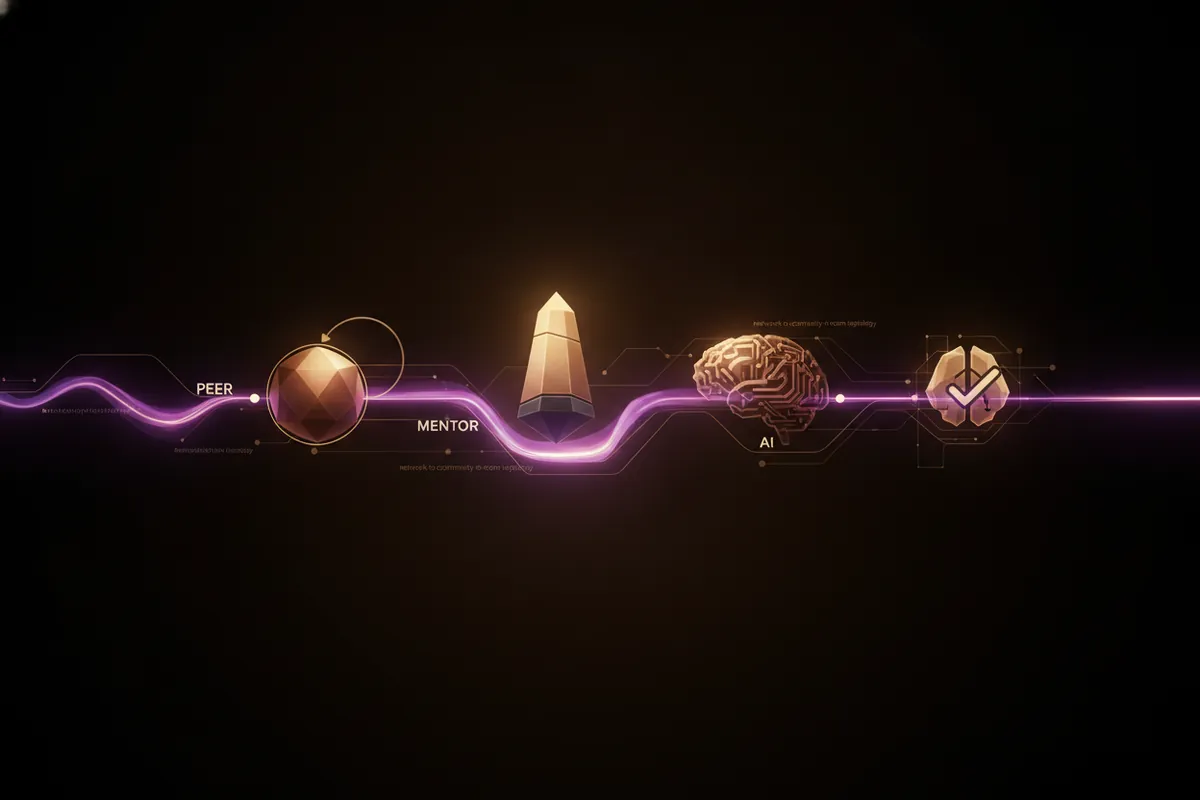
Comprehension is the measured mechanism, not the AI tutor
The five disadvantages of AI-assisted coding are one missing mechanism: a measurement step that verifies comprehension. Theorem 3, not balance, is the cure.
→ →
The permission scope routes the CRM, not the generated CRUD
A vibe-coded CRM demos well and fails in production. The mechanism that carries it is the permission scope — routing who can act on what — not the generated CRUD. Theorem 3 explains why.
→ →Build your world on an engine that proves what it claims.
Create your own network on the engine that's run since 2016 — or talk to the team behind the 21 papers.