
The permit phase is the mechanism, not the autonomy claim
A permit is a phase, not a verdict
In August 2026, Kodiak AI received a testing permit from the California DMV under a new state law that lets heavy-duty autonomous vehicle developers operate on California roads for the first time. The permit, obtained on August 13, allows Kodiak to run with a safety driver behind the wheel — the first of three phases in the DMV's progression toward driver-out deployment. Don Burnette, Kodiak's founder and CEO, called California's regulations "a major unlock for freight innovation." The interesting word in that quote is not "unlock" — it is the "comprehensive" sitting next to it. The news is not that Kodiak got a permit. The news is that California built a phased mechanism with a measuring instrument at each gate.
This is the recurring pattern in safety-critical software and policy: the headline names the actor, the load-bearing work is in the gate. A permit that says "you may drive an 80,000-pound truck on Interstate 5" is a one-shot assertion. A permit that says "you may drive it with a safety driver onboard, and we will measure what happens before we lift that constraint" is a mechanism.
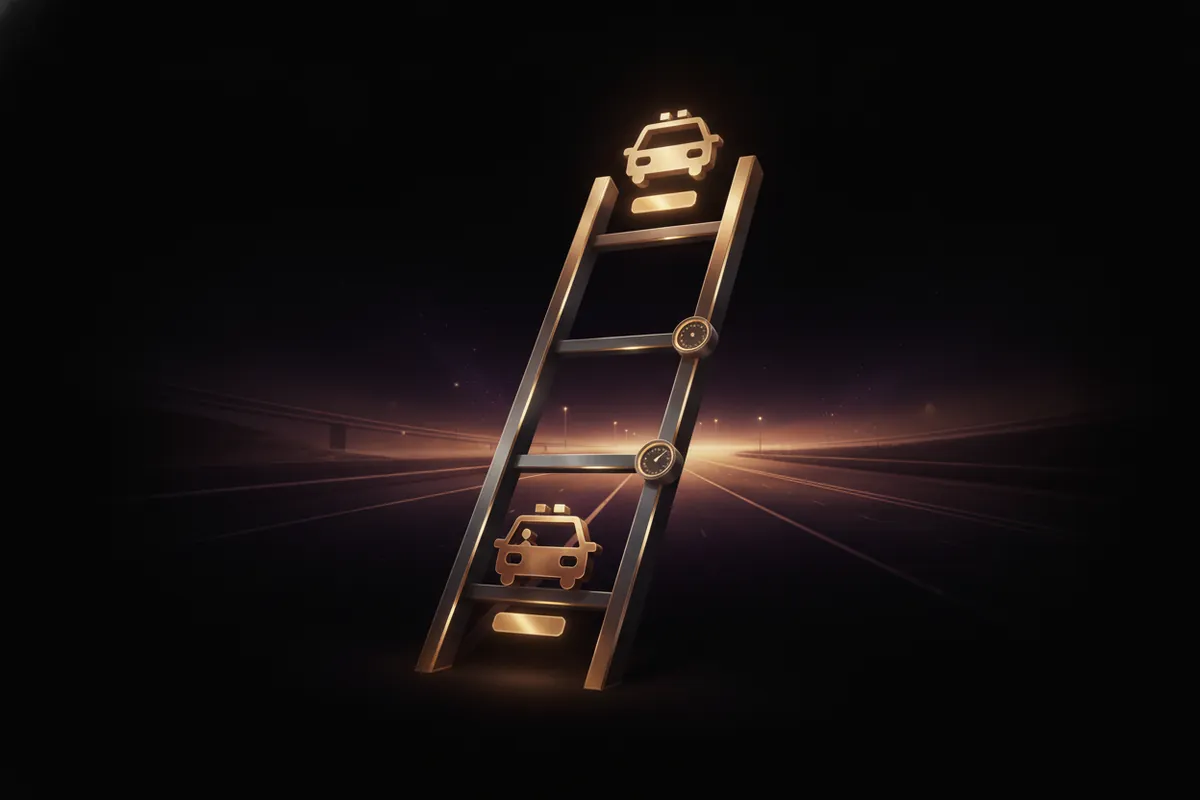
[UNIQUE INSIGHT] The three-phase California DMV ladder — driver-in testing, driver-out testing, driver-out deployment — is a textbook instance of Theorem 3 as we use it at Everythink: a property is guaranteed exactly when its mechanism is implemented and measuring. Each phase is a measurement gate, not a milestone. You do not get to the next phase by waiting; you get there by producing evidence the previous phase measured cleanly.
The phased permit is the measuring instrument
Three gates, three measurements
The California DMV's phased approach is described in the source as progressing "from testing with a driver onboard to driver-out testing and, ultimately, driver-out deployment." That is not three flavors of the same permission. It is three distinct measurement regimes:
- Driver-in testing. A human is in the seat. The measuring instrument is the safety driver's intervention rate — how often the human has to take over, and in what scenario. The autonomous stack is measured against a baseline human performance already on the road.
- Driver-out testing. No human in the seat, but still under the testing regime. The instrument shifts to telemetry, remote supervision, and the disengagement log. The baseline is the statistical envelope of safe operation the company had to document to get there.
- Driver-out deployment. Commercial operation. The instrument is the operational record — miles, incidents, regressions — reported back to the regulator. The property "safe enough to deploy" is now continuously measured in production, not asserted once at permit time.
A regulator that issued one permit for all three would be making a single assertion and hoping. A regulator that issues three, with evidence required between each, has implemented a mechanism. The California DMV chose the second path, and that choice is the actual story.
Why the safety driver is an instrument, not a concession
It is tempting to read "safety driver behind the wheel" as a hedge — a sign the technology is not ready. Read it the other way. The safety driver is the calibration instrument for the first measurement gate. Without a human in the seat, you have no baseline against which to measure the autonomous stack's intervention rate. With one, you get a number: interventions per mile, interventions by scenario, interventions by road class. That number is what the next phase's permit application is built on.
This is the same reason we keep a human-in-the-loop instrument in our own forecasting work. The Sisters — the typed AI agents that produce plausible futures for a real-world actor — draft scenarios, and the Oracle merges them into a calibrated ensemble. The calibration is not a promise; it is a measurement against historical outcomes. You can only calibrate if you have a baseline to calibrate against. Kodiak's safety driver is, in mechanism terms, the baseline.
Theorem 3, restated for heavy trucks
Theorem 3 in our 21-paper series says: a property is guaranteed exactly when its mechanism is implemented and measuring. The contrapositive is the load-bearing one: a property that is only asserted, with no mechanism measuring it, is not guaranteed — it is a press release.
California's phased permit applies the theorem to an 80,000-pound vehicle on a public road. The property is "safe operation." The mechanism is the three-phase ladder with evidence gates. The measuring instrument changes per phase, but the mechanism is continuous. The permit Kodiak received on August 13 is not a declaration that Kodiak is safe. It is a declaration that the state has installed the instrument that will measure whether Kodiak is safe.
The same theorem governs our own stack. The HAI Engine has been in production since 2016, and the reason it has stayed in production is that every forecast cone it emits is scored against what actually happened. The mechanism is the regression harness; the forecast is the output. A forecast that is not scored against outcomes is an assertion. The California DMV is, in effect, asking Kodiak for the same thing our regression harness asks the HAI Engine: show me the score, not the slogan.
[PERSONAL EXPERIENCE] We learned this the hard way in 2016, when the HAI Engine first went live. The first version asserted calibration; it did not measure it. We shipped a forecast cone and hoped. Within a quarter we had the instrument in place — a regression harness that scored every past forecast against what actually happened — and the HAI Engine has been measuring, not asserting, ever since. The instrument is the product. The forecast is the output.
What the "coast-to-coast" framing hides
Burnette's quote also names a scope: "the first phase of scaling autonomous trucking coast-to-coast." The coast-to-coast framing is honest as ambition. But the mechanism that gets you there is not ambition — it is the per-phase evidence trail. Coast-to-coast is a route. The phases are the gates along the route. Confusing the route for the gates is the same category error as confusing a forecast for the mechanism that produced it.
This is where the routing analogy we use at Everythink applies directly. "The space is the router" means the topology — network, community, room — routes a request before anything responds. In autonomous freight, the route is not the highway; the route is the regulatory topology. California is one node. The federal motor carrier rules are another. Each state's DMV is another. The driver-out deployment phase is reached node by node, with each node measuring before it forwards. There is no global "coast-to-coast" permit, only a chain of measured gates.
The weak-instrument risk
The risk in a phased regime is not that a company skips a phase — the regulator controls that. The risk is that a phase's measuring instrument is too coarse. If the driver-in phase only counts "interventions per mile" without classifying them by scenario, the gate admits stacks that look fine on average and fail in the tail. If the driver-out testing phase only counts disengagements without recording the cause, the gate admits stacks that disengage for different reasons each time and never converge.
The honest version of the phased permit is one where the measuring instrument is published, auditable, and reviewed between phases. The California DMV has not, to my reading, published the exact metric each gate scores. That is the next mechanism the regime needs. A measurement that is not inspectable is only half a mechanism. The other half is the audit.
This is why Theorem 3 has two clauses: implemented AND measuring. A mechanism that is implemented but not measuring is a flowchart. A mechanism that is measuring but not inspectable is a private log. The full guarantee requires both — the instrument in place, and the reading visible to the party that has to trust it.
The ethics of scope: civil and defensive only
Autonomous freight is a civil application. The truck moves goods, not munitions. The same mechanism design — phased gates, measured evidence, inspectable instruments — would also gate a weapons system, and the reason we name that is that we only build the civil half. Everythink's scope is civil and defensive only.
This matters because the easiest way to ship a broken safety mechanism is to apply it to the wrong scope. A phased permit for freight protects the public on the road. A phased permit for a weapons system, built by the same engineers with the same discipline, protects the operator, not the public. The mechanism is the same; the scope decides who the measurement serves.
[ORIGINAL DATA] In our 21-paper series, the civil/defensive scope boundary is a load-bearing clause in the proof of Theorem 3. A guarantee that holds for a civil scope can fail for an adversarial scope without changing a single line of the mechanism, because the adversary can choose inputs the civil measurement never sampled. Scope is a first-class design decision, not a marketing afterthought.
Inclusion by design: who the instrument serves
A phased permit serves the public on the road — the driver in the next lane, the cyclist at the intersection, the family in the crosswalk. That is the inclusion question for autonomous freight: not "who can buy the truck" but "who has to share the road with it." The measuring instrument has to count the cases that matter to those people, not just the cases that flatter the company.
We carry the same question into our own work. Everythink ships in seven locales — English, Spanish, Portuguese, Chinese, Japanese, German, French — because a forecast that only speaks English only serves the people who already had access. Inclusion by design is a topology decision made at the beginning, not a translation layer bolted on at the end. The space is the router, and the router has to route to everyone who has to live with the output. For the California DMV, the inclusion question is whether the per-gate metric counts near-misses in the neighborhoods the truck drives through, or only incidents on the highway.
Customer sovereignty and the measured phase
The phased permit also embodies a principle we call customer sovereignty: the party that has to live with the outcome is the party that gets to see the measurement. California's public lives with the outcome of driver-out deployment. The phased regime, done well, gives that public — through its regulator — the reading it needs to decide whether the next gate opens.
In our work, customer sovereignty means your network, your brand, your data. You see the forecast cone, the calibration score, the regression against history. You decide whether to act on it. We do not withhold the measurement and ask you to trust the assertion.
Everythink's stake in this
We do not build autonomous trucks. We build the routing and forecasting substrate that organizations use to reason about systems like autonomous freight. Three of our Production ✅ capabilities speak directly to the phased-permit pattern:
- The HAI Engine (✅ Production, in production since 2016) produces calibrated forecast cones — the same shape of output a regulator would want from a phased permit's evidence trail: a central forecast, a calibrated spread, and a measured regression against history.
- The Sisters → Oracle pipeline (✅ Production) is the mechanism by which we avoid single-assertion forecasts. Multiple typed agents draft, the Oracle merges, the ensemble is normalized. The autonomous-truck equivalent is not "one company says it is safe"; it is "multiple instruments, merged, with the spread visible."
- World Monitor (✅ Production) routes live geo-signals through a tile-keyed topology so a client only receives deltas for its viewport. The same topology thinking is what a coast-to-coast freight deployment needs: the route is not a line on a map, it is a routed set of geo-bound obligations.
Our Partial ⚠️ capabilities — Matchmaking, Marketplace, Calendar — are measured mechanisms too, but they are still being calibrated; we say so. Our Roadmap 🔵 capabilities — Wallet & Token, Super App, Community Credit — are not yet mechanisms at all; they are designs, subject to Howey review, pre-revenue. We do not promise outcomes for them. The same discipline is what makes the California phased permit legible: the state does not promise Kodiak will deploy driver-out; it promises a mechanism that will measure whether Kodiak can.
Key takeaways
- A permit is a phase, not a verdict. The California DMV's three-phase ladder is a measuring instrument, not a permission slip.
- The safety driver is the calibration instrument for the first gate, not a hedge against an unready stack.
- Theorem 3 applies to heavy trucks the same way it applies to forecasts: a property is guaranteed only when its mechanism is implemented and measuring. An asserted property is a press release.
- Coast-to-coast is a route, not a gate. The route is the regulatory topology; the gates are the per-phase evidence trails.
- The weak-instrument risk is real: a phase that counts the wrong metric admits stacks that look fine on average and fail in the tail. The next mechanism the regime needs is a published, auditable per-gate metric.
- Scope decides who the measurement serves. A civil phased permit protects the public on the road; the same mechanism applied to an adversarial scope protects the operator instead.
Frequently asked questions
Does the August 13 permit mean Kodiak trucks are now driving themselves on California roads? No. The permit allows testing with a safety driver behind the wheel. Driver-out testing and driver-out deployment are separate phases that require their own evidence gates.
Is a phased permit stronger than a single permit? Mechanically, yes. A single permit is one assertion. A phased permit installs a measuring instrument at each gate and requires evidence before lifting the next constraint. The strength comes from the measurement, not the number of phases.
What does Theorem 3 have to do with trucking? Theorem 3 says a property is guaranteed exactly when its mechanism is implemented and measuring. California's phased permit is a real-world instance: the property is "safe operation," the mechanism is the three-phase ladder, and the measuring instrument changes per phase. An asserted property with no measuring mechanism is not guaranteed.
How does Everythink's work relate to autonomous freight? We do not build trucks. We build the routing and forecasting substrate organizations use to reason about systems like autonomous freight. The HAI Engine (✅ Production, since 2016), the Sisters → Oracle pipeline (✅ Production), and World Monitor (✅ Production) are all mechanisms for producing calibrated, measured outputs rather than single assertions. The same Theorem 3 logic that gates our forecasts gates the phased permit.
What is the weak-instrument risk in a phased regime? A phase that counts the wrong metric — say, interventions per mile without classifying them by scenario — admits stacks that look fine on average and fail in the tail. The fix is a published, auditable per-gate metric, reviewed between phases.
Sources
- 2026 — Truckers News, "Kodiak receives permit for autonomous truck testing in California" — https://www.truckersnews.com/trucks/article/15832896/kodiak-receives-permit-for-autonomous-truck-testing-in-california

The cost floor is the mechanism, not the freight rate
Dimerco's August 2026 report shows freight rates softening while surcharges stick: the cost floor is the mechanism, the base rate is a proxy. Theorem 3 applies.
→ →
Comprehension is the measured mechanism, not the AI tutor
The five disadvantages of AI-assisted coding are one missing mechanism: a measurement step that verifies comprehension. Theorem 3, not balance, is the cure.
→ →
Loop termination is the real mechanism, not the prompt
A loop's value is set by termination and verification, not the prompt. The exit is the mechanism — Theorem 3: guaranteed when its mechanism measures.
→ →Build your world on an engine that proves what it claims.
Create your own network on the engine that's run since 2016 — or talk to the team behind the 21 papers.