
The entity record is the mechanism, not the analytics platform
Cognyte Analytics fuses and links what you give it. The mechanism that guarantees clean analysis is the entity record: a structured record with a what-to-enter column and a what-still-needs-checking column, built before the network is examined. The platform is the adapter. The entity record is the trait.

The entity record is the mechanism, not the analytics platform
Cognyte Analytics describes its software around investigative analytics and decision intelligence. Its published capabilities include data fusion, entity resolution, link analysis, graph analytics, and trend analysis. The easy reading is that the platform does the investigation. That reading is wrong. The platform fuses and links what you give it. What you give it is the mechanism, and what you give it is an entity record: a structured record built around the primary entity, with a field for what to enter and a field for what still needs checking. That record is the boundary between raw collection and network analysis, and it is what guarantees that discovered profiles are not treated as confirmed parts of a network. The platform is the adapter. The entity record is the trait.
This is the Honest Architect reading of the ESPY guide to maximizing OSINT with Cognyte Analytics (ESPY, «How to Maximize OSINT With Cognyte Analytics: A Practical Investigation Workflow», Jul 27, 2026; retrieved 2026-08-23). The thesis here is not that Everythink ships an OSINT tool. It does not. The thesis is that the design pattern is recognizable: a property is guaranteed exactly when its mechanism is implemented and measuring, and the property «clean analysis» is guaranteed by the mechanism «structure every incoming data point around the primary entity before looking for a network».
Mechanism 1 — Disciplined collection before volume
An investigation that begins with an unfamiliar email address connected to a suspicious account does not start by loading every available record into the analytics platform. That creates unnecessary noise. The first step is to build a reliable starting record: record the email exactly as found, where it appeared, when it was collected, and why it matters. Then list the questions that remain. Does the address connect to public profiles? Is a name associated with it? Does the same username appear elsewhere? Is there a phone number or photograph that can be checked? ✅
The property is «analysis starts clean». The mechanism is «start with one clue, build a reliable starting record, list the open questions». The measurement is the question list. A data dump has no question list. A disciplined collection has one, and each question is a port that the next stage answers. The platform cannot fuse what was never structured.
Mechanism 2 — The entity record as the collection-analysis boundary
The entity record is the load-bearing structure. Incoming data is structured around the primary entity, not around the isolated intake source. The record has fields: primary identifier (original email, phone, name, or username), related accounts (public profile links and platform names), dates (collection date and visible activity dates), locations (reported, registered, or profile locations), and source record (original URL and retrieval notes). Each field has two columns: what to enter, and what still needs checking. ✅
The property is «cleaner information to compare». The mechanism is «structure every data point around the primary entity with a what-to-enter and a what-still-needs-checking column, before looking for a network». The measurement is the gap between the two columns. A related account is entered, but whether the accounts share more than one identifier is still checking. A location is entered, but whether the locations refer to the same period is still checking. This prevents discovered profiles from being treated as confirmed parts of a network. The entity record is the trait boundary: the analysis depends on the structured record, not on the raw intake.
Mechanism 3 — Theory-testing against available records
Network connections are not found. They are tested. The investigation question becomes a theory: a suspicious email, a newly discovered username, and a public profile may belong to the same person. Cognyte's data-fusion and relationship-analysis capabilities examine where those records intersect with other people, organizations, locations, or events. The analyst asks which fields created the connection, whether the dates align, and whether another explanation fits. A shared location might be a workplace or public venue rather than evidence of a personal relationship. ✅
The property is «connections are real, not coincidental». The mechanism is «turn the question into a theory, test which fields created the connection, whether dates align, whether another explanation fits». The measurement is the set of fields that created the connection. A connection built on one shared field is weaker than one built on three. A connection whose dates do not align is not a connection. The platform reveals patterns across available data. Trained analysts decide whether those patterns are relevant, coincidental, or unsupported.
Mechanism 4 — Observation vs. assessment separation
Investigation notes must distinguish facts from interpretations. «Two accounts display the same username» is an observation. «The same person controls both accounts» is an assessment that requires support. Keeping those statements separate makes the reasoning easier to review and stops an early assumption from becoming accepted as fact. ✅
The property is «assumptions do not become facts». The mechanism is «keep the observation statement separate from the assessment statement, and require support for the assessment». The measurement is whether the assessment has supporting evidence beyond the observation. An assessment without support is a hypothesis, not a conclusion. This is Theorem 3 in its purest form here: the property is guaranteed by a mechanism that does not let the assessment merge with the observation. The single normalization site is the distinction itself.
Mechanism 5 — Facial recognition as hypothesis, not proof
Visual evidence provides critical resolution when disambiguating subjects with identical names or identifying recycled avatar media across platforms. But raw facial matches are non-deterministic. Sensor resolution, compression artifacts, lighting angles, and age variance influence match precision. Facial telemetry is an investigative hypothesis, not a conclusive identity mark. Integrating facial recognition search into early triage extracts confidence scores, source platform metadata, and linked web footprints alongside visual assets. ✅
The property is «identity is not falsely confirmed». The mechanism is «treat facial telemetry as a hypothesis, extract confidence scores and metadata, and correlate with identity signals before high-confidence records are ingested». The measurement is the confidence score. A high confidence score is a strong hypothesis, not a proof. A low confidence score is a weak hypothesis, not a disproof. The non-determinism is the reason the mechanism exists. If facial matches were deterministic, the hypothesis step would be unnecessary.
Mechanism 6 — Provenance preservation from query to assessment
Analysts need to know what was found and how it was found. Data provenance records the origin and history of data, which matters when information passes through several tools or analysts. For automated workflows, structured payloads across phone, email, and identity queries allow technical teams to pipe normalized data into downstream analytics platforms following standard security and access controls. ✅
The property is «every connection can be traced, questioned, and explained». The mechanism is «data provenance records the origin and history; each connection has a source path from initial query to final assessment». The measurement is whether another analyst can reopen the evidence. A connection without a source path cannot be questioned. A connection with a source path can be reopened, checked, and challenged. Provenance is the mechanism that makes the investigation reviewable.
What this looks like from a different stack
Everythink does not ship an OSINT tool. The parallels below are structural, not product claims, and they are tagged Partial because the analogy is the point, not a claim that Everythink does the same work.
The entity record as the boundary between collection and analysis is the same shape as the hexagonal trait-based ports. Each port answers a different question, and AppState repositories are Arc
The observation-vs-assessment separation, where the assessment must be supported beyond the observation, is the same shape as the Oracle's single normalization site. Probabilities are normalized in exactly one place in everythink-oracle, and consumers may rely on the sum being approximately one. The property is guaranteed by a mechanism that does not compete with the merge. ⚠️
The investigation pipeline that routes through stages (collect, entity record, theory-test, separate, provenance), each answering a different question, is the same shape as «the space is the router». Network, community, and room route before anything responds, and most requests resolve locally while a few travel the long path. The mechanism is the topology, and the measurement is where the request resolves. ⚠️
Provenance that records the origin and history of each data point, so another analyst can reopen the evidence, is the same shape as World Monitor's deterministic uuidv5 ids. Re-ingest updates, never duplicates, because the id is deterministic from source and native id. The property is «no duplicates on re-ingest», and the mechanism is the deterministic origin. ⚠️
The entity record that gives the analyst sovereignty over what enters the analysis, preventing discovered profiles from being treated as confirmed, is the same shape as Eye Key sovereignty. Eye Key plaintext never touches disk. Only the HMAC and fingerprint go to Postgres. The property is «sovereignty over the key», and the mechanism is the construction, not a penalty applied after the fact. ⚠️
The entity record fields as typed columns, each with a what-still-needs-checking companion, is the same shape as the Sisters' typed personalities. The analyst, contrarian, disruptor, historian, and institutionalist are typed, and the prompt version is stamped on every run for reproducibility. The property is «reproducible typed reasoning», and the mechanism is the personality plus the version stamp. ⚠️
The what-still-needs-checking column that validates each field at the boundary is the same shape as Zod at the runtime boundary. Wire types are parsed at the network boundary, and a bad payload surfaces as a typed ApiError, never a crash. The property is «bad data surfaces as a typed error», and the mechanism is the schema validation at the boundary, not a try-catch in the business logic. ⚠️
Scope limits and Roadmap
This post is civil and defensive scope: OSINT investigation, identity verification, risk signals, KYC and compliance. The article references authorized teams and government solutions. The Everythink parallels above are Partial because Everythink does not ship an OSINT tool; the structural analogy is the claim, not a product claim. The Eye Key is a developer-API sovereignty mechanism, Production, and is not an investment vehicle. HAI Engine has been in production since 2016. The 21 papers are Production. World Monitor is Production. The Oracle is Production. Sisters are Production. No token, wallet, or community-credit outcome is promised here; those remain Roadmap 🔵, subject to Howey review, and are never quietly promoted. Theorem 3 is the naming convention for the property-when-mechanism-implemented-and-measuring claim; it is not a legal term.
Two things most coverage missed
First, the entity record has two columns per field, not one. The what-to-enter column is the data. The what-still-needs-checking column is the measurement. Most coverage describes the entity record as a data structure. It is a data structure plus a validation structure. The second column is what makes the record a mechanism and not just a container. Without it, the record is a list. With it, the record is a port that answers whether the data is confirmed.
Second, the investigation question is turned into a theory before Cognyte is asked to fuse anything. The platform does not generate the theory. The analyst does. The platform tests the theory against available records. The difference matters: a platform that generates theories is a different tool from one that tests them. Cognyte is the second kind, and the workflow assumes the analyst brings the theory. A theory that is never stated explicitly cannot be tested. A theory that is stated can be falsified, refined, or confirmed. The discipline of stating the theory is what makes the platform useful rather than decorative.
Third, the entity record is built before the network is examined. The order is not optional. Building the entity record after looking at the network means the network shapes the record, and the record inherits the assumptions baked into the network. Building the record first means the network is tested against the record, and the record holds the line between what is confirmed and what is still checking. The order is the mechanism, and reversing it is the most common failure mode.
FAQ
Is Cognyte Analytics the investigation mechanism? No. Cognyte is the analytics platform that fuses and links what you give it. The mechanism is the entity record: a structured record built around the primary entity with what-to-enter and what-still-needs-checking columns. The platform is the adapter. The entity record is the trait.
Why does the entity record have a what-still-needs-checking column? Because a related account is not a confirmed connection. A location is not a confirmed co-location. The what-still-needs-checking column is the measurement that prevents discovered profiles from being treated as confirmed parts of a network. Without it, the record is a list. With it, the record is a port.
What is the difference between an observation and an assessment? An observation is a fact: «two accounts display the same username». An assessment is an interpretation that requires support: «the same person controls both accounts». Keeping them separate stops an early assumption from becoming accepted as fact. The assessment must have supporting evidence beyond the observation.
Why is facial recognition a hypothesis and not a proof? Because raw facial matches are non-deterministic. Sensor resolution, compression artifacts, lighting angles, and age variance influence match precision. A high confidence score is a strong hypothesis, not a proof. The non-determinism is the reason the hypothesis step exists. If matches were deterministic, the step would be unnecessary.
Can Everythink use Cognyte Analytics? The Everythink parallels in this post are structural. Everythink does not ship an OSINT tool. The analogy is to the design pattern, not to a product integration. The LLM providers Everythink uses are OpenAI-compatible.
Sources
- ESPY, «How to Maximize OSINT With Cognyte Analytics: A Practical Investigation Workflow», Jul 27, 2026 — https://espysys.com/blog/how-to-maximize-osint-with-cognyte-analytics/ — retrieved 2026-08-23
- Cognyte published capabilities referenced via ESPY: data fusion, entity resolution, link analysis, graph analytics, trend analysis
- ESPY tools referenced: Email Lookup, Reverse Phone Lookup, Facial Recognition Search, OSINT Profiler, IRBIS API
Read the Honest Architect on Theorem 3, the Oracle, and the space-is-the-router pattern. Everythink is in production; the parallels here are structural and tagged as such.
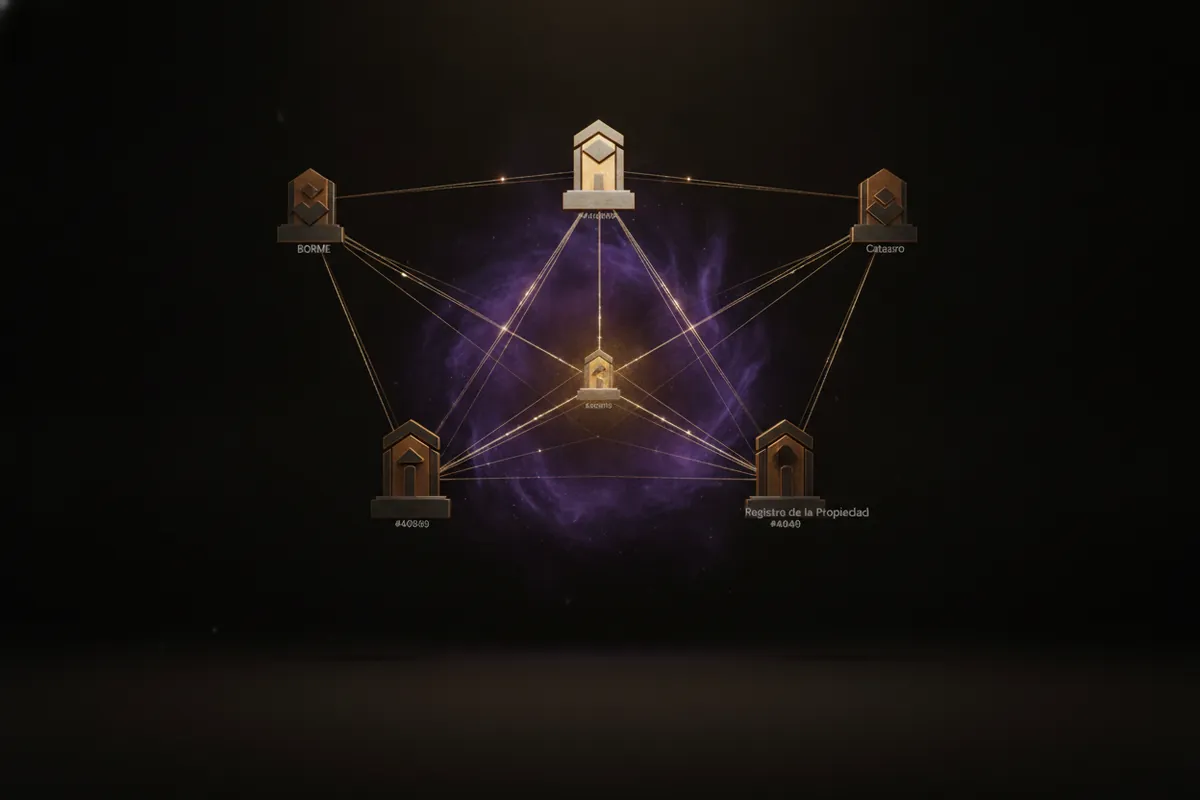
The cross-source gap is the mechanism, not the single registry
A patrimonial investigation locates hidden assets not in any single registry but in the gap between sources. The three-phase cross-source triangulation, with person-physical crossing as the load-bearing layer, is the Theorem 3 mechanism that guarantees the property.
→ →
OSINT consistency is the mechanism, not the manual-workflow assertion
An Honest Architect reading of OSINT automation: consistency is the mechanism, actionability is context-organization, quality-at-scale is structured-process, people-in-control is judgment.
→ →
Geolocating a MAC Address Needs the Mechanism, Not the Identifier
A MAC address does not contain GPS, but a wardriving database plus a signal-weighted centroid merge can geolocate a fixed access point. Theorem 3: the property comes from the mechanism, not the identifier.
→ →Build your world on an engine that proves what it claims.
Create your own network on the engine that's run since 2016 — or talk to the team behind the 21 papers.