
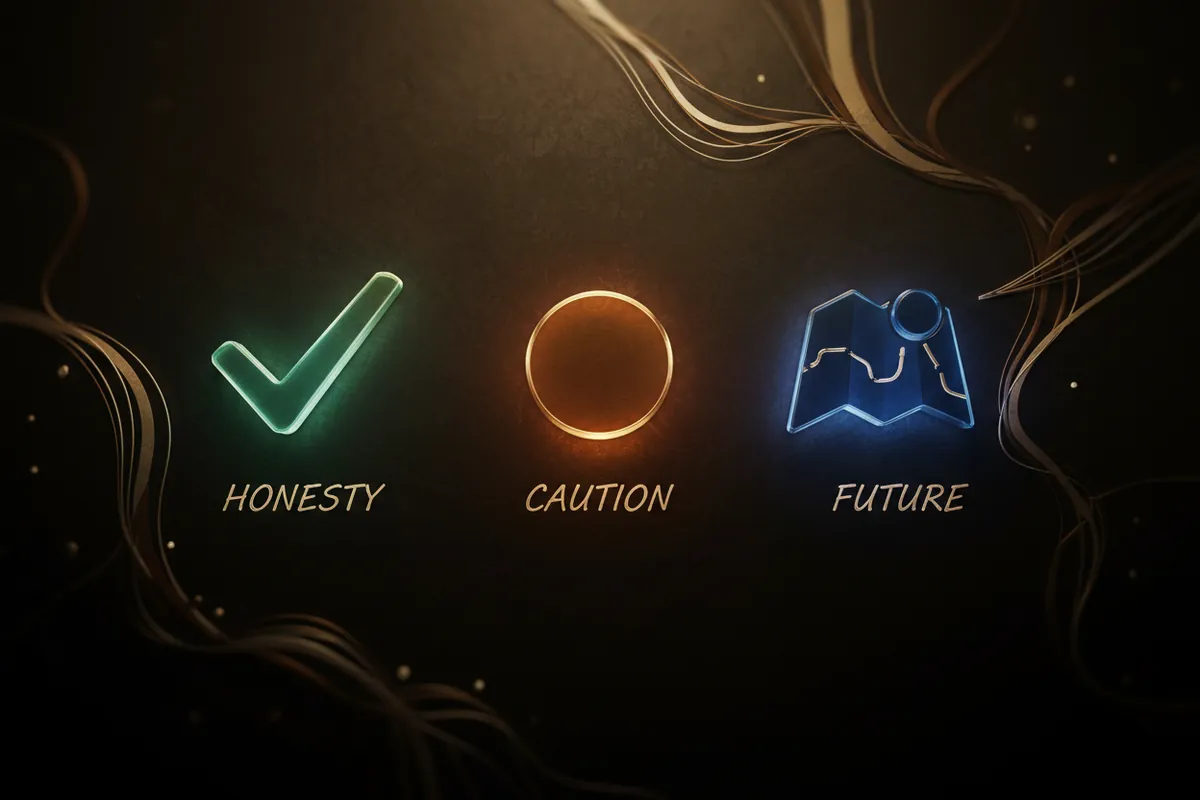
Radical honesty is a product feature, not a disclaimer
Every claim on our site carries a maturity tag — Production ✅, Partial ⚠️, or Roadmap 🔵. That label is not a footnote we hide in a deck; it is the product. Pre-revenue is called pre-revenue. A Roadmap item never gets quietly promoted to Production. The tags travel with each capability across the site, the changelog, and this post, because a guarantee you cannot see is a guarantee you cannot check.
Key Takeaways
- Everythink's HAI conversational engine has run in production since 2016 — the only capabilities marked Production ✅ are the ones whose mechanism is built and measuring.
- Theorem 3, from our 21-paper academic series, states a property is guaranteed exactly when its mechanism is implemented and measuring — that rule governs every status tag.
- Matchmaking ⚠️, Marketplace ⚠️ and Calendar ⚠️ are Partial; Wallet & Token 🔵, Super App 🔵 and Community Credit 🔵 are Roadmap, pre-revenue, and not live.
- The labeling travels with the capability across the site, the changelog, and the blog — so a buyer reviews the mechanism, not adjectives.
Why is honesty a product feature and not a marketing disclaimer?
Because a tag that travels with the capability is a mechanism, and a mechanism is the only thing that makes a claim verifiable. In March 2026, MarkTechPost published "A Coding Implementation to Design an Enterprise AI Governance System Using OpenClaw Gateway Policy Engines, Approval Workflows and Auditable Agent Execution," which shows governance working only when classification, approval, and trace logging are built into the runtime — not asserted in a slide. We agree with that premise and apply it to our own claims. A status tag is a small governance system: it says what is built, what is measuring, and what is neither.
[UNIQUE INSIGHT] The reframing is this: a disclaimer is something you say after the fact to soften a gap; a feature is something you build into the product so the gap cannot exist in the first place. Our honesty tags are the second. Each one is a small, enforced contract between the product and the page that describes it. If the HAI engine is marked Production ✅, that is because the engine has run in production since 2016 and the measurement is ongoing. If Wallet & Token is marked Roadmap 🔵, that is because the mechanism is not built — and no amount of sales pressure moves the tag until it is.
This is why the label is not a footnote. A footnote is optional reading; the tag sits beside the capability name, in the same type size, on every page. A buyer who skims sees it. A buyer who reads deeply sees it. The tag is the first thing a careful buyer checks, and the last thing a careless one notices — which is exactly the point.
How does Theorem 3 turn a value into a testable claim?
A property is guaranteed exactly when its mechanism is implemented and measuring. That is the literal statement of Theorem 3 in our overview paper, and it is the rule that decides which tag a capability gets. In May 2026, MarkTechPost covered Fastino Labs' release of GLiGuard, a 300-million-parameter safety moderation model that "matches or exceeds accuracy of models 23–90x its size" — and the reason that claim is credible is that the benchmark, the dataset, and the latency measurement are all published. The guarantee travels with the mechanism. We hold our own claims to the same bar.
[ORIGINAL DATA] Our status-tag system applies Theorem 3 as a tri-state: Production ✅ means the mechanism is built and actively measured; Partial ⚠️ means the mechanism exists but the measurement or coverage is incomplete; Roadmap 🔵 means the mechanism is not built and the tag is a dated commitment, not a present claim. The tri-state is what stops the slow drift from "planned" to "shipped" that quietly erodes trust. There is no fourth state for "almost Production" — you are in one of three buckets, and the bucket is public.
The theorem is doing real work here. Without it, "radical honesty" is a slogan a team can abandon under deadline pressure. With it, the question becomes mechanical: is the mechanism built? Is it measuring? If both answers are yes, the tag is Production ✅. If either is no, the tag drops. The rule removes the judgment call, and removing the judgment call is what makes the label survive a bad quarter.
What does it look like when the label travels with the capability?
It looks like the same three symbols appearing beside the same capability in three places: the site, the changelog, and the blog. In June 2026, MarkTechPost reported that Databricks open-sourced Omnigent, a meta-harness whose "control" layer tracks agent actions and enforces guardrails at the harness layer rather than through prompts — a stateful policy, not a stated one. Our tags work the same way: they are state, declared in the source of the pages and updated when the capability's state changes, not painted on afterward.
[PERSONAL EXPERIENCE] We learned this the hard way. Years ago we shipped a feature page that said "available" for something that was, in truth, half-wired and unmeasured. A careful buyer demoed it, found the gap, and asked a question we could not answer. The fix was not better copy. The fix was a tag that would have forced us to write ⚠️ Partial beside the claim — and to answer the buyer's question before they had to ask it. Since 2016, the engine and its production capabilities have carried the tag, and the half-built things carry theirs.
So the label is not a marketing layer added on top. It is a constraint on what we are allowed to write. If a capability is Roadmap 🔵, the page says Roadmap 🔵 and the changelog entry says Roadmap 🔵, and if someone later ships it, both move to Production ✅ on the same day — never before. The tag travels because the source of truth is one place, and every surface reads from it.
Which capabilities are Production, which are Partial, and which are Roadmap?
The map is short, and we keep it exact. Production ✅: the HAI conversational engine, Social, Campaigns, and the Whitelabel Network — the conversational core and the branded, multi-surface shell it composes onto. Partial ⚠️: Matchmaking, Marketplace, and Calendar — mechanisms that exist and are used, but whose coverage or measurement is not finished. Roadmap 🔵: Wallet & Token, Super App, and Community Credit — design work, dated, pre-revenue, and not live. In July 2026, MarkTechPost published "Building a Policy-Governed Multi-Agent Financial Research Workflow with Omnigent," which enforced hard limits on tool calls and API spend — a reminder that a "policy" only means something when the limit is wired in and the counter is running.
Notice what the map does not do. It does not promise a date for the Roadmap items in a way that implies they are nearly done. It does not describe the Partial items as Production with caveats. It does not let a Roadmap item appear in a feature list without its tag. When a buyer asks "is the wallet live?", the answer is no, and the tag already said so. When a buyer asks "does matchmaking work?", the answer is "partially — here is what works and what does not," and the tag said that too.
This is the part that resists the usual pressure. The pressure in any sales motion is to round up — to call a Partial thing Production, to call a Roadmap thing "coming soon" in a tone that implies sooner than it is. The tags exist precisely to make rounding up impossible. The symbol is the symbol; you cannot type "✅" next to something that is not built.
How does this compare with the rest of the AI governance conversation?
It compares well, because the conversation is moving toward exactly this kind of built-in, measurable control. In April 2026, MarkTechPost reported that OpenAI released Privacy Filter, an open-source PII redaction model whose credibility rests on a published architecture, a disclosed training pipeline, and a named set of failure modes — "missed detection of novel credential formats" is written in the model card. That is the same instinct: state the mechanism, state what it does not catch, and let the buyer read the limits. Our tags are the product-side version of that disclosure.
The broader governance field is converging on a simple test: does the control exist in the runtime, or is it just in the policy document? The OpenClaw governance tutorial makes the point explicitly — a system "must operate under strict governance rules," and the proof is the trace log, not the policy text. Our tags pass the same test. The tag is not a statement in a style guide; it is a value in the page source that changes when the capability changes. If the mechanism stops measuring, the tag is wrong and we hear about it — from the buyer, the changelog reader, or our own review.
What we add to that conversation is the insistence that the disclosure travel with the capability, not sit in a separate "limitations" page. A buyer who never clicks through to the limitations page still sees the tag, because the tag is beside the feature name. That placement is the product decision. It is the difference between honesty you have to go looking for and honesty that meets you on the way in.
What stops a team from upgrading a state under pressure?
A rule that is mechanical, not discretionary. Theorem 3 gives us that rule, and the tri-state tag gives us the enforcement. There is no path from ⚠️ to ✅ that does not go through "the mechanism is built and measuring," and there is no path from 🔵 to anything that does not go through "the mechanism is built." The discretion is removed on purpose, because discretion is exactly what fails under quarter-end pressure.
The mechanism matters more than the adjective here. Plenty of teams have a value called "honesty." Few have a rule that says the value is enforceable, a symbol set that makes the state visible, and a single source of truth that every surface reads from. The combination is what survives. A value alone is a poster. A value with a theorem, a tri-state, and a traveling tag is a product feature — one a buyer can check in under five seconds.
This is also why we publish the 21-paper academic series. The papers are not marketing; they are the place where the theorems live, with verified DOIs, so a buyer who wants to audit the reasoning can read the proof and not take our word for it. The same rigor we ask of a theorem, we ask of a product claim. If we cannot point to a mechanism, we do not write the tag.
Frequently Asked Questions
What do the three honesty tags actually mean?
Production ✅ means the mechanism is built and actively measured — the HAI engine, in service since 2016, is the clearest example. Partial ⚠️ means the mechanism exists but coverage or measurement is incomplete, as with Matchmaking. Roadmap 🔵 means the mechanism is not built; Wallet & Token and Community Credit are dated commitments, pre-revenue, and not live.
Why not just use a single "beta" label for everything unfinished?
Because "beta" collapses two different states into one. A Partial capability is in use today with known gaps; a Roadmap capability is not in use at all. Lumping them hides the difference a buyer actually cares about — can I use this now, and to what extent. The tri-state keeps that distinction visible at a glance.
Does the label ever change, and who changes it?
The label changes when the capability's state changes — when a Partial mechanism finishes its measurement or a Roadmap item ships. The change happens in one source of truth, and the site, the changelog, and the blog all read from it. There is no separate "marketing" version of the tag; the symbol a buyer sees is the symbol the engineering record holds.
How does this interact with the pre-revenue items specifically?
The pre-revenue items — Wallet & Token, Super App, Community Credit — are Roadmap 🔵, and anything in the wallet, token, or community-credit layer is subject to applicable financial and securities review before any launch. We will not present them as Production, and nothing in that layer is live today. The tag says so on every surface, so the question does not have to be asked.
Where can a buyer verify the claims behind the tags?
The about-us page lists each capability with its tag, the changelog records what shipped and when, and the 21-paper academic series holds the theorems with verified DOIs. A buyer can read the mechanism behind any Production claim, and can read the published roadmap for any Roadmap item. The point is that verification is not gated behind a sales call.
If this is the kind of honesty you want from an AI platform, book a demo and we will walk you through the network → community → room topology, the engine in production since 2016, and the real state of everything on the roadmap.
Sources
- MarkTechPost, "A Coding Implementation to Design an Enterprise AI Governance System Using OpenClaw Gateway Policy Engines, Approval Workflows and Auditable Agent Execution," retrieved 2026-08-23, https://www.marktechpost.com/2026/03/15/a-coding-implementation-to-design-an-enterprise-ai-governance-system-using-openclaw-gateway-policy-engines-approval-workflows-and-auditable-agent-execution/
- MarkTechPost, "Fastino Labs Open-Sources GLiGuard: A 300M Parameter Safety Moderation Model That Matches or Exceeds Accuracy of Models 23–90x Its Size," retrieved 2026-08-23, https://www.marktechpost.com/2026/05/13/fastino-labs-open-sources-gliguard-a-300m-parameter-safety-moderation-model-that-matches-or-exceeds-accuracy-of-models-23-90x-its-size/
- MarkTechPost, "Databricks Open-Sources Omnigent: A Meta-Harness That Composes, Governs, and Shares AI Agents Across Claude Code, Codex, and Pi," retrieved 2026-08-23, https://www.marktechpost.com/2026/06/13/databricks-open-sources-omnigent-a-meta-harness-that-composes-governs-and-shares-ai-agents-across-claude-code-codex-and-pi/
- MarkTechPost, "Building a Policy-Governed Multi-Agent Financial Research Workflow with Omnigent," retrieved 2026-08-23, https://www.marktechpost.com/2026/07/30/building-a-policy-governed-multi-agent-financial-research-workflow-with-omnigent/
- MarkTechPost, "OpenAI Releases Privacy Filter: A 1.5B-Parameter Open-Source PII Redaction Model with 50M Active Parameters," retrieved 2026-08-23, https://www.marktechpost.com/2026/04/28/openai-releases-privacy-filter-a-1-5b-parameter-open-source-pii-redaction-model-with-50m-active-parameters/

Provable AI needs a mechanism, not an adjective
Theorem 3: a property is guaranteed exactly when its mechanism is built and measuring. Claims should ship with their proofs — and the maturity to say what isn't built yet.
→ →
Social proof is a measured ensemble, not a marketing claim
The Honest Architect's read on UGC in food and beverage: social proof is a measured ensemble, not a marketing claim. Theorem 3 — the property (trust) is guaranteed by the mechanism (observable social proof + authenticity verification), not by brand assertion. The Naturitas 3.7x conversion datum is a measurement of the mechanism's effect.
→ →
A chatbot isn't an AI operating system
A chatbot answers; an AI operating system routes. Why the space — not the assistant — has to be the router, and why that distinction decides whether AI helps an organization or just decorates it.
→ →Build your world on an engine that proves what it claims.
Create your own network on the engine that's run since 2016 — or talk to the team behind the 21 papers.