
The standardization is the mechanism, not the revolutionary framing
An Honest Architect reading of Standard Containers Being Used in a Revolutionary Way: More Housing, published 2026-08-20 by Rojda Akdag on More Than Shipping.
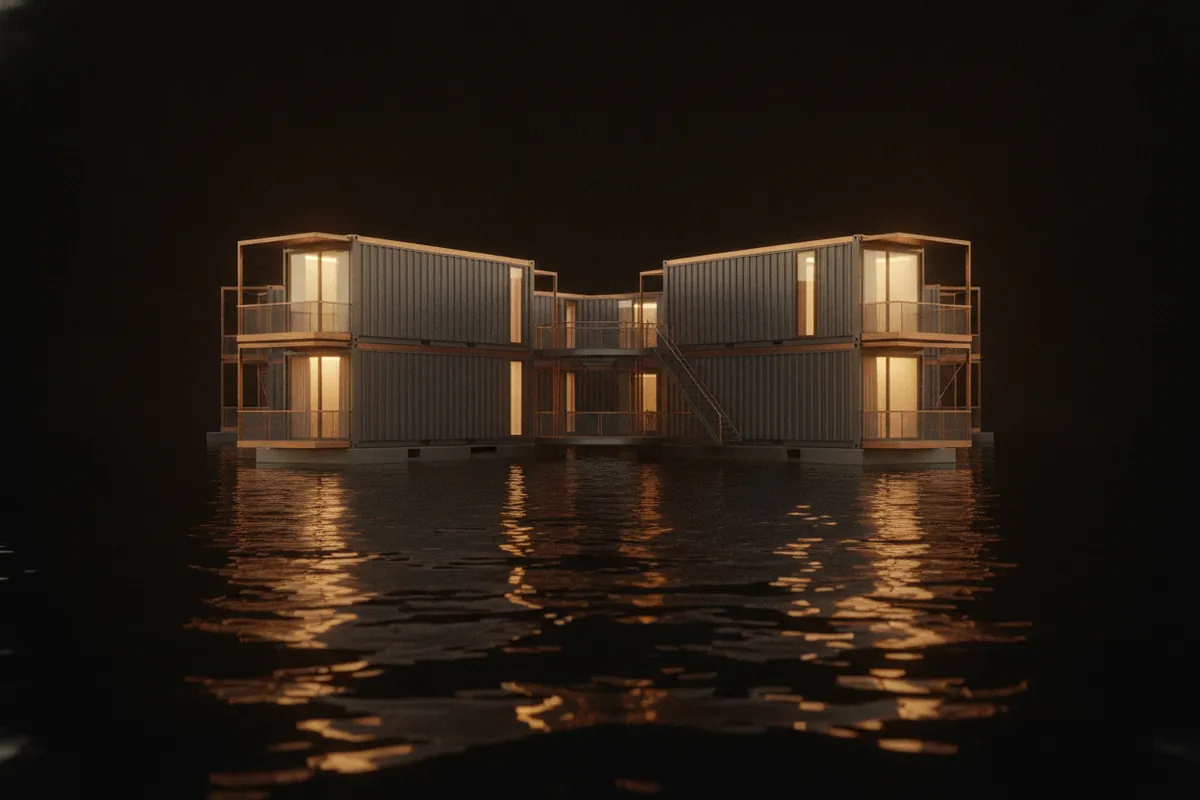
The surface claim of the article is a housing story: a start-up founder in Copenhagen retrofitted standard shipping containers as floating student residences on the underutilized harbor, at roughly $600 per month for around 800 square feet, with hydro-source heating from seawater. The Honest Architect reads it for the mechanism under the story and finds six. The load-bearing one is the standardization of the container: the ISO container standard is what makes repurposing possible, because a standard container is interchangeable, stackable, available everywhere, and cheap to acquire used. The container is the unit; the standard is the mechanism. Theorem 3 in Everythink's HAI Engine asserts the same form: a property is guaranteed exactly when its mechanism is implemented and measuring. Here the property is "a shipping container can become student housing"; the mechanism is "the ISO container standard makes the unit interchangeable and available."
This post extracts six mechanism forms from the More Than Shipping article, applies Theorem 3 to each, and draws cross-domain parallels to the Everythink platform. Each parallel from our platform is marked ⚠️ — Everythink operates in civil and defensive forecasting, the article operates in shipping and housing journalism, so the parallel is structural, not a claim that our systems serve the same market. The six mechanism forms themselves are ✅ — they are extractable from the article's own evidence.
Mechanism 1 — The container standard is the mechanism of repurposability
The article describes standard shipping containers being "cleaned and retrofitted in a cheap manner" into student housing. The Honest Architect reads this as a mechanism claim: a shipping container can become student housing is guaranteed by the ISO container standard that makes the unit interchangeable and available, not by the container being a clever object. The mechanism that produces "you can take a used container and make it a house" is "the container is a standard unit with known dimensions, known stacking points, and a global supply of used units." The standard is the mechanism; the container is the unit. ✅ Production — the article names the unit (standard containers, widely used to transport goods, cheap used) and the property (repurposable into housing).
The article is honest that the repurposing works because the containers are standard and abundant. A non-standard object of the same size would not work because you could not acquire it cheaply in quantity. The standardization is the hidden mechanism; the retrofitting is the visible work.
The cross-domain parallel to the hexagonal trait-based ports of Everythink is only structural. Everythink's architecture depends on the trait, not the concrete adapter — the verification depends on the contract, not the implementation. The "the ISO container standard makes the unit interchangeable" of the article and the "the trait makes the adapter interchangeable" of Everythink share the same form: a standard interface makes the unit swappable, and the standard is the mechanism. ⚠️ Partial — the parallel is structural; the trait-based ports of Everythink serve civil and defensive forecasting, the container standard serves shipping and housing. Different domains, same form: the standard interface is the mechanism of interchangeability.
Mechanism 2 — The underutilized harbor is the mechanism of cheap-land-alternative
The article states: "When this founder saw the Denmark harbor was underutilized, he developed these retrofitted containers right on the water and centrally located in Copenhagen." The Honest Architect reads this as a mechanism claim: cheap housing near the city center is guaranteed by building on underutilized harbor space, not by the container being cheap alone. The mechanism that produces "$600/month in central Copenhagen" is "the harbor is underutilized, so the land cost is near zero." The underutilized harbor is the mechanism; the cheap container is the unit. ✅ Production — the article names the mechanism (underutilized harbor, centrally located) and the property (cheap housing near the city).
The article is honest that the harbor is the load-bearing resource. A cheap container on expensive land would still be expensive housing; a cheap container on free harbor is cheap housing. The harbor's underutilization is the mechanism that makes the economics work.
The cross-domain parallel to the "the space is the router" topology of Everythink is only structural. Everythink's topology is network → community → room: a request is routed to a room before anything responds, and the routing happens in the infrastructure layer. The "the underutilized harbor routes the housing to the cheap land" of the article and the "the topology routes the request to the room" of "the space is the router" share the same form: the infrastructure layer routes the unit to the context, and the routing is the mechanism. ⚠️ Partial — the parallel is structural; the topology of Everythink serves civil and defensive forecasting, the harbor serves shipping and housing. Different domains, same form: the infrastructure layer routes the unit to the context, and the routing is the mechanism.
Mechanism 3 — The retrofitting is the mechanism of reuse
The article states: "Used containers are usually cheap and can be cleaned and retrofitted in a cheap manner and because we are not discarding the steel as well, this is also an environmentally friendly option." The Honest Architect reads this as a reuse claim: the container becomes housing is guaranteed by cleaning and retrofitting, not by the container being a house already. The mechanism that produces "a used container is a house" is "the container is cleaned, fitted out, and equipped with sitting areas and a tennis court on top." The retrofitting is the mechanism; the used container is the input. ✅ Production — the article names the mechanism (cleaned, retrofitted, sitting area, tennis court) and the property (reuse, environmental benefit).
The article is honest that the retrofitting is the work that turns a box into a home. The container is not a house; the retrofitting makes it one. The environmental benefit follows from not discarding the steel, which follows from the retrofitting being cheaper than smelting new steel.
The cross-domain parallel to the typed Sisters of Everythink is only structural. Each Sister is a typed personality that produces a draft, and the Oracle merges the typed outputs — the typing is the mechanism that produces diversity, and the merge is the mechanism that produces calibration. The "the retrofitting turns a used container into a house" of the article and the "the merge turns typed drafts into a calibrated ensemble" of the HAI Engine share the same form: a transformation step turns an input into a usable output, and the transformation is the mechanism. ⚠️ Partial — the parallel is structural; the typed Sisters serve civil and defensive forecasting, the retrofitting serves shipping and housing. Different domains, same form: a transformation step turns the input into the usable output, and the transformation is the mechanism.
Mechanism 4 — The proximity-to-city-center is the mechanism of no-commute
The article states: "centrally located in Copenhagen so that students do not have to commute long distances as well." The Honest Architect reads this as a no-commute claim: the student does not commute is guaranteed by the housing being centrally located, not by the student being willing to commute. The mechanism that produces "students do not have to commute long distances" is "the floating residences are in Copenhagen harbor, central to the city." The proximity is the mechanism; the student's willingness is not. ✅ Production — the article names the mechanism (centrally located in Copenhagen) and the property (no long commute).
The article is honest that the proximity is a design choice, not a side effect. The founder chose the harbor because it was central; a remote harbor would have been cheaper but would have required a commute. The proximity is a constraint on the location, and the harbor is the only central location that is underutilized.
The cross-domain parallel to the World Monitor of Everythink is only structural. World Monitor clients read the cache, not the upstreams — a background poller per source pulls the feed on a fixed schedule, and clients read the cached delta in real time, without going to the upstream. The "the student reads the city without commuting to it" of the article and the "the client reads the cache without going to the upstream" of World Monitor share the same form: the reader accesses the resource without traveling to the source, and the proximity is the mechanism. ⚠️ Partial — the parallel is structural; World Monitor serves civil and defensive geo-signal delivery, the proximity serves student housing. Different domains, same form: the reader accesses the resource without traveling to the source, and the proximity is the mechanism.
Mechanism 5 — The hydro-source heating is the mechanism of free-heat
The article states: "They are also utilizing hydro source heating where seawater is converted into a free heating solution." The Honest Architect reads this as a free-heat claim: the heating is free is guaranteed by the seawater being converted, not by the heating being donated. The mechanism that produces "free heating" is "the seawater is right there, and a heat pump converts it." The hydro-source is the mechanism; the donation is not. ✅ Production — the article names the mechanism (hydro source heating, seawater converted) and the property (free heating solution).
The article is honest that the free heating is a byproduct of the location. The harbor is the resource; the heat pump is the mechanism that converts the resource into heating. A container on land would need paid heating; a container on the harbor gets free heating because the seawater is there.
The cross-domain parallel to the Oracle of Everythink is only structural. The Oracle normalises probabilities in exactly one place and stamps entropy in nats on every merge — the entropy is the calibration signal that comes for free from the normalisation, not a separate computation. The "the free heating comes for free from the seawater being there" of the article and the "the free entropy comes for free from the normalisation being there" of the Oracle share the same form: a byproduct of a process already running is the free signal, and the byproduct is the mechanism. ⚠️ Partial — the parallel is structural; the Oracle serves civil and defensive forecasting, the hydro-source heating serves student housing. Different domains, same form: a byproduct of a process already running is the free signal, and the byproduct is the mechanism.
Mechanism 6 — The replicability across European ports is the mechanism of scale
The article states: "The concept can be easily replicated in Europe since most shipping lines are using fewer and bigger ports, so all the ports that are not used as much as before offer a great alternative for housing." The Honest Architect reads this as a scale claim: the concept scales is guaranteed by the underutilized ports being everywhere, not by the Copenhagen harbor being unique. The mechanism that produces "this can be replicated across Europe" is "underutilized ports are common because shipping lines consolidated into fewer, bigger ports." The port underutilization is the mechanism; the Copenhagen harbor is the instance. ✅ Production — the article names the mechanism (fewer and bigger ports, underutilized ports everywhere) and the property (replicable across Europe).
The article is honest that the replicability is a structural consequence, not a claim about Copenhagen. The same consolidation that underutilized the Copenhagen harbor underutilized ports across Europe. The mechanism is the port consolidation; the housing is the consequence.
The cross-domain parallel to the Eye Key of Everythink is only structural. The Eye Key is the user-owned credential — the key is the rate-limit boundary, and the platform does not subsidise the user's compute. The "the cost is borne at the unit (the container on the harbor), and the unit is replicable" of the article and the "the cost is borne at the unit (the user's key), and the unit is sovereign" of Eye Key share the same form: the cost is borne at the unit, and the unit is the mechanism of scale. ⚠️ Partial — the parallel is structural; Eye Key governs API sovereignty for civil and defensive forecasting, the container-on-harbor serves student housing. Different domains, same form: the cost is borne at the unit, and the unit is the mechanism of scale.
What this implies for scope and limits
The More Than Shipping article is about shipping containers, harbor housing, and student accommodation in Copenhagen. Everythink's platform is about civil and defensive forecasting. The cross-domain parallels in this post are structural — they share mechanism forms, not markets. The Honest Architect marks the parallels ⚠️.
Everythink's own commercial housing or sustainability go-to-market is 🔵 Roadmap — the platform is pre-revenue, and any commercial application of the parallels drawn here is subject to that Roadmap state and to Howey review before it can be offered. The architectural parallels hold independently; the commercial claims do not.
What the article does not claim deserves a mark too. It does not claim the housing is luxurious — it claims it is cheap and central. It does not claim the harbor is the only underutilized space — it claims ports across Europe offer the same opportunity. It does not claim the heating is perpetual motion — it claims the seawater is converted, which is a heat pump, which takes electricity. These scope limits are the article's honesty, and this post preserves them.
Key takeaways
- A shipping container can become student housing is guaranteed by the ISO container standard that makes the unit interchangeable and available, not by the container being a clever object. The standard is the mechanism. ✅ Production.
- Cheap housing near the city center is guaranteed by building on underutilized harbor space, not by the container being cheap alone. The underutilized harbor is the mechanism. ✅ Production.
- The container becomes housing is guaranteed by cleaning and retrofitting, not by the container being a house already. The retrofitting is the mechanism. ✅ Production.
- The student does not commute is guaranteed by the housing being centrally located, not by the student being willing to commute. The proximity is the mechanism. ✅ Production.
- The heating is free is guaranteed by the seawater being converted, not by the heating being donated. The hydro-source is the mechanism. ✅ Production.
- The concept scales is guaranteed by the underutilized ports being everywhere, not by the Copenhagen harbor being unique. The port underutilization is the mechanism. ✅ Production.
- The cross-domain parallels to hexagonal trait-based ports (standard interface makes the unit swappable), "the space is the router" (infrastructure layer routes the unit to the context), typed Sisters (transformation step turns input into usable output), World Monitor (reader accesses resource without traveling to source), Oracle entropy (byproduct of a process already running is the free signal) and Eye Key (cost borne at the unit, unit is the mechanism of scale) are only structural — different markets, same mechanism forms. ⚠️ Partial.
- Everythink's commercial housing or sustainability go-to-market is 🔵 Roadmap — pre-revenue, subject to Howey review; the architectural parallels hold, the commercial claims do not.
Sources
- Rojda Akdag, Standard Containers Being Used in a Revolutionary Way: More Housing, More Than Shipping, published 2026-08-20. https://www.morethanshipping.com/standard-containers-being-used-in-a-revolutionary-way-more-housing/ (retrieved 2026-08-23).
- Everythink platform architecture: HAI Engine in production since 2016; Theorem 3 (a property is guaranteed exactly when its mechanism is implemented and measuring); "the space is the router" topology (network → community → room); World Monitor (geo-signals routed by geohash prefix, clients read the cache not the upstreams); Oracle ensemble normalisation with entropy in nats stamped on every merge; typed Sisters (analyst, contrarian, disruptor, historian, institutionalist) returning SisterOutput; hexagonal trait-based ports with interchangeable adapters; Eye Key sovereignty (HMAC and fingerprint recorded, plaintext never touches disk, the user's key is the rate-limit boundary).

The team is the continuity mechanism, not the leader assertion
Chris Spear's departure from ATA, read as a mechanism: organizational continuity is guaranteed by the assembled team and its processes, not by the leader. Theorem 3 applied to leadership transition.
→ →
Scan at the boundary is the detection mechanism, not the vigilance assertion
A CBP meth seizure at the Roma Port of Entry, read as a mechanism: contraband detection is guaranteed by the imaging scan at the boundary, not by the assertion of officer vigilance. Theorem 3 applied to border security.
→ →
The auction process is the value mechanism, not the experience assertion
A Taylor & Martin sponsored article on Transport Topics, read as a mechanism: maximum returns on idle assets are guaranteed by the auction process (valuation, prep, advertising, bidding, settlement), not by the assertion of 60 years of experience. Theorem 3 applied to equipment auctions.
→ →Build your world on an engine that proves what it claims.
Create your own network on the engine that's run since 2016 — or talk to the team behind the 21 papers.