The Metric Is the Mechanism, Not the Resolution
Every imaging system is sold on proxies. Megapixels. Signal-to-noise ratio. Resolution charts. A lens advertised as "sharp" and a sensor advertised as "clean" get bolted together, and the buyer is expected to infer that the combination will distinguish the objects they actually care about. It rarely does, cleanly, because the proxies were never the property. The property is: can the measurement distinguish the objects? The mechanism that guarantees it is: measure how much the measurement reduces uncertainty about the object, and maximize that directly.
A January 2026 BAIR Blog post, "Information-Driven Design of Imaging Systems" (Berkeley AI Research, 2026, retrieved 2026-08-23, https://bair.berkeley.edu/blog/2026/01/10/information-driven-imaging/), reports a NeurIPS 2025 result that does exactly this. The authors replace resolution, SNR, and end-to-end decoder training with a single quantity: mutual information between object and measurement. They show it predicts downstream performance across four imaging domains, and they introduce a method — Information-Driven Encoder Analysis Learning (IDEAL) — that optimizes the imaging hardware by gradient ascent on the information estimate alone, with no decoder in the loop. The result matches state-of-the-art end-to-end optimization while using less memory, less compute, and no task-specific decoder design.
This is a Theorem 3 story. ✅ A property is guaranteed exactly when its mechanism is implemented and measuring. The property is distinguish objects; the mechanism is estimate mutual information from measurements with known noise physics, and optimize against that estimate. The rest of this post unpacks the six mechanism forms the paper instantiates, then draws the partial parallels to how Everythink's architecture treats measurement, validation, and sovereignty. The imaging-systems result is Production-grade work from Berkeley; the Everythink parallels are Partial ⚠️ — same shape of argument, different domain, our claims are not the BAIR result.
Mechanism 1: Mutual information is the unifying metric (load-bearing)
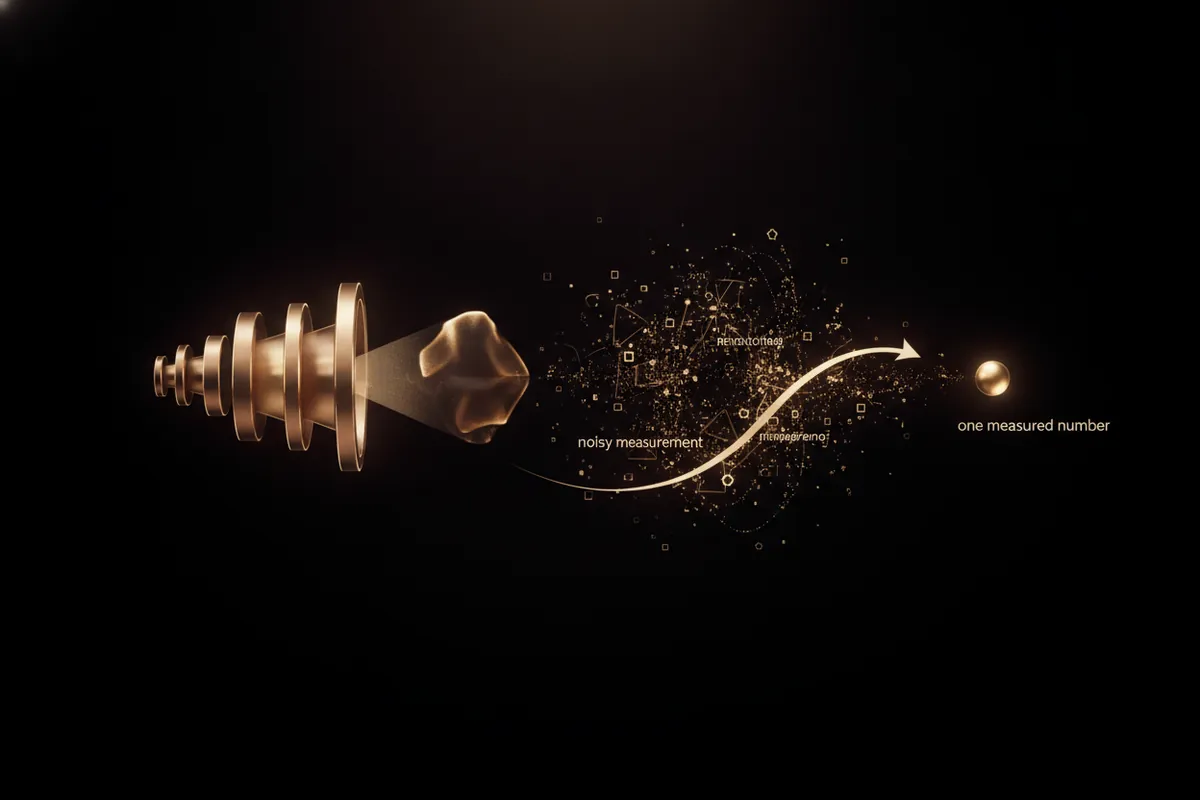
Resolution measures how small a feature the optics can resolve. SNR measures how much signal stands above noise. Spectral sensitivity measures which wavelengths the sensor captures. Each is a proxy for one axis of quality, and each is blind to the trades between axes. A blurry, noisy image that preserves the features needed to distinguish objects can contain more information than a sharp, clean image that loses those features — the BAIR post states this directly. Mutual information collapses resolution, noise, sampling, and spectral sensitivity into one number: how much the measurement reduces uncertainty about the object that produced it.
✅ The mechanism is implemented and measuring: the metric is defined as I(X; Y) = H(Y) − H(Y|X), estimated from measurements, and reported as a single comparable number across systems. Two systems with the same mutual information are equivalent in their ability to distinguish objects, even if their measurements look completely different. The paper validates this claim across four imaging domains — color photography, radio astronomy, lensless imaging, and microscopy — and in every domain, higher information meant better downstream performance. That is the Theorem 3 form: the property is operationalized as a single quantity, the quantity is measured, and the measurement predicts the property.
Mechanism 2: Known noise physics, learned only what is unknown
Estimating mutual information between high-dimensional variables is notoriously hard. Sample requirements grow exponentially with dimensionality, and naive estimates suffer high bias and variance. The BAIR authors avoid the worst of this by decomposing the problem. Mutual information splits as I(X; Y) = H(Y) − H(Y|X). The first term, H(Y), measures total variation in measurements from both object differences and noise. The second term, H(Y|X), measures variation from noise alone.
The decisive move: imaging systems have well-characterized noise. Photon shot noise follows a Poisson distribution. Electronic readout noise is Gaussian. That known physics means H(Y|X) can be computed analytically, leaving only H(Y) to be learned from data — fit with a stationary Gaussian process, a full Gaussian, or an autoregressive PixelCNN, depending on the efficiency-accuracy tradeoff the designer wants. ✅ The mechanism is implemented and measuring: the noise model is a verified physical fact, not a learned guess, so half of the estimation problem is solved by physics and only the measurement distribution is learned. This is the load-bearing split. It is what makes the estimator tractable on real imaging data instead of a toy channel.
Mechanism 3: Upper-bound safety property
The estimator provides an upper bound on true information. Any modeling error can only overestimate, never underestimate. This is a safety property, not a performance claim. A designer who optimizes against the upper bound is optimizing against an optimistic estimate of the system's information capacity; the true capacity is at most that high, and the downstream decoder will perform at most as well as the bound predicts.
✅ The mechanism is implemented and measuring: the bound is provable from the estimator's construction (a learned model of H(Y) can only fail to capture all the structure in the measurement distribution, which can only inflate the entropy estimate, which can only inflate the mutual information estimate). The designer is never surprised by a system that performs better than the bound predicted — the failure mode is conservative, the optimistic case is bounded. This is the kind of mechanism a Theorem 3 analysis looks for: not "it works," but "the way it can fail is itself characterized."
Mechanism 4: Optimize the encoder, not the decoder
The standard approach to computational imaging design, end-to-end optimization, jointly trains the imaging hardware and a neural network decoder. This requires backpropagating through the entire decoder, which creates memory constraints, optimization difficulties, and a hard coupling between the hardware design and the specific decoder architecture chosen for training. IDEAL avoids all of this. It optimizes the encoder alone — the imaging system parameters — by gradient ascent on the information estimate, with no decoder in the loop.
✅ The mechanism is implemented and measuring: the encoder is optimized against a decoder-agnostic objective, so the resulting hardware is not married to any one downstream consumer. The paper tested this on color filter design: starting from a random filter arrangement, IDEAL progressively improved the design and the final result matched end-to-end optimization in both information content and reconstruction quality, while avoiding decoder complexity during training. The encoder is evaluable on its own terms, by its information content, without committing to a decoder.
Mechanism 5: Validated across four domains
A metric that predicts downstream performance in one imaging domain might be an artifact of that domain. The BAIR authors test the estimator across four: color photography (comparing Bayer, random, and learned color filter arrays), radio astronomy (telescope site selection across configurations where each site's value depends on all others), lensless imaging (comparing a lens, microlens array, and diffuser at various noise levels), and microscopy (LED array microscopes predicting protein-expression accuracy from cell images). In all four, higher information estimates consistently produced better results on the downstream task.
✅ The mechanism is implemented and measuring: the same estimator, the same decomposition, the same upper-bound property, applied to four physically distinct imaging systems, predicted downstream performance in every case. The metric is not a color-photography trick or a radio-astronomy trick; it is a property of measurement itself. Generalization evidence is the difference between a mechanism that holds in one lab and a mechanism that holds.
Mechanism 6: Predicts downstream performance without the downstream task
The deepest implication is that the information estimate predicts decoder performance without requiring the decoder to be trained. In radio astronomy, this means telescope site selection without expensive image reconstruction. In microscopy, it means evaluating illumination designs without expensive protein-labeling experiments. In color photography, it means ranking filter designs without running neural-network demosaicing.
✅ The mechanism is implemented and measuring: the property (downstream task performance) is guaranteed by a measured quantity (mutual information) that does not require the downstream task to be instantiated. This is the Theorem 3 payoff. You do not have to build the decoder to know whether the encoder is good. You measure the information content of the measurements, and that measurement is the guarantee.
Cross-domain parallels (Partial ⚠️)
The BAIR result is a Production ✅ mechanism in computational imaging. The parallels below are Partial ⚠️ — same shape of argument, applied to Everythink's domain, not validated to the BAIR paper's standard.
Single normalization site. ⚠️ Everythink's Oracle normalizes scenario probabilities in exactly one place — the ensemble merge — so consumers can rely on sum(probability) ≈ 1.0, scenarios sorted descending, entropy in nats. This is the same shape as mutual information collapsing resolution, noise, and sampling into one number: a property that was previously scattered across proxies is guaranteed by a single measured quantity. The Oracle's single normalization is not mutual information, but it is the same architectural move — unify the property into one measured mechanism.
Validate at the boundary. ⚠️ Everythink parses wire types with Zod at the network boundary; a bad payload surfaces as a typed ApiError, never a crash. This is the same shape as IDEAL optimizing the encoder alone: validate the input where it enters, do not couple the validation to every downstream consumer. The imaging analog is "evaluate the encoder by its information content, not by the decoder's output"; the Everythink analog is "validate the payload at the API, not at every call site."
Trait, not adapter. ⚠️ Everythink's AppState repositories are Arc
Sovereignty by construction. ⚠️ Eye Key plaintext never touches disk — only the HMAC and fingerprint go to Postgres, and the plaintext is shown once, in memory. This is the same shape as the BAIR estimator's upper-bound property: the failure mode is characterized by construction. Eye Key's failure mode is "the plaintext is gone, the HMAC remains" — a conservative failure, not a leak. The estimator's failure mode is "the bound is loose, the true capacity is at most that high" — also a conservative failure. Both are mechanisms whose safety is in how they can fail.
Deterministic identity. ⚠️ World Monitor's GeoSignal ids are deterministic uuidv5(source, native_id), so re-ingest updates rather than duplicates. This is the same shape as the BAIR noise-physics decomposition: a known, deterministic component of the problem (the source identity, the noise distribution) is computed analytically rather than learned, and only the uncertain component (the signal delta, the measurement distribution) is learned from data. Known physics, deterministic identity — both collapse the learning problem onto what is actually unknown.
Versioned reproducibility. ⚠️ Everythink's Sisters are typed personalities loaded from TOML at runtime, and the prompt version in the TOML is stamped on every run for reproducibility. This is the same shape as the BAIR estimator's upper-bound property: a guarantee that is attached to the output, not asserted separately. The Sisters' stamp is "this forecast was produced with prompt version X"; the estimator's bound is "this measurement has information at most Y." Both make the guarantee inspectable on the artifact.
Scope limits
The BAIR result is civil/defensive in the broad sense — imaging systems include medical imaging (MRI, microscopy) and autonomous-vehicle sensors, where the cost of a bad measurement is harm. The Everythink parallels are commercial/industrial: the Oracle is a forecasting engine for commercial and industrial decision-making, not a medical device, and the Eye Key is a developer-API sovereignty mechanism, not a clinical safety control. The cross-domain parallels are architectural-shape claims, not performance claims — Everythink's single normalization site is not validated to BAIR's four-domain standard, and the trait-based port pattern is not validated as an information estimator. The 21 papers underlying Everythink's forecasting guarantees are a separate corpus; the BAIR NeurIPS 2025 paper is one paper, in one domain, with one mechanism. No token, wallet, or community-credit outcome is promised here — those remain Roadmap 🔵, pre-revenue, subject to Howey review.
FAQ
Is mutual information a new idea? No. The BAIR post names two prior attempts: treating imaging systems as unconstrained communication channels (which ignored physical limits and produced wildly inaccurate estimates), and requiring explicit object models (which limited generality). The contribution is estimating information directly from measurements with known noise physics, avoiding both prior failure modes.
Does IDEAL replace end-to-end optimization? In the color filter design test, IDEAL matched end-to-end optimization in both information content and reconstruction quality while using less memory, less compute, and no task-specific decoder design. The paper does not claim IDEAL dominates end-to-end in every setting; it claims the encoder-optimization path is competitive and cheaper. That is a substitution claim in the tested domain, not a universal claim.
Why does the upper bound matter? A conservative estimator is safe to optimize against. If the estimator could underestimate, a designer optimizing against it might leave performance on the table and never know. If the estimator can only overestimate, the designer knows the true capacity is at most the bound, and the downstream decoder will perform at most as well as the bound predicts. The failure mode is characterized, not hidden.
How is this different from just training a decoder and measuring accuracy? Training a decoder conflates the quality of the imaging hardware with the quality of the algorithm. A good decoder can compensate for a bad sensor, and a bad decoder can sabotage a good sensor. The information metric isolates the hardware: it measures the encoder's information content directly, without the decoder's quality contaminating the evaluation.
What does this mean for Everythink? Architectural shape, not performance. The Oracle's single normalization site, the trait-based ports, the Eye Key's sovereignty-by-construction, and the Zod-at-the-boundary pattern are all the same shape of argument as the BAIR mechanism: unify the property into one measured mechanism, validate at the boundary, characterize the failure mode. The BAIR paper is the Production ✅ version of that shape in computational imaging; Everythink's parallels are Partial ⚠️ versions in forecasting and developer-tooling architecture.
Sources
- Berkeley AI Research (BAIR) Blog, "Information-Driven Design of Imaging Systems," January 10, 2026. URL: https://bair.berkeley.edu/blog/2026/01/10/information-driven-imaging/. Retrieved 2026-08-23. Publisher: Berkeley AI Research (UC Berkeley). The post reports the NeurIPS 2025 paper "Information-Driven Encoder Analysis Learning (IDEAL)" and the information-estimation framework validated across color photography, radio astronomy, lensless imaging, and microscopy.
The Honest Architect says: measure the property directly, characterize how the measurement can fail, and optimize against the measurement. Proxies are what you sell; mechanisms are what you build.
The Tier Is the Routing Mechanism, Not the Prestige Ladder
A BeInfluence guide lays out a four-tier influencer ecosystem — nano, micro, macro, mega — each with a distinct structural property. Six mechanism forms drawn to Theorem 3, with Partial parallels to Everythink architecture.
→ →
The Century Is the Measurement Mechanism, Not the Milestone
A Bulk Transporter article on Hendrickson's 100th anniversary of the walking beam suspension frames the century as a measurement duration, not a milestone. Six mechanism forms drawn to Theorem 3, with Partial parallels to Everythink architecture.
→ →
Customization is the mechanism separation, not the open weights
Inkling is designed to be customized not because of its Apache 2.0 license but because each architectural decision isolates a measurable property behind its own mechanism. The bias-based load balancing is the purest Theorem 3 instance: a property guaranteed by a mechanism that does not compete with the main objective.
→ →Build your world on an engine that proves what it claims.
Create your own network on the engine that's run since 2016 — or talk to the team behind the 21 papers.