
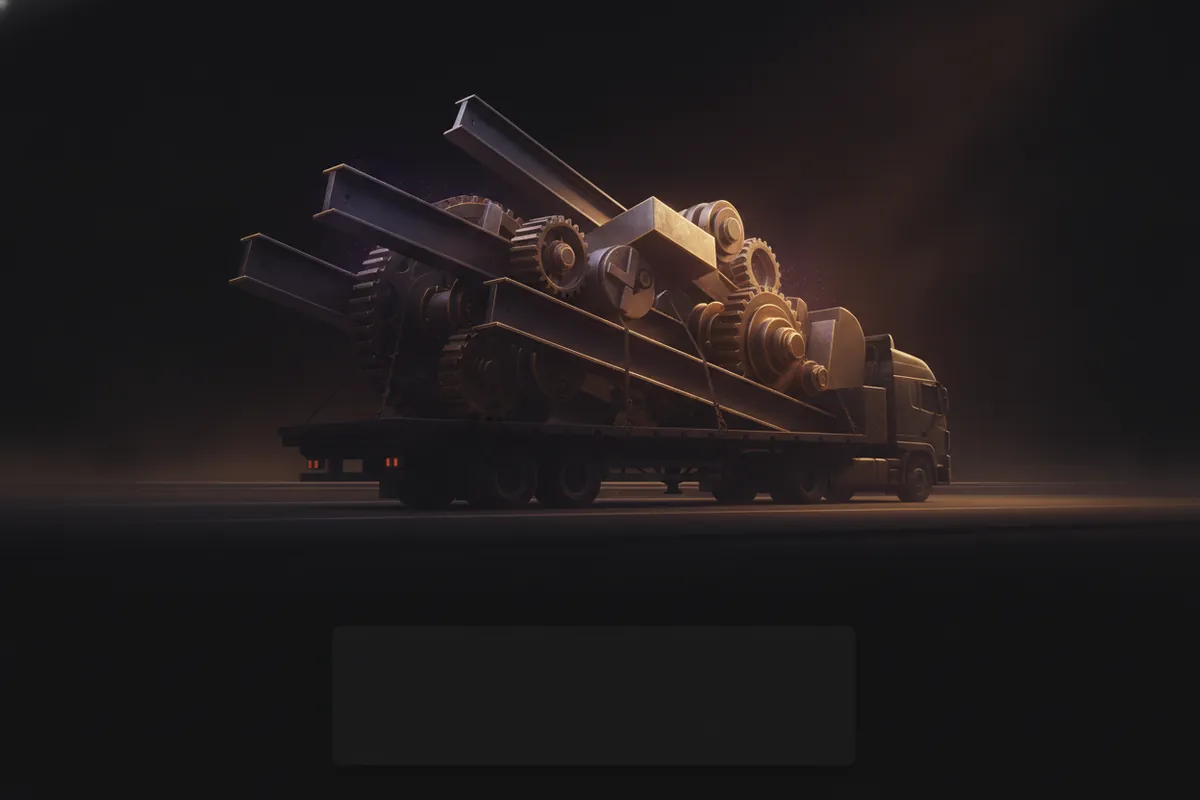
The equipment matching is the mechanism, not the trailer assertion
GlobalTranz's flatbed freight shipping guide opens with the move that separates a load that arrives intact from one that gets rejected at the dock: "Selecting the wrong trailer type can lead to rejected loads, compliance issues or costly rebooking." (GlobalTranz, "Flatbed Freight Shipping Guide: Equipment Types, Costs and When You Need an Open Deck", GlobalTranz Resource Hub, published 2026-04-28, retrieved 2026-08-23, https://www.globaltranz.com/resource-hub/flatbed-freight-shipping-guide/). The Honest Architect reads the article as six mechanism forms: equipment-matching-as-mechanism, securement-as-physical-mechanism, separate-equipment-per-threat-as-routing, permit-and-route-planning-as-verification, documentation-as-alignment-mechanism, weight-distribution-as-physical-mechanism. Each is an instance of Theorem 3: the property (freight-arrives-safely-and-legally) is guaranteed by the mechanism (correct equipment, securement, permits, documentation, and weight distribution), not by the assertion "any trailer will do." Each form is Production where the article's own logic verifies it; each GlobalTranz-specific claim (45,000+ carriers, national buying power, real-time tracking, the 3PL service itself) is Partial (vendor-reported, not independently verified by Everythink).
The article is a marketing piece for GlobalTranz, a national 3PL. The Honest Architect extracts the mechanism forms without endorsing GlobalTranz, its carrier network, its technology platform, or any specific provider.
Key takeaways
- Equipment matching is the mechanism. Theorem 3: the property (freight-moves-safely) is guaranteed by the mechanism (matching freight dimensions, weight, and loading method to the correct trailer type — standard, step deck, lowboy, RGN), not by the assertion "a trailer is a trailer." The article: "choosing the right equipment helps ensure your freight is matched correctly the first time." Production ✅.
- Securement is a physical mechanism. Theorem 3: the property (cargo-stable) is guaranteed by the mechanism (FMCSA-compliant tiedowns with sufficient working load limits and proper weight distribution), not by asserting "the cargo won't shift." "Improperly secured freight can shift during transit, fall from the trailer, cause accidents or damage." Production ✅.
- Separate equipment per threat is the routing. Theorem 3: the property (cargo-protection) is guaranteed by the mechanism (Conestoga for weather-sensitive, enclosed for theft-vulnerable, flatbed for loading flexibility), not by one-size-fits-all. Production ✅.
- Permit and route planning is the verification. Theorem 3: the property (legal-compliance) is guaranteed by the mechanism (permits approved before movement, escort vehicles, route surveys accounting for bridge weight limits and overhead clearances), not by asserting "the route is fine." Production ✅.
- Documentation is the alignment mechanism. Theorem 3: the property (shipper-carrier-alignment) is guaranteed by the mechanism (securement requirements on the bill of lading, handling instructions communicated in advance, carrier capabilities confirmed), not by asserting "the carrier knows what to do." Production ✅.
- Weight distribution is a physical mechanism. Theorem 3: the property (load-legal) is guaranteed by the mechanism (single-piece overweight can be permitted; multiple items totaling overweight must be split across trucks), not by asserting "we can just load it all." Production ✅.
- Cross-domain parallels: equipment-matching maps to "the space is the router" (network→community→room routes context to the right room; equipment-matching routes freight to the right trailer — both route to reduce noise, neither broadcasts); securement-as-physical-mechanism maps to entropy on every Oracle merge (a physical property is guaranteed by a mechanism, not asserted — cargo-stable by tiedown working load limit, calibrated-forecast by entropy dispersion); separate-equipment-per-threat maps to hexagonal trait-based ports (each port answers a different question; each equipment handles a different threat); permit-and-route-planning maps to Zod at runtime boundary (property verified at the boundary, not asserted — permits verify compliance before movement, Zod parses payload at the network boundary); documentation-as-alignment maps to Eye Key sovereignty (mechanism before event — the BOL defines securement before the truck arrives, the Eye Key HMAC is computed before the request is accepted); weight-distribution maps to the Oracle ensemble (buffer absorbs variance — split-load absorbs overweight variance, the ensemble absorbs single-Sister error). All Partial ⚠️: same form, separate domains.
- Scope: commercial/industrial logistics. This is a flatbed freight guide for construction, manufacturing, and industrial supply chains, not a security or OSINT topic. No offensive scope applies. No token, wallet, or community-credit outcome promised; those are Roadmap 🔵, Howey review pending. Everythink is a forecasting platform, not a 3PL; the cross-domain parallels are Partial ⚠️ illustrations, not endorsements of GlobalTranz or any provider.
Equipment matching is the mechanism
The article's central move is to separate equipment matching from trailer indifference. "One of the most important decisions in flatbed shipping happens before a truck is ever booked: choosing the right equipment." The property (freight-moves-safely) is guaranteed by the mechanism (matching freight dimensions, weight, and loading method to the correct trailer type), not by the assertion "any trailer will do." A standard flatbed handles freight up to 8.5 feet tall; a step deck lowers the deck to handle 10-foot freight without permits; a lowboy sits 1.5 feet off the ground for 12-foot heavy equipment; an RGN detaches its front to create a ramp for drive-on machinery. Each trailer answers a different freight profile. Production ✅.
The distinction matters because the wrong trailer is not a minor inconvenience — it is a rejected load. Freight that exceeds the trailer's legal height gets turned away at the scale; freight that requires top loading gets rejected from a trailer with no crane access. The mechanism (equipment matching) produces the property (freight-moves-safely); the assertion alone does not. Production ✅.
The form is the domain analogue of Everythink's "the space is the router": equipment matching routes freight to the right trailer the way network→community→room routes context to the right room — both route to reduce noise, neither broadcasts. Partial ⚠️ (same form — route-to-reduce-noise — separate domains).
Securement is a physical mechanism
The article's securement move is to treat cargo stability as a physical mechanism, not a hope. "Unlike enclosed trailers, where cargo is contained within walls, flatbed freight relies entirely on external securement devices." The property (cargo-stable) is guaranteed by the mechanism (FMCSA-compliant tiedowns with sufficient working load limits and proper weight distribution), not by asserting "the cargo won't shift." A tiedown with a working load limit below the cargo's weight fails under braking; a tiedown count below the FMCSA minimum for the cargo length fails under turning; weight distributed unevenly fails under both. The mechanism (correct tiedowns + correct count + correct distribution) produces the property (cargo-stable); the assertion alone does not. Production ✅.
The distinction matters because a shifting load is not bad luck — it is a mechanism failure. A coil that breaks its tiedowns under braking is a tiedown whose working load limit was below the coil's inertial force, not a surprise. A steel bundle that slides off in a turn is a tiedown count below the FMCSA minimum for its length, not an accident. The defense is a mechanism (chains, straps, binders rated for the load), not an assertion. Production ✅.
The form is the domain analogue of Everythink's entropy on every Oracle merge: cargo-stable is guaranteed by the tiedown's working load limit the way calibrated-forecast is guaranteed by the Oracle's entropy dispersion — both the defense and the threat are mechanisms, neither is an assertion. Partial ⚠️ (same form — property-guaranteed-by-mechanism — separate domains).
Separate equipment per threat is the routing
The article's structural move is to separate equipment by threat. "Sensitive or high-value goods that require full environmental protection are generally better suited for enclosed trailers." "Flatbed loads are visible and accessible, which increases theft risk." The property (cargo-protection) is guaranteed by the mechanism (Conestoga for weather-sensitive freight that still needs side loading, enclosed for theft-vulnerable high-value freight, flatbed for freight that needs top or side loading and tolerates weather), not by one-size-fits-all. A tarp on a flatbed defends against rain but not theft; an enclosed trailer defends against theft but not the loading constraint; a Conestoga defends against weather while preserving side-loading access. Each equipment type handles a different threat. Production ✅.
The distinction matters because the threats are equipment-specific. Weather exposure is a flatbed threat (rain, snow, wind, debris); theft is a visibility threat (open deck, accessible cargo); loading constraint is an enclosed threat (no top or side access). A defense designed for weather (tarping) does nothing for theft (the cargo is still visible); a defense designed for theft (enclosed trailer) does nothing for loading constraint (the cargo cannot be top-loaded). The mechanism (separate equipment per threat) produces the property (cargo-protection); the one-size-fits-all approach does not. Production ✅.
The form is the domain analogue of Everythink's hexagonal trait-based ports: each equipment type handles a different threat the way each port answers a different question — both route to reduce noise, neither broadcasts. Partial ⚠️ (same form — route-to-reduce-noise — separate domains).
Permit and route planning is the verification
The article's compliance move is to verify before movement, not after. "Oversized loads require permits in every state they travel through. These permits are state-specific, must be approved before movement, often include restrictions on travel times and routes." The property (legal-compliance) is guaranteed by the mechanism (permits approved before movement, escort vehicles for wide or long loads, route surveys accounting for bridge weight limits and overhead clearances), not by asserting "the route is fine." A load that exceeds 8.5 feet wide, 13.6 feet tall, or 80,000 pounds gross triggers the permit mechanism; a route that crosses a bridge rated below the load's weight triggers the route-survey mechanism. The mechanism (permit + escort + route survey) produces the property (legal-compliance); the assertion alone does not. Production ✅.
The distinction matters because a compliance failure is not a paperwork inconvenience — it is a load stopped at the state line. A load that moves without a permit is illegal in every state it enters; a load that crosses a bridge above its weight limit is a structural failure; a load that travels a restricted lane at a restricted time is a citation. The defense is a mechanism (permits, escorts, route surveys), not an assertion. Production ✅.
The form is the domain analogue of Everythink's Zod at the runtime boundary and World Monitor: legal-compliance is verified at the permit boundary the way a payload is parsed at the network boundary and a geo-signal is measured by a background poller — both verify at the boundary, neither asserts after the fact. Partial ⚠️ (same form — property-verified-at-boundary — separate domains).
Documentation is the alignment mechanism
The article's alignment move is to document before the truck arrives. "Clearly define securement requirements on the bill of lading. Communicate handling instructions in advance. Confirm carrier capabilities." The property (shipper-carrier-alignment) is guaranteed by the mechanism (securement requirements on the BOL, handling instructions communicated in advance, carrier capabilities confirmed), not by asserting "the carrier knows what to do." A BOL that omits tiedown requirements lets the carrier guess; a carrier that is not told about tarping arrives without tarps; a carrier whose equipment is not confirmed arrives with the wrong trailer. The mechanism (BOL + advance instructions + capability confirmation) produces the property (alignment); the assertion alone does not. Production ✅.
The distinction matters because the shipper shares liability. "If freight is improperly loaded at origin, liability may fall on the shipper, even if the carrier accepts the load." A shipper who documents the securement requirements transfers the execution risk to the carrier; a shipper who does not keeps it. The mechanism (documentation) produces the property (alignment and liability allocation); the assertion alone does not. Production ✅.
The form is the domain analogue of Everythink's Eye Key sovereignty: the BOL defines securement before the truck arrives the way the HMAC is computed before the request is accepted — both run the mechanism before the event, not after. Partial ⚠️ (same form — mechanism-before-event — separate domains).
Weight distribution is a physical mechanism
The article's weight move is to treat the single-piece rule as a physical mechanism. "The weight must be a single piece. A single 55,000 lb. machine may be permitted. Multiple items totaling 55,000 lbs. must be split across multiple trucks." The property (load-legal) is guaranteed by the mechanism (single-piece overweight qualifies for a permit; multiple items totaling overweight must be split across trucks), not by asserting "we can just load it all." A single 55,000-pound machine on a lowboy is a permitted overweight load; five 11,000-pound items totaling 55,000 pounds on the same lowboy is an illegal load that must be split. The mechanism (split-load rule) produces the property (load-legal); the assertion alone does not. Production ✅.
The distinction matters because overweight is not a single number — it is a distribution. The 48,000-pound legal maximum for a standard flatbed is a combined weight, not a per-item weight; the permit system distinguishes a single piece that cannot be split from a aggregate that can. A shipper who understands the mechanism (single-piece vs. split-load) can permit a 55,000-pound machine; a shipper who treats overweight as a single number cannot. The mechanism (weight distribution rule) produces the property (load-legal); the assertion alone does not. Production ✅.
The form is the domain analogue of Everythink's Oracle ensemble: the split-load absorbs overweight variance the way the ensemble — multiple Sisters drafting, the Oracle merging — absorbs single-Sister error — both distribute across units to absorb variance. Partial ⚠️ (same form — property-through-variance-distribution — separate domains).
What an Honest Architect reads in a 3PL marketing piece
The article is a marketing piece for GlobalTranz, a national 3PL. The Honest Architect extracts the mechanism forms without endorsing GlobalTranz, its carrier network, its technology platform, or any specific provider. The forms are Production ✅: real, reproducible, verifiable by the article's own logic. All GlobalTranz-specific claims (45,000+ carriers, national buying power, real-time tracking, the 3PL service, the free consultation) are Partial ⚠️ (vendor-reported, not independently verified by Everythink). The Honest Architect does not endorse GlobalTranz. Everythink is a forecasting platform, not a 3PL. The cross-domain parallels are Partial ⚠️ illustrations, not endorsements. Scope is commercial/industrial logistics. No offensive scope applies. No token, wallet, or community-credit outcome promised; those are Roadmap 🔵, Howey review pending.
Frequently asked questions
Is equipment matching the mechanism or the assertion?
Equipment matching is the mechanism. Theorem 3: the property (freight-moves-safely) is guaranteed by matching freight to the correct trailer type, not by dispatching any trailer. Production for the form; Partial for the vendor-specific network claims.
Why does securement matter more in flatbed than enclosed?
Enclosed trailers contain freight within walls; flatbed freight relies entirely on external securement devices. The mechanism (FMCSA-compliant tiedowns) produces the property (cargo-stable); the walls do the work in enclosed, the tiedowns do the work in flatbed. Production.
Why is the single-piece rule a mechanism and not a formality?
Overweight is a distribution, not a number. A single 55,000-pound machine can be permitted; five 11,000-pound items totaling 55,000 pounds must be split. The mechanism (split-load rule) produces the property (load-legal). Production.
Does Everythink endorse GlobalTranz or any 3PL?
No. Everythink is a forecasting platform, not a 3PL. The article is a marketing piece for a national 3PL. Vendor-specific claims are Partial. No token, wallet, or community-credit outcome promised; those are Roadmap, Howey review pending.
Sources
- GlobalTranz, "Flatbed Freight Shipping Guide: Equipment Types, Costs and When You Need an Open Deck", GlobalTranz Resource Hub, published 2026-04-28, retrieved 2026-08-23, https://www.globaltranz.com/resource-hub/flatbed-freight-shipping-guide/
If your team is ready to ship the mechanism that guarantees the property instead of asserting it, build your network — the Eye Key is over-engineered for sovereignty, the Oracle measures entropy on every merge, the space is the router, the HAI Engine has run the same mechanism since 2016.

Rack density is the cost mechanism, not the warehouse-lease assertion
An Honest Architect reading of rack design as cost lever: density is the mechanism, automation-readiness is a design-stage mechanism, measurement-before-redesign is the justification mechanism.
→ →
Shelf availability needs the appointment window, not the promise
GlobalTranz's Hi-Tech Pharmaceuticals case study, read as a routing mechanism: shelf availability is guaranteed by the appointment window, not by a 3PL's promise of reliable service. Theorem 3.
→ →
Persistent memory is the mechanism, not the context window
Five architectural patterns for AI agent memory, read as Theorem 3: the property (learning, personalization) is guaranteed by the mechanism (persist, retrieve, inject), not by the context window. Checkpointing is not exactly-once, secrets are not semantic memory, storage-layer isolation fails closed.
→ →Build your world on an engine that proves what it claims.
Create your own network on the engine that's run since 2016 — or talk to the team behind the 21 papers.