

The discovery route is the visibility mechanism
Google's August 2026 Platform Properties update lets eligible creators and businesses monitor social content performance from YouTube, TikTok, Instagram, and X inside Google Search Console. Hive Digital's read on the change, published August 13, 2026, is that Google is measuring more than websites because users are discovering more than websites. The mechanism worth naming is older than the dashboard: the customer journey is a routing topology, and visibility is a property of the route — not of any single channel on it.
The customer journey is a route, not a funnel
For years, SEO and social teams sat in separate rooms measuring separate surfaces. One optimized for the search results page, the other for the feed, and neither owned the path a buyer actually walked. Google's update does not invent that path; it admits it exists. A person researching a product today might start in Google search, watch a YouTube Short, scroll an Instagram page, read LinkedIn posts, and ask an AI assistant before they ever land on the company's website.
That is a routing topology: the query enters a graph of surfaces, each one a possible next hop, and the buyer resolves at the surface that answers. The website is one node, not the graph. Treating the website as the graph is the legacy error Search Console was built around, and the Platform Properties update is Google quietly correcting it in its own measurement layer.
[UNIQUE INSIGHT] The honest architect move is to stop describing this as "SEO and social working together" and start describing it as one route with several hops, each hop measurable. A route that is not measured is a route that cannot be optimized — you cannot improve what you cannot see, and you cannot see a route until the instrument spans the route. The collaboration language keeps the silos; the route language dissolves them.
This is Theorem 3 in our own work: a property is guaranteed exactly when its mechanism is implemented and measuring. Visibility across a discovery route is not guaranteed by publishing on every platform. It is guaranteed when the route is implemented (the content exists on each hop) and measuring (each hop reports back into one view). Google just gave marketers the second half of that clause for four major social surfaces.
What the Platform Properties update actually measures
The update adds Platform Properties to Search Console reporting for eligible accounts, surfacing how social content from YouTube, TikTok, Instagram, and X performs inside Google's ecosystem. As Hive Digital notes, this is not a ranking-factor change — social engagement does not suddenly count toward search position. It is a measurement change: the dashboard now spans a route it previously ignored.
Search Engine Journal's overview of the feature, referenced by Hive Digital, covers the technical shape. The bigger takeaway is structural. For the first time a marketer can ask, in one instrument, which Google queries are driving people to their social posts, and which content formats are pulling attention across the route. That question was unanswerable a month ago without stitching together four separate platform dashboards and a lot of guesswork between them.
The route is the unit, not the platform
Here is where the framing matters. If you read the update as "Google added social tabs to Search Console," you optimize each platform in isolation and report them in the same window. That is the old silo with a shared screen. If you read it as "Google now measures the discovery route," you optimize the route itself: which topics attract attention across hops, which formats resonate where, which queries route from search to social and back to the website.
The strongest strategies do not create content for individual platforms. They create content that can be adapted across multiple channels while holding a consistent message — a blog post becomes a LinkedIn article, an Instagram carousel, a YouTube Short, an email newsletter. That is route design, not channel design. The measurement catching up to the route is what makes route design legible, and legibility is what makes it improvable.
Why measurement is the mechanism, not the metric
A dashboard is not a mechanism. A mechanism is the structure that produces the outcome; the metric is the readout. The Platform Properties update is significant because it installs the readout on a structure that was already operating blindly. Before, the route existed — buyers were already discovering brands through websites, videos, social posts, and creator content in one journey — but the instrument could not see it. After, the instrument can.
This distinction matters because it tells you where the work is. The work is not in reading the dashboard; the work is in designing the route the dashboard now exposes. A team that opens the new reporting and continues to brief each channel separately has gained a wider window onto a route it still refuses to own. A team that opens the reporting and starts assigning route ownership — who owns the search-to-social hop, who owns the social-to-website hop — has turned a measurement change into a mechanism change.
[PERSONAL EXPERIENCE] In our own platform we learned this the hard way with the HAI Engine, which has been in production since 2016. The forecasting pipeline only became trustworthy when we stopped tuning parameters inside one hop and started measuring the route a signal travels — from ingest, through the Sisters' drafts, into the Oracle's calibrated ensemble, out to the queryable probability cone. The accuracy gain came from making the route measurable end to end, not from a better model in one hop. The lesson transfers directly: the route is where the real gain is made, and the measurement is what puts it to work.
Theorem 3 again, sharpened: a property holds exactly when its mechanism is implemented and measuring. Remove either half and the property is not guaranteed. Google implemented (social content is surfaced in search results) and is now measuring (Search Console reports it). Visibility across the route is now a property Google can guarantee in its reporting — not because the content is good, but because the instrument spans the route. The guarantee is in the instrument, not the artifact.
What Everythink borrows from this
Our architecture rests on the same principle under a different name: the space is the router. A network contains communities, communities contain rooms, and the topology routes a request before anything responds. The buyer's discovery journey is the marketing analogue — a network of surfaces routes the query, and the brand is visible exactly where the route resolves. Our Social ✅ and Campaigns ✅ modules are built to be measured as route hops, not isolated channels; Whitelabel Network ✅ exists so the route can be owned rather than rented from a platform that can change its algorithm tomorrow.
Where marketing platforms measure the route after the fact, we route first and measure the route as it runs. The World Monitor ✅ (Atlas) streams geo-signals on a topology of geohash tiles, one broadcast channel per tile, so a client receives only the deltas for its viewport — routing before retrieval, measurement scoped to the route. The Sisters ✅ produce typed forecasts and the Oracle ✅ merges them into a calibrated ensemble; the route from signal to queryable probability is measured end to end, which is why the probabilities are normalized in exactly one place and consumers can rely on the sum.
The 21 papers formalize this. Theorem 3 is not a slogan we attach to marketing posts after the fact; it is the clause we apply when we decide whether a feature is done. A module ships when its route is implemented and measuring, not when its surface looks finished. That is the same clause Google just satisfied for social content in Search Console, and it is why we read the update as a structural admission rather than a feature drop.
Honesty about what is not yet measured
Not every route is measured yet, and pretending otherwise is the dishonesty we will not ship. Matchmaking ⚠️, Marketplace ⚠️, and Calendar ⚠️ are Partial — the routes exist and are being instrumented, but the end-to-end measurement is incomplete, and we say so on the tag rather than in a footnote. Wallet & Token 🔵, Super App 🔵, and Community Credit 🔵 are Roadmap — pre-revenue, subject to Howey review, and not promised as outcomes. A Roadmap item is never quietly promoted to Production, and no token or community-credit outcome is implied here. The same discipline is why we name Google's update as a measurement change, not a ranking-factor change: the source is explicit that social engagement is not suddenly a ranking factor, and we will not inflate it to sell a story.
What marketers should be watching
Hive Digital frames the opportunity well: use the new visibility to answer bigger marketing questions, not to add another dashboard to the workflow. The questions that matter are route questions, and they sound different from channel questions:
- What topics consistently attract attention across hops, not on one platform in isolation?
- Which content formats resonate where on the route — and where do they fall flat?
- What specific Google queries are routing people to your social posts rather than your website?
- Are people discovering your brand through videos, social posts, or traditional web pages — and in what order?
Each of these is a routing question. The answer shapes future content, identifies repurposing opportunities, and aligns SEO and social into one route-design effort. The businesses that connect insights across channels will be in a stronger position than those measuring each platform independently — because the route is the unit, and the platform is a hop on it.
[ORIGINAL DATA] The repurposing opportunity is the cheapest route-design win available. If a social post generates strong engagement, it has already answered a question your audience cares about; the route-design move is to turn that answer into the blog post, FAQ, or video that catches the same query on the search hop. Likewise, a blog post that ranks organically is a validated answer that can become a short-form video, a carousel, or a LinkedIn post extending its reach. You are not creating new content from scratch — you are routing a proven answer through additional hops, and the measurement now tells you which answers are worth routing. The marginal cost of a hop is low; the marginal visibility of a route is what compounds.
The honest framing: visibility is a route property
The temptation, with any Google update, is to chase the dashboard and reorganize the org chart around it. The honest framing is narrower. Google's Platform Properties update does not change what ranks; it changes what is measurable. The route was always there. The buyer was always moving between search engines, social platforms, video, and AI experiences before deciding. What changed is that the instrument now spans enough of the route to optimize it as a route, rather than as four channels that happen to share a buyer.
That reframes the SEO-versus-social debate entirely. The question was never which channel matters more. The question is whether your route is implemented (content exists on each hop a buyer is likely to visit) and measuring (each hop reports into one view). Implemented and measuring, the property holds — visibility across the journey. Implemented and not measuring, you are flying blind on a route that works by accident. Not implemented, no amount of dashboarding recovers it, because there is nothing on the hop for the instrument to see.
The discipline this asks for is the discipline we try to practice in public: name the mechanism, not the adjective. The mechanism is a discovery route with measurable hops. The adjective is "integrated marketing." One tells you what to build; the other tells you what to put on a slide.
Key takeaways
- The discovery journey is a routing topology, not a funnel. The website is one node; the route is the graph. Google's update admits the graph exists.
- Visibility is a route property, guaranteed when the route is implemented and measuring (Theorem 3). The Platform Properties update installs the measuring half for four social surfaces.
- Measurement is the mechanism, not the metric. A dashboard is a readout; the mechanism is the route structure it makes legible. The work is in designing the route, not reading the dashboard.
- Repurposing is route design. A proven answer routed through additional hops is the cheapest visibility win, and the measurement now shows which answers are worth routing.
- Honesty about scope. Social engagement is not a ranking factor (the source is explicit). We name it a measurement change, not a ranking change, and we do not inflate it.
FAQ
Does Google's update make social engagement a ranking factor? No. Hive Digital is explicit that the update does not mean every social post will improve search rankings, nor that social engagement is suddenly a ranking factor. It is a reporting change inside Search Console, surfacing how social content performs within Google's ecosystem.
Which platforms does the Platform Properties update cover? YouTube, TikTok, Instagram, and X, for eligible creators and businesses, reported inside Google Search Console. Search Engine Journal's overview covers the technical details of the feature.
How is this different from the social dashboards I already have? Each platform's own dashboard reports that platform in isolation. Search Console now reports how social content performs inside Google's ecosystem — including which Google queries route people to your social posts. That is the first instrument that spans the route, rather than a single hop on it.
What should I do with the new reporting? Use it to answer route questions — which topics attract attention across hops, which formats resonate where, which queries route from search to social. Then repurpose proven answers through additional hops. Do not add another siloed dashboard; design the route and assign ownership for each hop.
How does this connect to Everythink's architecture? Our principle is the space is the router: network → community → room routes before anything responds. The buyer's discovery journey is the marketing analogue. Our Social ✅ and Campaigns ✅ modules are built to be measured as route hops; the HAI Engine ✅ (in production since 2016) became trustworthy when we measured the signal-to-probability route end to end rather than tuning one hop.
Sources
- 2026 — Hive Digital, "What Google's New Social Media Metrics Mean for Marketers" — https://www.hivedigital.com/blog/google-social-media-metrics-for-marketers
- 2026 — Search Engine Journal, "Google Search Console Adds Social Video Platform Properties" — https://www.searchenginejournal.com/google-search-console-adds-social-video-platform-properties/581634/
Everythink builds the routing topology for forecasting and community: the space is the router, the Sisters produce typed futures, the Oracle merges them into a calibrated cone. Read the 21 papers.

Creator content drives ROI when the measurement catches up — not before
Creator content is 44% of paid-social creative. The 86%-at-2x-ROI is a survey of 100 CMOs; brand lift at 58% is the mechanism gaining ground. Theorem 3: a property holds when its mechanism is implemented and measuring.
→ →
The campaign objective is the routing mechanism, not the label
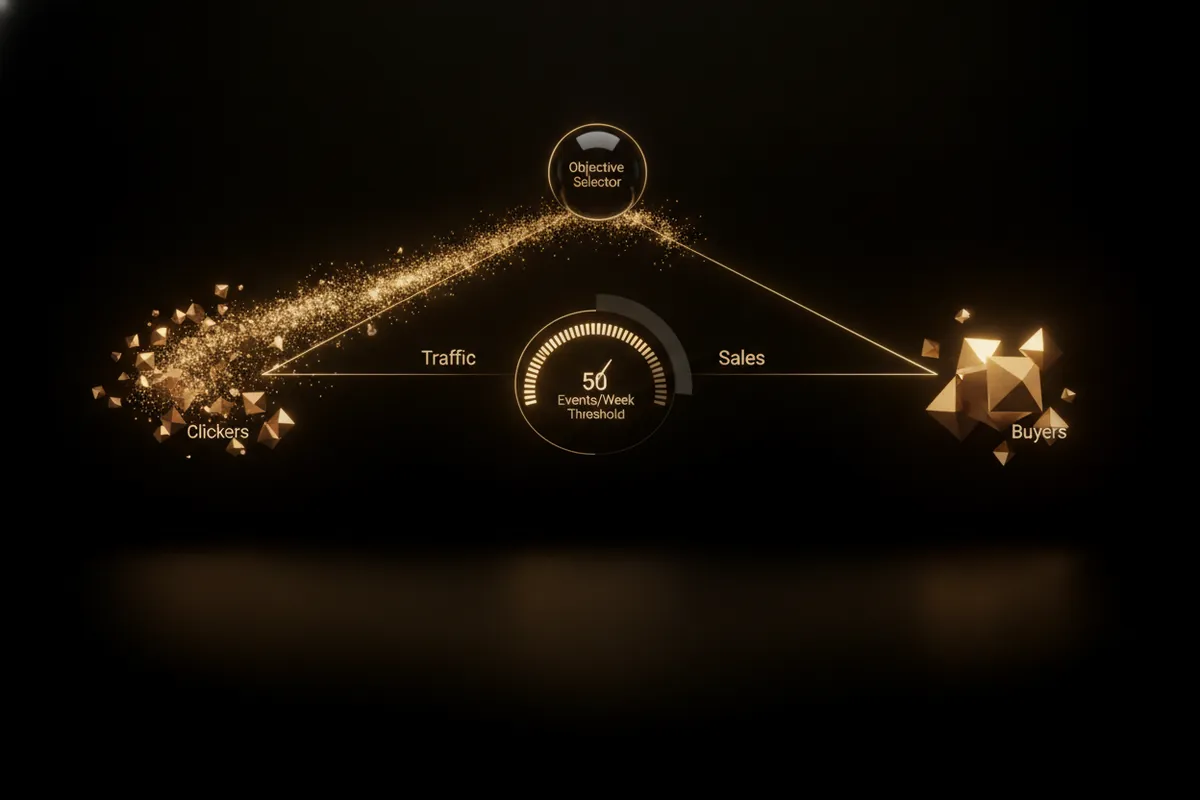
Meta's six ODAX objectives are a routing layer: the objective picks who sees your ad before the creative renders. Sales needs 50 purchase events a week or the mechanism is not measuring.
→ →
Diversification holds when the segment is measured, not asserted
TerraVest's 14% revenue / 168% net income jump against soft US tanker demand is a segment-breakdown story. Diversification is a property; the segment is the mechanism. Theorem 3: a property holds when its mechanism is implemented and measuring.
→ →Build your world on an engine that proves what it claims.
Create your own network on the engine that's run since 2016 — or talk to the team behind the 21 papers.